AL East:
For a decade, the AL East was an annul two-horse race between the Yankees and Red Sox. In 2008, the Tampa Bay Rays force there way into playoff picture. Now, with the Blue Jays and Orioles both fielding impressive young rosters for whom winning records are very realistic, nobody looks forward to visiting any of these cities. The vaunted East is not far from being a wide-open competition.
But not this year...
I think the Jays and Rays will both be better than .500 teams, and I expect Buck Showalter's "Baby Birds" to have their best season since 2004, but when all is said and done, the Yankees and Red Sox will again be headed for the postseason.
Following an active offseason, in which Theo Epstein brought in a pair of premier hitters, Adrian Gonzalez and Carl Crawford, to add to a lineup which already promised to be buoyed by the returns of Kevin Youkilis, Dustin Pedroia, and Jacoby Ellsbury, the BoSox are the odds-on favorite not only to win the East, but also the AL Pennant, and the World Series. They've got a loaded lineup, a deep rotation, and a dynamic bullpen.
The Yankees are far less complete. They have only once truly dependable starting pitcher. They have a very uncertain catching situation. And they depend upon an aging core, several of whom are coming off down seasons. Still, they've got an abundance of talent, especially on offense, and while it would hardly surprise me if they caught a few bad breaks and fell back of the Rays and/or Jays, I'm having a hard time talking myself into making that prediction.
Boston Red Sox 97 W
New York Yankees 91 W
Toronto Blue Jays 89 W
Tampa Bay Rays 87 W
Baltimore Orioles 78 W
MVP Candidate: Kevin Youkilis, Red Sox
Cy Young Candidate: C. C. Sabathia, Yankees
Rookie of the Year: Kyle Drabek, Blue Jays
Comeback of the Year: Daisuke Matsuzaka, Red Sox
Breakout Candidates: Ricky Romero, Blue Jays; Adam Jones, Orioles; Brian Matusz, Orioles; Brett Cecil, Blue Jays; Matt Joyce, Rays; Sean Rodriguez, Rays; Jed Lowrie, Red Sox
AL Central:
Many will bet the chalk in the AL Central. The Twins had an impressive 2010 campaign and none of their divisional opponents made big splashes this offseason. The Twins do have a few things to hang their hats on. They've got a plethora of power-hitters. They've got a three-time batting champ. They've got arguably the best pitcher in the division. They've also got some serious uncertainty at the back of the rotation. They've got unproven players at three infield positions. And their cleanup hitter is still recovering from a concussion he suffered nine months ago.
Chicago relatively quietly improved themselves this offseason. Their big move was the addition of free agent, Adam Dunn, who give them a consistent power source to slide into the lineup between Paul Konerko and Carlos Quentin. They bolstered their bullpen with the addition of veteran relievers, Jesse Crain and Will Ohman. They added an inexpensive high-upside outfielder in Lastings Milledge. And they brought back clubhouse leaders Konerko, A. J. Pierzynski, and Omar Vizquel.
More importantly, however, the Sox have plenty of depth in their rotation and a handful of young players who could make much bigger contributions in 2011. Foremost among these is Gordon Beckham, the 24-year-old second-baseman who struggled mightily in the first half of his sophomore season, but made adjustments and hit .310 in the second half. The White Sox could also get substantial contributions from rookies Chris Sale and Brent Morel, and sophomores Sergio Santos and Dayan Viciedo.
I often preach the importance of depth in the marathon season. The White Sox have it. The Twins don't.
Chicago White Sox 92 W
Minnesota Twins 86 W
Detroit Tigers 77 W
Cleveland Indians 70 W
Kansas City Royals 62 W
MVP Candidate: Miguel Cabrera, Tigers
Cy Young Candidate: Francisco Liriano, Twins
Rookie of the Year: Tsuyoshi Nishioka, Twins
Comeback of the Year: Jake Peavy, White Sox
Breakout Candidates: Max Scherzer, Tigers; Gordon Beckham, White Sox; Kila Ka'aihue, Royals; Asdrubel Cabrera, Indians
AL West:
Sure, they'll miss Cliff Lee. But the rumors of the Rangers demise have been greatly exaggerated. Remember, Texas was five games up in the West and playing at a .581 clip before Lee ever threw a pitch for them in 2010.
The ever-optimistic Angels fans will rally behind their solid rotation and their improved bullpen depth, but the Angels ability to score runs remains in doubt, especially with Kendrys Morales remaining on the D.L. to begin the season and still no long-term solution at third base.
The major threat to a Texas repeat is actually the Oakland Athletics. Billy Beane helped move his offense towards respectability by adding David DeJesus and Hideki Matsui, but the A's still don't possess a legitimate middle-of-the-order hitter. However, teams like the Giants and Padres have proven that mediocre offense can be overcome by superlative pitching. The A's have potentially superlative pitching. If the rotation keeps Oakland in the race into July, expect Beane to chase impending free agent rentals.
Texas Rangers 91 W
Oakland Athletics 87 W
Los Angeles Angels 75 W
Seattle Mariners 68 W
MVP Candidate: Josh Hamilton, Rangers
Cy Young Candidate: Jered Weaver, Angels
Rookie of the Year: Chris Carter, Athletics
Comeback of the Year: Chone Figgins, Mariners
Breakout Candidates: Brett Anderson, Athletics; Julio Borbon, Rangers; Jason Vargas, Mariners

Showing posts with label Minnesota Twins. Show all posts
Showing posts with label Minnesota Twins. Show all posts
Friday, April 01, 2011


Saturday, January 22, 2011
Plowing The Depths of the Designated Hitting Market
When the week began, the only question remaining for the Hot Stove season was how to sort out the plethora of defensively-challenged veterans still looking for work. You could've had your pick of players with Hall of Fame (or, at least, borderline Hall of Fame) credentials, including Jim Thome, Vladimir Guerrero, Manny Ramirez, and Johnny Damon. As the week comes to a close, it looks like they've all been signed (or are on the verge of signing) and several teams are faced with the need to creatively distribute at-bats.
Tampa Bay Rays:
Only a handful of the self-anointed "idiots" who broke the Curse of the Bambino in 2004 are still bouncing around the major leagues. Two of the most recognizable players from that legendary team, Manny Ramirez and Johnny Damon, brought their talents back to the AL East this morning by signing one-year deals with the Tampa Bay Rays.
Both are coming off severely disappointing seasons:
Damon: .271/.355/.401, 145 G, 81 R, 8 HR, 51 RBI, 11 SB
Ramirez: .298/.409/.460, 90 G, 38 R, 9 HR, 42 RBI, 1 SB
However, the Rays can certainly find evidence of remaining skills (especially in the OBP department) and may hope that giving them the opportunity to stick it to their former teams will further motivate the former superstars.
ESPN is speculating that Damon, coming of a year in which he spent the majority of his time at DH for the Tigers, will get the bulk of the innings in left field, while Manny concentrates exclusively on his hitting. It is certainly true that, while both are suspect fielders, Damon is the preferable option.
However, what has gone largely uncommented upon, at least thusfar, is the extent to which this complicates Tampa Bay's roster math. There has been some dramatic turnover on the Rays since they got knocked out of the playoffs last October. Among hitters, Carl Crawford, Carlos Pena, Jason Bartlett, Rocco Baldelli, and Willy Aybar have all been jettisoned. Only a few things about the 2011 Rays lineup seem certain. Evan Longoria, presuming his health, will start every game at third base. Ben Zobrist will also play nearly everyday, wherever he is asked. John Jaso and Kelly Shoppach will share the catching duties.
The remaining six lineup spots will presumably be shared by some combination of Ramirez, Damon, B. J. Upton, Reid Brignac, Sean Rodriguez, Desmond Jennings, Matt Joyce, Dan Johnson, and Leslie Anderson. That's right, there may not be enough roster spots for all these guys, especially of the Rays need to carry extra relievers in the early weeks of the season. The Spring Training competition could get pretty heated.
If you've read this blog at all, you're aware that I consider depth to be one of the foremost necessities of a competitive franchise, so Andrew Friedman has clearly done his manager a great service with these cost-effective signings. Joe Maddon has a great track record for finding a sizable share of at-bats for everybody on his bench and he like to play matchup baseball. It's worth pointing out, the above list of players features four lefties and five righties.
I wouldn't assume that Damon (L) and Ramirez (R) are everyday players. Tampa Bay has generally put a high priority on defense, and there's no doubt that their best defensive alignment features Upton, Jennings, and either Zobrist or Joyce in the outfield.
This move should, however, light a fire under Jennings. Most had assumed Jennings would open 2011 as a starter, but Tampa has frequently looked to slow down the arbitration clock on their top prospects by promoting them in May or June.
I'd also direct your attention to these splits from 2010:
Brignac (2B/SS): .224 AVG/654 OPS v. LH, .263 AVG/701 OPS v. RH
Rodriguez (2B/SS/OF): .282 AVG/824 OPS v. LH, .231 AVG/629 OPS v. RH
Joyce (1B/OF/DH): .190 AVG/774 OPS v. LH, .246 AVG/843 OPS v. RH
Johnson (1B/DH): .343 AVG/1068 OPS v. LH, .170 AVG/.696 OPS v. RH
Now, these are young players (except Johnson) who had only limited playing time in 2010, so the sample sizes are small and therefore suspect, but you can see the possibility of Maddon exploring platoons (good news for Rays fans, bad news for fantasy owners).
Toronto Blue Jays:
Alex Anthopoulos appears to have pulled off the biggest swindle since A. J. Pierzynski spent an unhappy year in San Francisco. Yesterday, he sent Vernon Wells and $75 Million of remaining salary to the Los Angeles Angels (of Desperation Valley) for Mike Napoli and Juan Rivera. The evisceration of Tony Reagins commenced the moment this deal was announced. Anthopoulos couldn't have given Wells away to any of the other 28 GMs. But, instead of lingering over the creative destruction of one of the most successful franchises of the last decade (in 2011, the Angels owe approximately $60 Million, which is the Blue Jays entire payroll, to Wells, Torii Hunter, Bobby Abreu, and Gary Matthews Jr.), I want to concentrate on the somewhat odd situation this creates for Toronto.
The Jays now feature five players - Napoli, Rivera, Adam Lind, Jose Bautista, and Edwin Encarnacion - who are, to put it mildly, defensive liabilities. Anthopolous has basically fielded an entire roster of DHs. And I'm not even considering the fact that early scouting reports are very skeptical about the glovework of young Travis Snider and J. P. Arencibia.
The Jays are sluggers (#1 in HR, SLG% in 2010), but they are also slugs (28th in SB), and the loss of Vernon Wells, Lyle Overbay, and John Buck (actually some of their better defensive players) isn't going to change that. Lind, who made 120 starts at DH last year, is slated to be their new first-baseman (he's logged a total of 76 innings there in his career). Bautista will reprise his role as a utilityman of the Paul Molitor variety (a.k.a. he plays many positions poorly). The Jays manager will daily debate whether he prefers Rivera and his -7.5 UZR in LF or Encarnacion and his -11.5 UZR at 3B. Napoli (24% CS) and Arencibia (28% CS in minors) will take turns letting AL speedsters run wild.
None of this is intended as derision toward Anthopoulos. He's pumped up the offense while slashing the payroll. One can easily imagine the Jays and their solid corps of young talent developing into contenders while somebody else is still paying the outrageous contracts of Wells and Alex Rios (both through 2014!).
Up the middle, the Jays have actually improved via the quiet acquisitions (during the 2010 season) of Rajai Davis and Yunel Escobar. Nevertheless, there will probably be some Bad New Bears reenactments as Toronto tries to find someplace on the field to hide all their brawny bashers.
Minnesota Twins:
The good news for Twins fans is that Jim Thome and Carl Pavano, both of whom played major roles in last year's 94-win campaign, are back for another go-round. The bad news is that means Jason Kubel will be forced to reprise his role as "outfielder." Anybody who watched the Twins play with any regularity last season will not be surprised to discover these stats:
Denard Span: 1349 INN, 6.3 UZR (#4 among 15 AL CF)
Delmon Young: 1277 INN, -9.7 UZR (#13 among 14 AL LF)
Jason Kubel: 670 INN, -8.8 UZR (#15 among 16 AL RF)
Michael Cuddyer: 539 INN, -8.5 UZR (#14 among 16 AL RF)
Yes, their corner outfield defense was abyssmal, easily the worst in either league.
Last year, this shortcoming was balanced, at least in part, by the fact that J. J. Hardy (#3 among AL SS in UZR) and Orlando Hudson (#2 among AL 2B in UZR) were outstanding middle-infielders. Minnesota must hope they can get similar defense from Alexi Casilla (-7.9 UZR/150 in 1998 career innings at 2B) and rookie shortstop, Tsuyoshi Nishioka.
Tampa Bay Rays:
Only a handful of the self-anointed "idiots" who broke the Curse of the Bambino in 2004 are still bouncing around the major leagues. Two of the most recognizable players from that legendary team, Manny Ramirez and Johnny Damon, brought their talents back to the AL East this morning by signing one-year deals with the Tampa Bay Rays.
Both are coming off severely disappointing seasons:
Damon: .271/.355/.401, 145 G, 81 R, 8 HR, 51 RBI, 11 SB
Ramirez: .298/.409/.460, 90 G, 38 R, 9 HR, 42 RBI, 1 SB
However, the Rays can certainly find evidence of remaining skills (especially in the OBP department) and may hope that giving them the opportunity to stick it to their former teams will further motivate the former superstars.
ESPN is speculating that Damon, coming of a year in which he spent the majority of his time at DH for the Tigers, will get the bulk of the innings in left field, while Manny concentrates exclusively on his hitting. It is certainly true that, while both are suspect fielders, Damon is the preferable option.
However, what has gone largely uncommented upon, at least thusfar, is the extent to which this complicates Tampa Bay's roster math. There has been some dramatic turnover on the Rays since they got knocked out of the playoffs last October. Among hitters, Carl Crawford, Carlos Pena, Jason Bartlett, Rocco Baldelli, and Willy Aybar have all been jettisoned. Only a few things about the 2011 Rays lineup seem certain. Evan Longoria, presuming his health, will start every game at third base. Ben Zobrist will also play nearly everyday, wherever he is asked. John Jaso and Kelly Shoppach will share the catching duties.
The remaining six lineup spots will presumably be shared by some combination of Ramirez, Damon, B. J. Upton, Reid Brignac, Sean Rodriguez, Desmond Jennings, Matt Joyce, Dan Johnson, and Leslie Anderson. That's right, there may not be enough roster spots for all these guys, especially of the Rays need to carry extra relievers in the early weeks of the season. The Spring Training competition could get pretty heated.
If you've read this blog at all, you're aware that I consider depth to be one of the foremost necessities of a competitive franchise, so Andrew Friedman has clearly done his manager a great service with these cost-effective signings. Joe Maddon has a great track record for finding a sizable share of at-bats for everybody on his bench and he like to play matchup baseball. It's worth pointing out, the above list of players features four lefties and five righties.
I wouldn't assume that Damon (L) and Ramirez (R) are everyday players. Tampa Bay has generally put a high priority on defense, and there's no doubt that their best defensive alignment features Upton, Jennings, and either Zobrist or Joyce in the outfield.
This move should, however, light a fire under Jennings. Most had assumed Jennings would open 2011 as a starter, but Tampa has frequently looked to slow down the arbitration clock on their top prospects by promoting them in May or June.
I'd also direct your attention to these splits from 2010:
Brignac (2B/SS): .224 AVG/654 OPS v. LH, .263 AVG/701 OPS v. RH
Rodriguez (2B/SS/OF): .282 AVG/824 OPS v. LH, .231 AVG/629 OPS v. RH
Joyce (1B/OF/DH): .190 AVG/774 OPS v. LH, .246 AVG/843 OPS v. RH
Johnson (1B/DH): .343 AVG/1068 OPS v. LH, .170 AVG/.696 OPS v. RH
Now, these are young players (except Johnson) who had only limited playing time in 2010, so the sample sizes are small and therefore suspect, but you can see the possibility of Maddon exploring platoons (good news for Rays fans, bad news for fantasy owners).
Toronto Blue Jays:
Alex Anthopoulos appears to have pulled off the biggest swindle since A. J. Pierzynski spent an unhappy year in San Francisco. Yesterday, he sent Vernon Wells and $75 Million of remaining salary to the Los Angeles Angels (of Desperation Valley) for Mike Napoli and Juan Rivera. The evisceration of Tony Reagins commenced the moment this deal was announced. Anthopoulos couldn't have given Wells away to any of the other 28 GMs. But, instead of lingering over the creative destruction of one of the most successful franchises of the last decade (in 2011, the Angels owe approximately $60 Million, which is the Blue Jays entire payroll, to Wells, Torii Hunter, Bobby Abreu, and Gary Matthews Jr.), I want to concentrate on the somewhat odd situation this creates for Toronto.
The Jays now feature five players - Napoli, Rivera, Adam Lind, Jose Bautista, and Edwin Encarnacion - who are, to put it mildly, defensive liabilities. Anthopolous has basically fielded an entire roster of DHs. And I'm not even considering the fact that early scouting reports are very skeptical about the glovework of young Travis Snider and J. P. Arencibia.
The Jays are sluggers (#1 in HR, SLG% in 2010), but they are also slugs (28th in SB), and the loss of Vernon Wells, Lyle Overbay, and John Buck (actually some of their better defensive players) isn't going to change that. Lind, who made 120 starts at DH last year, is slated to be their new first-baseman (he's logged a total of 76 innings there in his career). Bautista will reprise his role as a utilityman of the Paul Molitor variety (a.k.a. he plays many positions poorly). The Jays manager will daily debate whether he prefers Rivera and his -7.5 UZR in LF or Encarnacion and his -11.5 UZR at 3B. Napoli (24% CS) and Arencibia (28% CS in minors) will take turns letting AL speedsters run wild.
None of this is intended as derision toward Anthopoulos. He's pumped up the offense while slashing the payroll. One can easily imagine the Jays and their solid corps of young talent developing into contenders while somebody else is still paying the outrageous contracts of Wells and Alex Rios (both through 2014!).
Up the middle, the Jays have actually improved via the quiet acquisitions (during the 2010 season) of Rajai Davis and Yunel Escobar. Nevertheless, there will probably be some Bad New Bears reenactments as Toronto tries to find someplace on the field to hide all their brawny bashers.
Minnesota Twins:
The good news for Twins fans is that Jim Thome and Carl Pavano, both of whom played major roles in last year's 94-win campaign, are back for another go-round. The bad news is that means Jason Kubel will be forced to reprise his role as "outfielder." Anybody who watched the Twins play with any regularity last season will not be surprised to discover these stats:
Denard Span: 1349 INN, 6.3 UZR (#4 among 15 AL CF)
Delmon Young: 1277 INN, -9.7 UZR (#13 among 14 AL LF)
Jason Kubel: 670 INN, -8.8 UZR (#15 among 16 AL RF)
Michael Cuddyer: 539 INN, -8.5 UZR (#14 among 16 AL RF)
Yes, their corner outfield defense was abyssmal, easily the worst in either league.
Last year, this shortcoming was balanced, at least in part, by the fact that J. J. Hardy (#3 among AL SS in UZR) and Orlando Hudson (#2 among AL 2B in UZR) were outstanding middle-infielders. Minnesota must hope they can get similar defense from Alexi Casilla (-7.9 UZR/150 in 1998 career innings at 2B) and rookie shortstop, Tsuyoshi Nishioka.
Monday, October 04, 2010
My Broke-Ass Ouija Board Says...Rangers v. Rays Is Better Than You Think ('10 Division Series Preview)
On the one hand, I will miss the drama of the play-in game. Such games have provided arguably the finest competition of the season in each of the past two Octobers. However, wins from the Braves and Giants on Sunday eliminated the cinderella Padres, and in so doing, assured the best possible matchups in the NLDS.
Let's face it, the Padres played over their heads in the first half, and although they made a valiant effort to hold off the Giants in the waning days, their 30-30 record in the last two months is probably an accurate reflection of the quality of their team. With a beleaguered young rotation, an overworked bullpen, and an empty lineup, it was a forgone conclusion that they would've gotten pummeled by whomever their opponent was in the NLDS, if they had managed to squeak in. So, R.I.P. 2010 Padres...
I promise to get you your last two Narrative Likability Factors, for the Giants and Braves, before their series begins on Thursday, but for now, let's focus not on what we'd like to happen, but what's likely to happen. Here's how I'd handicap the 2010 postseason...
ALDS: Texas Rangers v. Tampa Bay Rays
By beating the Royals on the final day of the regular season, the Rays wrapped up the AL East title and the best record in the American League. As a reward, they'll get a first-round pairing with a Rangers team that has been coasting for most of the last two months and features the top starting pitcher on the AL side of the bracket, Cliff Lee, and the likely AL MVP, Josh Hamilton.
Although Tampa Bay sports the best rotational ERA among AL playoff teams (3.99), in a short series, Texas poses quite a challenge. For starters, here are the Wins Above Replacement (WAR) numbers for each teams anticipated starters:
As you can see, when you adjust for park factors and competition (as WAR does), Texas appears to have three starters who are, at the very least, the equal of Tampa's best. Of course, this doesn't tell the whole story, either, as Matt Garza and Wade Davis were both much better in the second half. Both teams have rotations replete with pitchers capable of dominating on any given night. What these numbers suggest, however, is that those who are quick to cite the Rays pitching advantage have not really done their homework. Cliff Lee went 4-0 last October. If the Rays plan on advancing, they're going to need to find a way to get David Price at least one victory.
On offense, the Rays and Rangers ranked third and fourth in the AL in scoring. However, while Texas was 2nd only to the Yankees in scoring at home, the Rays were tops in the AL on the road. Perhaps we should expect pitching duels at Tropicana Field and slugfests when we move to Arlington.
Tampa definitely has the deeper roster, as Joe Maddon mixes and matches with Matt Joyce, Dan Johnson, Sean Rodriguez, Reid Brignac, and Willy Aybar at RF, DH, and 2B. All posses considerable power and are game-tested options off the bench when they don't start. However, on both sides of the ball, the Rays are a better team for 162 than for 5 or 7. As a unit, they hit for a very low average (.249) and are extremely susceptible to the strikeout, with 108 more Ks than any other team in the AL. This could present a major problem when facing pitchers like Lee and Lewis, who have both overpowering stuff and excellent control. Lee, Lewis, and Wilson all ranked in the top 25 in the AL in K/9, HR/9, and K/BB. This could be a lethal combination of pitchers against a team that depends heavily on walks and homers.
The Rangers, on the other hand, led the American League in batting average (.276) behind free-swinging all-fields hitters like Josh Hamilton and Vladimir Guerrero. They struck out infrequently (4th fewest in the AL) and still, like Tampa, hit plenty of homers.
I believe this will be the most evenly-matched series in the opening round and would be surprised if it didn't go to five games. Both teams possess balanced attacks. They've got deep bullpens, solid defenses, speed and power. In the end, however, I think the Rangers approach on both sides of the ball will be more successful in a short series.
Texas in 5.
ALDS: New York Yankees v. Minnesota Twins
The Twins have never beat the Yankees in a postseason series and have lost three Division matchups to them in the last seven seasons, so the "law of averages" is working in their favor, whatever that means. Also working in their favor is their new ballpark, which boasted the biggest home-field advantage in the AL this season (53-28, .654), and where they are slated to host three ALDS games.
This is not the same Twins team which lost to the Yanks last October. The lineup is deeper and perfectly balanced (4 lefties, 4 righties, 1 switch-hitter). They have a legitimate Ace in the form of Francisco Liriano, who has a 3.12 career ERA against New York. And, the pitching staff as a whole is back to being among the best in the league (4th in ERA, 3rd in WHIP, 3rd in WAR) after an uncharacteristically bad showing in '09.
Also, this is not the same Yankee team that stomped through Minnesota on the way to their 27th Championship in 2009. They won fewer games, scored fewer runs, and slumped down the stretch, winning only nine of their final 26 games (.346). They've got question marks in the rotation and in the bullpen. They have an atrocious infield defense. They have struggled to hit southpaws. In the lineup, only Robinson Cano, Nick Swisher, and Brett Gardner have had "good" years, according to their own standards, while Derek Jeter and Lance Berkman have been downright bad. Similarly, the rotation relies heavily on C. C. Sabathia and Andy Pettitte, who made only four starts in the second half.
An abundance of chinks have been exposed in their armor, especially in the final two months of the regular season, yet they are still the defending champs. The lineup is, as usual, loaded and experienced, and Sabathia will pitch twice, if given the chance.
In general, first-games have been crucial to Division Series victory. Game 1 winners have advanced 73.3% of the time. Last year they went 4-for-4. In this series, Game 1 is even more critical, as both teams will lean heavily on their Aces. If Liriano can neutralize Sabathia, the Twins become heavy favorites, as Hughes has struggled down the stretch, Burnett has been terrible all season, and Pettitte has yet to prove he's fully healthy.
Twins in 4.
NLDS: Cincinnati Reds v. Philadelphia Phillies
The Phillies are clearly this year's runaway favorite in the NL. They are a battle-tested veteran team which has been to each of the last two World Series and has an All-Star at every position (except catcher, though there was a good argument for Carlos Ruiz this year). There is no indication that they've peaked, as they improved throughout the last four months, playing .500 ball in June, .536 in July, .643 in August, and a ridiculous .768 in September. The lineup is deep as ever, and, as a silver lining to their pervasive midseason health problems, they're well-rested. They have the best pitcher in baseball, and two others which ain't that shabby. And, thanks to an NL All-Star victory, they've got home-field advantage throughout the postseason.
The Reds, on the other hand, depend heavily on young players, many of whom have never played baseball in October. They've got no dominant starting pitchers, a slightly suspect closer, and an outfield corp that combined for over 500 strikeouts.
With the Phillies able to throw Halladay, Hamels, and Oswalt exclusively, thanks to the eight-day schedule granted to the #1-seeded team, this has all the makings of a bloodbath. That trio has a career record of 30-4 against the Reds, with an ERA well under 3.00. I am very fond of what Walt Jocketty and Dusty Baker have done in Cincinnati, but I can't find any matchup in which they're the favorite. They managed only two wins in seven tries against the Phillies during the regular season, getting swept when they journeyed to Citizens Bank Park. It wasn't just Padres fans who were rooting against the Braves and Giants yesterday. Those wins put a dagger in the Reds resurgent season by punching their ticket to Philadelphia.
Phillies in 3.
NLDS: Atlanta Braves v. San Francisco Giants
On the surface, these would appear to be two very similar teams. They've got nearly identical records. They both clinched on the last day of the season. They both outscored their opponents by exactly 115 runs. Both depended heavily upon dominant starting pitching, deep bullpens, and experienced managers who cobbled together mediocre lineups. They both played significantly better at home.
Upon further review, however, they are not that evenly matched. These are two ballclubs headed in opposite directions. The Braves peaked in May, when they won 20 games and scored 163 runs. Since then, their offensive production has taken a dive, due in part to a flurry of injuries, especially to Chipper Jones and Martin Prado, both finished for the season. In September they scored just 105 runs on route to a 14-16 record. Their pitching also faltered. While Tommy Hanson and Derek Lowe were excellent down the stretch, the Braves lost Jair Jurrjens to another injury and Tim Hudson, who was a Cy Young candidate as late as September 1st, posted a 5.32 ERA and four losses in his final month.
The Giants picked up their pace dramatically following the All-Star Break, and won 19 games in September. Scoring improved following the promotions of Andres Torres and Buster Posey, and the acquisition of Pat Burrell. And the Giants pitching, good throughout the season, became unhittable down the stretch, with a 1.91 ERA in the final month.
By winning on Sunday, the Giants assured that Tim Lincecum could be slated for a pair of starts. The Freak went 5-1 with a 1.94 ERA and 52 K in 42 September innings. Jonathan Sanchez was even better, going 4-1 with a 1.03 ERA and 48 K in 44 innings over his last seven outings. Even with Bobby Cox's good karma, I don't see how the Braves survive.
Giants in 4.
Let's face it, the Padres played over their heads in the first half, and although they made a valiant effort to hold off the Giants in the waning days, their 30-30 record in the last two months is probably an accurate reflection of the quality of their team. With a beleaguered young rotation, an overworked bullpen, and an empty lineup, it was a forgone conclusion that they would've gotten pummeled by whomever their opponent was in the NLDS, if they had managed to squeak in. So, R.I.P. 2010 Padres...
I promise to get you your last two Narrative Likability Factors, for the Giants and Braves, before their series begins on Thursday, but for now, let's focus not on what we'd like to happen, but what's likely to happen. Here's how I'd handicap the 2010 postseason...
ALDS: Texas Rangers v. Tampa Bay Rays
By beating the Royals on the final day of the regular season, the Rays wrapped up the AL East title and the best record in the American League. As a reward, they'll get a first-round pairing with a Rangers team that has been coasting for most of the last two months and features the top starting pitcher on the AL side of the bracket, Cliff Lee, and the likely AL MVP, Josh Hamilton.
Although Tampa Bay sports the best rotational ERA among AL playoff teams (3.99), in a short series, Texas poses quite a challenge. For starters, here are the Wins Above Replacement (WAR) numbers for each teams anticipated starters:
| Texas: | Tampa: | ||
| Cliff Lee | 7.0 | David Price | 4.3 |
| C. J. Wilson | 4.4 | Matt Garza | 2.0 |
| Colby Lewis | 4.4 | Wade Davis | 0.9 |
| Tommy Hunter | 0.7 | James Shields | 2.2 |
As you can see, when you adjust for park factors and competition (as WAR does), Texas appears to have three starters who are, at the very least, the equal of Tampa's best. Of course, this doesn't tell the whole story, either, as Matt Garza and Wade Davis were both much better in the second half. Both teams have rotations replete with pitchers capable of dominating on any given night. What these numbers suggest, however, is that those who are quick to cite the Rays pitching advantage have not really done their homework. Cliff Lee went 4-0 last October. If the Rays plan on advancing, they're going to need to find a way to get David Price at least one victory.
On offense, the Rays and Rangers ranked third and fourth in the AL in scoring. However, while Texas was 2nd only to the Yankees in scoring at home, the Rays were tops in the AL on the road. Perhaps we should expect pitching duels at Tropicana Field and slugfests when we move to Arlington.
Tampa definitely has the deeper roster, as Joe Maddon mixes and matches with Matt Joyce, Dan Johnson, Sean Rodriguez, Reid Brignac, and Willy Aybar at RF, DH, and 2B. All posses considerable power and are game-tested options off the bench when they don't start. However, on both sides of the ball, the Rays are a better team for 162 than for 5 or 7. As a unit, they hit for a very low average (.249) and are extremely susceptible to the strikeout, with 108 more Ks than any other team in the AL. This could present a major problem when facing pitchers like Lee and Lewis, who have both overpowering stuff and excellent control. Lee, Lewis, and Wilson all ranked in the top 25 in the AL in K/9, HR/9, and K/BB. This could be a lethal combination of pitchers against a team that depends heavily on walks and homers.
The Rangers, on the other hand, led the American League in batting average (.276) behind free-swinging all-fields hitters like Josh Hamilton and Vladimir Guerrero. They struck out infrequently (4th fewest in the AL) and still, like Tampa, hit plenty of homers.
I believe this will be the most evenly-matched series in the opening round and would be surprised if it didn't go to five games. Both teams possess balanced attacks. They've got deep bullpens, solid defenses, speed and power. In the end, however, I think the Rangers approach on both sides of the ball will be more successful in a short series.
Texas in 5.
ALDS: New York Yankees v. Minnesota Twins
The Twins have never beat the Yankees in a postseason series and have lost three Division matchups to them in the last seven seasons, so the "law of averages" is working in their favor, whatever that means. Also working in their favor is their new ballpark, which boasted the biggest home-field advantage in the AL this season (53-28, .654), and where they are slated to host three ALDS games.
This is not the same Twins team which lost to the Yanks last October. The lineup is deeper and perfectly balanced (4 lefties, 4 righties, 1 switch-hitter). They have a legitimate Ace in the form of Francisco Liriano, who has a 3.12 career ERA against New York. And, the pitching staff as a whole is back to being among the best in the league (4th in ERA, 3rd in WHIP, 3rd in WAR) after an uncharacteristically bad showing in '09.
Also, this is not the same Yankee team that stomped through Minnesota on the way to their 27th Championship in 2009. They won fewer games, scored fewer runs, and slumped down the stretch, winning only nine of their final 26 games (.346). They've got question marks in the rotation and in the bullpen. They have an atrocious infield defense. They have struggled to hit southpaws. In the lineup, only Robinson Cano, Nick Swisher, and Brett Gardner have had "good" years, according to their own standards, while Derek Jeter and Lance Berkman have been downright bad. Similarly, the rotation relies heavily on C. C. Sabathia and Andy Pettitte, who made only four starts in the second half.
An abundance of chinks have been exposed in their armor, especially in the final two months of the regular season, yet they are still the defending champs. The lineup is, as usual, loaded and experienced, and Sabathia will pitch twice, if given the chance.
In general, first-games have been crucial to Division Series victory. Game 1 winners have advanced 73.3% of the time. Last year they went 4-for-4. In this series, Game 1 is even more critical, as both teams will lean heavily on their Aces. If Liriano can neutralize Sabathia, the Twins become heavy favorites, as Hughes has struggled down the stretch, Burnett has been terrible all season, and Pettitte has yet to prove he's fully healthy.
Twins in 4.
NLDS: Cincinnati Reds v. Philadelphia Phillies
The Phillies are clearly this year's runaway favorite in the NL. They are a battle-tested veteran team which has been to each of the last two World Series and has an All-Star at every position (except catcher, though there was a good argument for Carlos Ruiz this year). There is no indication that they've peaked, as they improved throughout the last four months, playing .500 ball in June, .536 in July, .643 in August, and a ridiculous .768 in September. The lineup is deep as ever, and, as a silver lining to their pervasive midseason health problems, they're well-rested. They have the best pitcher in baseball, and two others which ain't that shabby. And, thanks to an NL All-Star victory, they've got home-field advantage throughout the postseason.
The Reds, on the other hand, depend heavily on young players, many of whom have never played baseball in October. They've got no dominant starting pitchers, a slightly suspect closer, and an outfield corp that combined for over 500 strikeouts.
With the Phillies able to throw Halladay, Hamels, and Oswalt exclusively, thanks to the eight-day schedule granted to the #1-seeded team, this has all the makings of a bloodbath. That trio has a career record of 30-4 against the Reds, with an ERA well under 3.00. I am very fond of what Walt Jocketty and Dusty Baker have done in Cincinnati, but I can't find any matchup in which they're the favorite. They managed only two wins in seven tries against the Phillies during the regular season, getting swept when they journeyed to Citizens Bank Park. It wasn't just Padres fans who were rooting against the Braves and Giants yesterday. Those wins put a dagger in the Reds resurgent season by punching their ticket to Philadelphia.
Phillies in 3.
NLDS: Atlanta Braves v. San Francisco Giants
On the surface, these would appear to be two very similar teams. They've got nearly identical records. They both clinched on the last day of the season. They both outscored their opponents by exactly 115 runs. Both depended heavily upon dominant starting pitching, deep bullpens, and experienced managers who cobbled together mediocre lineups. They both played significantly better at home.
Upon further review, however, they are not that evenly matched. These are two ballclubs headed in opposite directions. The Braves peaked in May, when they won 20 games and scored 163 runs. Since then, their offensive production has taken a dive, due in part to a flurry of injuries, especially to Chipper Jones and Martin Prado, both finished for the season. In September they scored just 105 runs on route to a 14-16 record. Their pitching also faltered. While Tommy Hanson and Derek Lowe were excellent down the stretch, the Braves lost Jair Jurrjens to another injury and Tim Hudson, who was a Cy Young candidate as late as September 1st, posted a 5.32 ERA and four losses in his final month.
The Giants picked up their pace dramatically following the All-Star Break, and won 19 games in September. Scoring improved following the promotions of Andres Torres and Buster Posey, and the acquisition of Pat Burrell. And the Giants pitching, good throughout the season, became unhittable down the stretch, with a 1.91 ERA in the final month.
By winning on Sunday, the Giants assured that Tim Lincecum could be slated for a pair of starts. The Freak went 5-1 with a 1.94 ERA and 52 K in 42 September innings. Jonathan Sanchez was even better, going 4-1 with a 1.03 ERA and 48 K in 44 innings over his last seven outings. Even with Bobby Cox's good karma, I don't see how the Braves survive.
Giants in 4.
Wednesday, September 22, 2010
"Narrative Likability Factor: A Metric For Humanities Majors" & The Minnesota Twins
Any of you who have read this blog before are well aware that I have no problem being conversive in sabermetrics. This is not a intended as an anti-SABR diatribe or parody. All I intend to suggest is that at times, and especially in the romantic seasons (i. e. spring and fall), it is easy to become immersed in baseball humanism. Baseball humanism is the perception that the game possesses a metanarrative, something akin to a parable, or a synechdoche of American history, which makes it more than just a mechanism for enabling gamblers.
Certainly, at its worst, baseball humanism inspires crass nostalgia, old-fogeyism, and self-righteousness. It is the undercurrent of belligerent steroid conspiracy theories, short-sighted assertions that baseball's "Golden Age" happened prior to integration, basically the entire body of Murray Chass' forgettable canon, and the abundant moralizing of other half-wit sportswriters. Being a good baseball humanist does not, as Chass believes, mean you hate statistics and stubbornly believe that the abject coincidences of your own experience are necessarily equivalent to "truth." Bill James and Rob Neyer, two of the most notorious voices of sabermetrics, are both apparent baseball humanists. The power of baseball humanism (like all humanisms, for that matter) is in our hope that the game, governed by a fairly knowable system of laws, conventions, and politics, is analogous to everything else, that broiling, festering knot of opaque inconsistency and unfathomable immensity we call life.
Some of the heroes of baseball humanism are obvious: Jackie Robinson, Roberto Clemente, Curt Flood. The powerful social implications of their careers are inestimable. Likewise, there are antiheroes - Ty Cobb, Pete Rose, Jose Canseco - whose stories, though not to be emulated, are equally compelling. One of the reasons we adore sport is that the lives of such athletes unfold in front of us as though they were the protagonists of a serialized fiction. And we have great patience for every variation within the genre. We are equally amused by the heroic ascensions of Horatio Alger (i.e. Hank Greenberg) and the absurdist tragedies of Franz Kafka (i.e. Milton Bradley). Omniscience is limited, obviously, but not as much as proponents of privacy would expect. Thus, we are guided along by an anonymous author whose incredible skill is his ability to write as eloquently as Michael Lewis and Buzz Bissinger, when the occasion demands, but also as amateurishly as Gene Wojciechowski and Mark Fainura-Wada, when his aims are satirical. It's a dexterity not even John Dos Passos could equal.
One of the great joys of the postseason is joining narratives in media res. For those players who advance deep into October, especially, a major episode is being written, one which, when we reflect on their "story," will likely help to guide our interpretation. (Clemente's story is soulful, regardless, but is made so much sweeter by his performance in the 1971 postseason. Similar claims can be made for Bob Gibson, Reggie Jackson, Brooks Robinson, etc.) In this season's postseason primer, I preview each team based not on their talent, but on their dramatic potential. What narratological traits have guided them so far, what kind of stories could be yielded by a deep run in October. Let's begin with a look at the narrative potential of the first team to officially punch their postseason ticket, the Minnesota Twins.
As with just about any team, you can point to several other soulful players - Orlando Hudson, Francisco Liriano, J. J. Hardy, Matt Capps - who have something to prove in the bright lights of the postseason. The likely pairing of the Twins with the Yankees makes them feel like a natural underdog. However, we should point out that they will have the third highest payroll of any team in this year's playoffs (regardless of how it all plays out in the NL). And, frankly, does MLB need anymore fuel for their "if you build it, they will come" mantra? Especially since, by "they," MLB means "the affluent." New York and St. Louis both won championships in the opening season at their gaudy new stadiums, each within the last five years. It's kind of a tired premise. Still, of all the teams battling for a playoff bid, only the Reds (1990) and Rangers (19-never) have gone longer without representing their league in the World Series.
Narrative Likability Factor: B+
Certainly, at its worst, baseball humanism inspires crass nostalgia, old-fogeyism, and self-righteousness. It is the undercurrent of belligerent steroid conspiracy theories, short-sighted assertions that baseball's "Golden Age" happened prior to integration, basically the entire body of Murray Chass' forgettable canon, and the abundant moralizing of other half-wit sportswriters. Being a good baseball humanist does not, as Chass believes, mean you hate statistics and stubbornly believe that the abject coincidences of your own experience are necessarily equivalent to "truth." Bill James and Rob Neyer, two of the most notorious voices of sabermetrics, are both apparent baseball humanists. The power of baseball humanism (like all humanisms, for that matter) is in our hope that the game, governed by a fairly knowable system of laws, conventions, and politics, is analogous to everything else, that broiling, festering knot of opaque inconsistency and unfathomable immensity we call life.
Some of the heroes of baseball humanism are obvious: Jackie Robinson, Roberto Clemente, Curt Flood. The powerful social implications of their careers are inestimable. Likewise, there are antiheroes - Ty Cobb, Pete Rose, Jose Canseco - whose stories, though not to be emulated, are equally compelling. One of the reasons we adore sport is that the lives of such athletes unfold in front of us as though they were the protagonists of a serialized fiction. And we have great patience for every variation within the genre. We are equally amused by the heroic ascensions of Horatio Alger (i.e. Hank Greenberg) and the absurdist tragedies of Franz Kafka (i.e. Milton Bradley). Omniscience is limited, obviously, but not as much as proponents of privacy would expect. Thus, we are guided along by an anonymous author whose incredible skill is his ability to write as eloquently as Michael Lewis and Buzz Bissinger, when the occasion demands, but also as amateurishly as Gene Wojciechowski and Mark Fainura-Wada, when his aims are satirical. It's a dexterity not even John Dos Passos could equal.
One of the great joys of the postseason is joining narratives in media res. For those players who advance deep into October, especially, a major episode is being written, one which, when we reflect on their "story," will likely help to guide our interpretation. (Clemente's story is soulful, regardless, but is made so much sweeter by his performance in the 1971 postseason. Similar claims can be made for Bob Gibson, Reggie Jackson, Brooks Robinson, etc.) In this season's postseason primer, I preview each team based not on their talent, but on their dramatic potential. What narratological traits have guided them so far, what kind of stories could be yielded by a deep run in October. Let's begin with a look at the narrative potential of the first team to officially punch their postseason ticket, the Minnesota Twins.
- Retribution Songs (Verse 1): In order to reach the World Series, the Twins will need to upset at least one and likely both of the AL East juggernauts. New York upended Minnesota with relative ease in the ALDS a year ago, so that sting is relatively fresh for several Twinks, but the personal scars run deeper for Carl Pavano. Pavano spent four years in the Bronx as part of the largest contract of his career ($40 Million). During that time he managed to make only 26 starts and compiled a 5.00 ERA. Through a combination of flukish injuries, off-the-field antics, and clubhouse scuffles, he became one of the most ridiculed figures in New York sports and a major scapegoat for the Yankees inability to get past the Division Series from '05-'08. Last year, Pavano pitched an outstanding game (7 IP, 5 H, 2 ER, 0 BB, 9 K) against his former team in Minnesota, but the Yankees still won, finishing off their sweep. This year, Pavano will likely get the chance to pitch in Yankee Stadium, in front of fans who unmercifully booed him for most of his tenure in New York. Beating the Yankees is always sweet, but for Carl Pavano it would be even sweeter.
- Retribution Songs (Verse 2): If the Twins matchup with Tampa Bay in either the ALDS or the ALCS, their lead singer will be Delmon Young. The Devil Rays made Young the #1 draft pick in 2003 and in 2007, at the age of 21, he played all 162 games and finished 2nd in the Rookie of the Year balloting. As reward, he was traded to the cold Northwest for Matt Garza and Jason Bartlett. The following season, the team exorcized the "Devil" from their name and went to the World Series. The underlying narrative was quite simple. The entitled, bat-tossing Young had been the bad egg amongst a group of outstanding prospects, including Josh Hamilton, B. J. Upton, and Elijah Dukes. For two seasons Young floundered for the Twins, struggling to even hold onto a starting role, while Matt Garza and Jason Bartlett were key players for the Rays. This year, however, in the parlance of our times, the "script has been flipped." Young was on the Final Vote ballot for the All-Star game. He leads his team in doubles (42) and RBI (105), and he just turned 25 last week, while Bartlett is in danger of losing his starting position to Reid Brignac and Garza has posted the worst ERA of his career (4.01, not that bad). If Young can help the Twins eliminate the Rays, it would be a cold, raw plate of revenge. This is the window of opportunity for the Rays team as it is currently constructed, featuring many of Young's longtime compadres. Next year, Tampa will lose many key players, slash their payroll, and begin the rebuilding process. They'd like to do so on the back of their first championship. Standing in their way is their former top prospect.
- Overcoming Adversity: If Justin Morneau cannot recover from his concussion in time for the playoffs, the Twins will take the field without two of their three highest-paid and most popular players. Minnesota lost long-time closer, Joe Nathan, before the season even began and Morneau, who was an MVP candidate in the first half, hasn't played since the All-Star Break. Nevertheless, the Twins are in the running for the best record in baseball, fueling Ron Gardenhire's candidacy for Manager of the Year.
- Dome Sweet Dome?: This is the Twins first year in a new waterfront stadium, Target Field, which is, by all reports I've gathered, a lovely place to see a ballgame. Moreover, its opening inspired Twins management to raise their payroll by $30 Million and resign the face of the franchise, Joe Mauer. Nevertheless, there is still a small but vocal minority who believe the Twins sacrificed a franchise icon and one of the keys to their prolonged success by leaving the florescent glare of the Metrodome, and they can back their arguments up with a pretty potent home-field advantage demonstrated over many seasons. Bringing home the first Twins championship since 1991 would be the most effective way of putting a sock in the naysayers.
- Sweet Ole' Jim: The Twins DH, Jim Thome, is high on the list of greatest players who have never won a World Series. He hasn't even been to a World Series since 1997, and, at 40, he's not got a lot of chances left. By all accounts, Thome is an all-around nice guy and a superb teammate. He's also put the team on his Paul Bunyan shoulders for much of the second-half, following Justin Morneau's concussion, so he's more than just a familiar face. In terms of "win one for the gipper"-type sentimentality, Thome is pretty easy to get behind.
As with just about any team, you can point to several other soulful players - Orlando Hudson, Francisco Liriano, J. J. Hardy, Matt Capps - who have something to prove in the bright lights of the postseason. The likely pairing of the Twins with the Yankees makes them feel like a natural underdog. However, we should point out that they will have the third highest payroll of any team in this year's playoffs (regardless of how it all plays out in the NL). And, frankly, does MLB need anymore fuel for their "if you build it, they will come" mantra? Especially since, by "they," MLB means "the affluent." New York and St. Louis both won championships in the opening season at their gaudy new stadiums, each within the last five years. It's kind of a tired premise. Still, of all the teams battling for a playoff bid, only the Reds (1990) and Rangers (19-never) have gone longer without representing their league in the World Series.
Narrative Likability Factor: B+
Tuesday, September 21, 2010
Who should be the Twins starter in ALDS Game 1?
With another White Sox loss (7 in a row, geesh) and another Twins victory last night, Minnesota's magic number is 2, meaning they will almost certainly be the first team to clinch, perhaps as soon as tonight. The question will then be, how eagerly will Gardenhire pursue home-field advantage? The Twins are neck-and-neck with the Yankees and Rays at this point, so they'll have to play dominant ball over the next two weeks in order to come out with the top record, especially since following the New York series, Tampa will be getting rich on Seattle, Baltimore, and Kansas City.
Gardy's already announced that he's going with a six-man rotation for the next couple turns, but that doesn't necessarily mean the Twins can't win a lot of those games, facing teams like Cleveland, Detroit, and Kansas City. It would, however, probably require him to continue to lean heavily on relievers like Jesse Crain and Matt Capps, while playing Joe Mauer and Jime Thome almost everyday, and my inclination is that all those guys could use some rest.
I know Gardy isn't exactly a stats guys, but when it comes to setting a playoff rotation, it's hard to ignore these:
Scott Baker - Home: 8-3, 3.98 ERA, 1.33 WHIP, Away: 4-6, 5.24 ERA, 1.34 WHIP
Nick Blackburn - Home: 6-3, 4.04 ERA, 1.31 WHIP, Away: 3-7, 6.99 ERA, 1.70 WHIP
Brian Duensing - Home: 6-1, 1.59 ERA, 1.06 WHIP, Away: 4-1, 2.86 ERA, 1.22 WHIP
Francisco Liriano - Home: 7-4, 2.83 ERA, 1.15 WHIP, Away: 7-4, 4.19 ERA, 1.38 WHIP
Carl Pavano - Home: 8-4, 3.90 ERA, 1.24 WHIP, Away: 9-7, 3.38 ERA, 1.09 WHIP
Kevin Slowey - Home: 8-4, 3.67 ERA, 1.20 WHIP, Away: 5-2, 4.91 ERA, 1.36 WHIP
What this suggests to me is that home-field advantage makes a big difference to the Twins, not necessarily in whether or not they can win a five-game series, but in terms of which pitchers give them the best opportunity for doing so. Frankly, there's no way I give Blackburn a start away from Target Field, regardless of his recent hot streak. I also make sure that Pavano is starting at least one of my road games, two if that's possible. If all other factors are moot, here's how I think you'd set it up:
w/ Home Field:
Liriano (H), Duensing (H), Pavano (R), Slowey (R), Liriano (H)
w/o Home Field:
Pavano (R), Liriano (R), Duensing (H), Blackburn (H), Pavano (R)
The other thing Gardy should take into account is the fact that Yankee Stadium is tailored to left-handed hitters, so left-handed pitchers usually fair better there, thus perhaps tempting him to go against Liriano and Duensing's home/road splits. Undoubtedly, he's waiting to see who his opponent is before setting the rotation. The Yankees have a .625 W% against RHP this year, compared to .574 against LHP. Tampa is the exact opposite: .561 v. RHP, .667 v. LHP. So, basically, the argument for Pavano over Liriano to get two starts makes much more sense if the Twins are starting the series in Tampa Bay, rather than in New York or in Minnesota.
At the end of the day, however, while I think these stats should be taken into account when deciding whether to go with Blackburn over Slowey or Baker, I want my best pitcher taking the hill for two starts in a short series, no matter what the splits say. And the best pitcher on the Twins is Liriano, and it's not really close:
Liriano - 14-8, 3.44 ERA, 1.25 WHIP, 9.38 K/9, 2.75 BB/9, 0.25 HR/9, 2.44 FIP (Fielding Independent Pitching), 6.3 WAR (Wins Above Replacement)
Pavano - 17-11, 3.60 ERA, 1.16 WHIP, 4.80 K/9, 1.54 BB/9, 0.90 HR/9, 3.92 FIP, 3.2 WAR
Let me break this down a little. The Yankees and Rays rank 3rd and 5th in the AL in homers this season. Both teams, but especially the Yankees, score a high percentage of their runs off the long ball. Pavano is three times more likely to give up homers. Pavano has also been a little lucky this season in terms of batting average on balls in play (BABIP). Generally, when hitters manage to put the ball in play, it drops for a hit around 30% of the time. Pavano has been are 28%, while Liriano has been around 34%. Neither is an incredible outlier, but this explains to some extent why the FIP statistic theorizes that over a prolonged period of time, if Pavano and Liriano pitched under the same exact circumstance, Pavano's ERA would be a little higher than it is (3.92), while Liriano's would be a full run lower than it is.
But what really strikes me here is the Wins Above Replacement gap, with Liriano being three wins more valuable than Pavano. WAR takes into account things like the quality of competition, the places the pitcher made his specific starts, etc. Basically, what WAR is telling us is that although Liriano has been a bit unlucky in terms of wins and ERA, he's about twice as valuable a pitcher as Pavano. This, I think you'll agree, is backed up by watching them pitch. While Liriano has suffered from injury and inconsistency over the course of his career, he has frequently shown the ability to be a dominant "Ace," as he has been doing throughout this year. Pavano, despite an excellent performance in 2010, has never really been that kind of pitcher. Maybe he was in 2004 with the Marlins (18-8, 3.00 ERA), but the 34-year-old version is considerably changed with long intervening track record of mediocrity.
Obviously, it would be great to see Pavano dominate the Yankees in New York, wreaking vengeance for years of ridicule and abuse. However, this story is all the more powerful if it unfolds in game two or game three, especially if the Twins already have a series lead.
Tuesday, September 07, 2010
A Guide To September Viewing (9/6-9/16)
For those of you utilizing MLB.tv or MLB Extra Innings, here are some series you might want to mark your calender for:
Monday, 9/6 - Thursday, 9/9: Cincinnati Reds @ Colorado Rockies
This four-game series began yesterday with a win for the Rockies, led by Ubaldo Jimenez and Carlos Gonzalez. That win was Colorado's fourth in a row and brought them within 4.5 games of the Padres and 5 of the Wild Card leading Phillies. It doesn't take a tremendous memory to recall the Rockies tendency towards September momentum. Meanwhile, the central-leading Reds need to fight off complacency and assure they don't allow the Cardinals to climb back into the race.
Thursday, 9/9 - Sunday, 9/12: San Francisco Giants @ San Diego Padres
The Padres finally put an end to their prolonged losing streak on Monday against the Dodgers, but now hold only a game advantage over the Giants, who have won five of their last six. Regardless of what transpires on Tuesday and Wednesday, the division lead will be on the line when these two teams face off at PETCO this weekend. With the Padres young rotation starting to show its fatigue, it's difficult to argue that they have the advantage in any of the pitching matchups. The climactic battle is undoubtedly the highlight, as Tim Lincecum faces Mat Latos on Sunday afternoon.
Monday, 9/13 - Wednesday, 9/15: San Diego Padres @ Colorado Rockies
Things don't get any easier for the Friars, as they begin a ten-game road trip by heading to Denver. At 44-22, the Rockies boast the second-best home record in the NL (behind Atlanta). To make matters worse (for San Diego, that is), the Rockies have won eleven of the first fifteen games in their season series, including a sweep in San Diego to begin the month, so they don't exactly head to the high altitude brimming with confidence. It's not hard to imagine them leaving Colorado in third place.
Monday, 9/13 - Wednesday, 9/15: New York Yankees @ Tampa Bay Rays
Both teams seem safely on course for postseason berths, but with seven games left against each other, the division, and home-field advantage, are still on the line. The series kicks off with stellar pitching battle between two Cy Young contenders, C. C. Sabathia and David Price.
Tuesday, 9/14 - Thursday, 9/16: Minnesota Twins @ Chicago White Sox
Assuming the Sox can maintain their winning ways, having strung together seven in a row going into tonight, this could be a battle for the last remaining AL playoff spot. The Twins are saddled with injuries, but have still managed to win at an impressive clip, recently sweeping the Rangers. They've dominated the season series up to this point, taking ten of fifteen, but far more will be riding on this series than any that came before it.
Monday, 9/6 - Thursday, 9/9: Cincinnati Reds @ Colorado Rockies
This four-game series began yesterday with a win for the Rockies, led by Ubaldo Jimenez and Carlos Gonzalez. That win was Colorado's fourth in a row and brought them within 4.5 games of the Padres and 5 of the Wild Card leading Phillies. It doesn't take a tremendous memory to recall the Rockies tendency towards September momentum. Meanwhile, the central-leading Reds need to fight off complacency and assure they don't allow the Cardinals to climb back into the race.
Thursday, 9/9 - Sunday, 9/12: San Francisco Giants @ San Diego Padres
The Padres finally put an end to their prolonged losing streak on Monday against the Dodgers, but now hold only a game advantage over the Giants, who have won five of their last six. Regardless of what transpires on Tuesday and Wednesday, the division lead will be on the line when these two teams face off at PETCO this weekend. With the Padres young rotation starting to show its fatigue, it's difficult to argue that they have the advantage in any of the pitching matchups. The climactic battle is undoubtedly the highlight, as Tim Lincecum faces Mat Latos on Sunday afternoon.
Monday, 9/13 - Wednesday, 9/15: San Diego Padres @ Colorado Rockies
Things don't get any easier for the Friars, as they begin a ten-game road trip by heading to Denver. At 44-22, the Rockies boast the second-best home record in the NL (behind Atlanta). To make matters worse (for San Diego, that is), the Rockies have won eleven of the first fifteen games in their season series, including a sweep in San Diego to begin the month, so they don't exactly head to the high altitude brimming with confidence. It's not hard to imagine them leaving Colorado in third place.
Monday, 9/13 - Wednesday, 9/15: New York Yankees @ Tampa Bay Rays
Both teams seem safely on course for postseason berths, but with seven games left against each other, the division, and home-field advantage, are still on the line. The series kicks off with stellar pitching battle between two Cy Young contenders, C. C. Sabathia and David Price.
Tuesday, 9/14 - Thursday, 9/16: Minnesota Twins @ Chicago White Sox
Assuming the Sox can maintain their winning ways, having strung together seven in a row going into tonight, this could be a battle for the last remaining AL playoff spot. The Twins are saddled with injuries, but have still managed to win at an impressive clip, recently sweeping the Rangers. They've dominated the season series up to this point, taking ten of fifteen, but far more will be riding on this series than any that came before it.
Saturday, September 04, 2010
The State of The Hippeaux
As you've probably noted, the site has been on hiatus for most of the last two months, as I've been in the process of relocating to Long Beach, CA, as well as dealing with a particularly busy summer, personally and professionally. This hiatus has no doubt resulted in the loss of a substantial portion of the loyal readership I've fostered over the last few years, and for that I'm certainly sorry. However, this does give me an opportunity to perform a moderate redesign and refocus. Although a continued hectic schedule will probably prevent me from maintaining the posting frequency which preceded this hiatus, I will be covering the pennant races and postseason in some detail, as well as the hot stove and fantasy preseason, as in the past. Again, I apologize for the delay and thank all those who emailed me to voice their concern. Now, a few observations on the time I missed...
I've been waiting all season for a freefall from the Braves and Padres, two teams who I doubted going into the season and saw cause for calling "flukish" throughout the first half. As both are certainly headed for 85-90 win seasons, clearly I have cause to alter that estimation, however, we are finally seeing the chinks in their armor.
San Diego, clearly the most surprising franchise of the 2010 season, not long ago looked like the sure-fire NL West champs, but an eight-game losing streak has brought them back within three games of the Giants and they now face a particularly grueling schedule. The Friars have only one series left against a losing franchise (four games against the Cubs at the end of September), while they have twelve games against the two teams closest on their heels (Giants & Rockies) and seven against other contenders (Reds & Cardinals). Their vaunted young rotation, clearly the reason for their unexpected run this season, may also end up being the cause of their demise. Clayton Richard and Mat Latos are already well beyond their career highs in innings and Wade LeBlanc will soon join them. The wear and tear is starting to show. The team's ERA has risen in every month to a high of 3.71 in August. With a mediocre lineup, even after the infusion of Miguel Tejada and Ryan Ludwick, the Padres cannot afford to give up four runs a game, especially against teams like the Giants, Cardinals, and Rockies. Unfortunately for San Diego's faithful, I think the selling of postseason tickets may have been a little premature.
In Atlanta, the issue is not so much that the Braves are diving (they still won eighteen games in August), as that the two-time NL champion Phillies are finally healthy and appear to be starting their annual September streak. They've won seven of their last eight, now sit just one game back of Atlanta, and are looking forward to a fairly soft September, as their only remaining games against contenders two series against the Braves. If the Braves do get caught (and I think they inevitably will), they are still very much alive in the Wild Card. A serious cause for concern, however, is the Braves 29-38 record on the road, which is where they will be spending most of the next month.
In the American League we may be seeing one of the most anticlimactic pennant races in recent memory, as Boston, despite being on pace for 92 wins, is now seven games back of Tampa Bay in the Wild Card, and Texas long ago wrapped up the AL West. Our only hope for late-season drama comes in the Central, where the Manny-infused White Sox are four games back of the Twins. With Justin Morneau still out indefinitely with concussion issues and Kevin Slowey also shelves, Minnesota does have some chinks in its armor. Since the All-Star Break, Michael Cuddyer, Jason Kubel, and Denard Span all of OPSs well under 800. J. J. Hardy has been in and out of the lineup. On the other hand, Minnesota's front four - Francisco Liriano, Carl Pavano, Brian Duensing, and Scott Baker - have combined to go 21-6 since the break, so modest run-scoring has usually been more than enough. The three-game set in Chicago in the middle of September could prove crucial.
Here are my postseason seeding predictions:
AL:
Minnesota Twins vs. New York Yankees
Tampa Bay Rays vs. Texas Rangers
NL:
San Francisco Giants vs. Cincinnati Reds
St. Louis Cardinals vs. Philadelphia Phillies
I've been waiting all season for a freefall from the Braves and Padres, two teams who I doubted going into the season and saw cause for calling "flukish" throughout the first half. As both are certainly headed for 85-90 win seasons, clearly I have cause to alter that estimation, however, we are finally seeing the chinks in their armor.
San Diego, clearly the most surprising franchise of the 2010 season, not long ago looked like the sure-fire NL West champs, but an eight-game losing streak has brought them back within three games of the Giants and they now face a particularly grueling schedule. The Friars have only one series left against a losing franchise (four games against the Cubs at the end of September), while they have twelve games against the two teams closest on their heels (Giants & Rockies) and seven against other contenders (Reds & Cardinals). Their vaunted young rotation, clearly the reason for their unexpected run this season, may also end up being the cause of their demise. Clayton Richard and Mat Latos are already well beyond their career highs in innings and Wade LeBlanc will soon join them. The wear and tear is starting to show. The team's ERA has risen in every month to a high of 3.71 in August. With a mediocre lineup, even after the infusion of Miguel Tejada and Ryan Ludwick, the Padres cannot afford to give up four runs a game, especially against teams like the Giants, Cardinals, and Rockies. Unfortunately for San Diego's faithful, I think the selling of postseason tickets may have been a little premature.
In Atlanta, the issue is not so much that the Braves are diving (they still won eighteen games in August), as that the two-time NL champion Phillies are finally healthy and appear to be starting their annual September streak. They've won seven of their last eight, now sit just one game back of Atlanta, and are looking forward to a fairly soft September, as their only remaining games against contenders two series against the Braves. If the Braves do get caught (and I think they inevitably will), they are still very much alive in the Wild Card. A serious cause for concern, however, is the Braves 29-38 record on the road, which is where they will be spending most of the next month.
In the American League we may be seeing one of the most anticlimactic pennant races in recent memory, as Boston, despite being on pace for 92 wins, is now seven games back of Tampa Bay in the Wild Card, and Texas long ago wrapped up the AL West. Our only hope for late-season drama comes in the Central, where the Manny-infused White Sox are four games back of the Twins. With Justin Morneau still out indefinitely with concussion issues and Kevin Slowey also shelves, Minnesota does have some chinks in its armor. Since the All-Star Break, Michael Cuddyer, Jason Kubel, and Denard Span all of OPSs well under 800. J. J. Hardy has been in and out of the lineup. On the other hand, Minnesota's front four - Francisco Liriano, Carl Pavano, Brian Duensing, and Scott Baker - have combined to go 21-6 since the break, so modest run-scoring has usually been more than enough. The three-game set in Chicago in the middle of September could prove crucial.
Here are my postseason seeding predictions:
AL:
Minnesota Twins vs. New York Yankees
Tampa Bay Rays vs. Texas Rangers
NL:
San Francisco Giants vs. Cincinnati Reds
St. Louis Cardinals vs. Philadelphia Phillies
Tuesday, May 25, 2010
I know you love Nick Punto, but...
A fews years back, the Cardinals tore down their 40-year-old "multi-purpose" stadium, a ballpark which, despite its obvious aesthetic limitations, was quite popular with local fans. Good seats at the old Busch Stadium came relatively cheap and the product on the field was of consistently high quality. The Cardinals went to the playoffs eleven times during their tenure in the old ballpark. Among National League teams, only the Atlanta Braves fared better during those decades.
Protests against the new stadium were plentiful. Taxpayers resisted replacing a still-functional facility. Droves of middle-class Cardinals fans worried about the inevitable price hike. And, many operated under the impression that Cardinals ownership, led by Bill DeWitt, had not shown enough interest in re-investing their abundant profits in the team. The stadium, after considerable politicking, was eventually pushed through, but a particularly loud conglomerate of season-ticket holders threatened to boycott if the Cardinals didn't "spend to win" in their new stadium.
This group of would-be holdouts was dramatically assuaged when the Cardinals won their first World Series since 1982 during the new Busch Stadium's first year in existence. As expected, ticket prices went up dramatically, especially at the field level, but the Cardinals have since won a pair of divisions, a pennant, and a World Series, hosted an All-Star Game, and maintained a very competitive payroll (~$95 Million). The organization now operates with about as much support from the local media and fanbase as any in baseball.
As Busch Stadium I went the way of the Astrodome, Kingdome, Riverfront, Three Rivers, and Veteran's Stadium, there was but one remnant of the "cookie cutter" era remaining: that plastic and polyester monstrosity known as the Metrodome. Like Cardinals fans, Minnesotans had become peculiarly attached to their 60,000-seat simulacra colosseum, which housed the Twins beginning in 1961. The concrete turf, the inflatable, oddly baseball-colored roof, the plexiglass outfield wall, the cacophonous, echoey dimensions, and the infamous right-field "baggy" combined to give the Twinks what many considered the best home-field advantage in sports.
Minnesotans were also intensely skeptical of publicly funding a stadium for an organization that had, as recently as 2002, volunteered to be contracted. The Twins owner, Carl Pohlad, was a controversial figure, with a reputation for cutthroat frugality befitting a man who made his fortune foreclosing homes during the Great Depression, was an army loan shark during the D-Day invasion, and spent much of the 1980s buying up failed S&Ls. Carl Pohlad was the type of billionaire who still turned his underwear inside-out on Tuesday, ate government cheese, and considered coffee ground reusable. Frustrated by league-average attendance, Pohlad continually threatened the move the Twins throughout the '90s, than offered to sell them to MLB in 2001.
In recent years, Pohlad's son has taken over the reins (Carl died in early 2009), but Twins fans still had every reason to be skeptical of the family's intentions. As in St. Louis, ownership, in combination with MLB, eventually pressured the city into construction, and the Twins recently moved into space-age Target Field. In an effort to persuade Minnesotans that they were committed to more than higher prices, the Pohlad's hiked their payroll up by $30 Million between '09 and '10, one of the largest one-year spikes in MLB history, and they committed a big portion of it to Minnesota poster-child and '09 MVP, Joe Mauer. Nevertheless, nothing would go further toward justifying the new stadium than a championship.
In the early weeks of the season, the Twins played like a team with something to prove, surging to the front of the AL Central by going 13-5 out of the gate. Their May schedule has been less kind. Despite sweeping the second-place Tigers early in the month, Minnesota has been a .500 team over their last 26 games, and were humbled by a 2-5 road trip through the AL East. The Twins were reminded that if they are going to make a deep run in the playoffs, they will need to prove themselves capable of beating the Red Sox, Yankees, and Rays, even on their own turf. Minnesota has not advanced past the Division Series in their last four attempts, falling three times to the Yankees.
In recent weeks, they've looked too much like the team that was steamrolled last October. One through five, the Twins lineup is as good as any in baseball, led by the tandem MVPs, Mauer and Justin Morneau. But, with Jim Thome and J. J. Hardy on the D.L., and Jason Kubel off to another slow start, it seems that the Twins fold as comfortably as a homemade quilt in one out of every three innings. So far they have surrendered some three hundred plate appearances to Kubel, Brendan Harris, and Nick Punto, who have a combined OPS well under 600 (league average = 736).
One would assume that some combination of Kubel and Thome will eventually provide the Twins with quality at-bats at DH and, hopefully, Hardy will return very soon, provide a substantial boost offensively and defensively. But their lineup depth will remain the foremost charge against the Twins World Series aspirations. In this department, Twins GM Bill Smith should take a lesson from the 2006 World Champion Cardinals.
As you may recall, in '06 the Astros took the Cardinals down to the wire, and St. Louis entered October with only 83 wins, the fewest of any postseason team. They were able to squeak into the playoffs because then GM, Walt Jocketty, took initiative in filling out a lineup that relied too heavily on the trio of Albert Pujols, Scott Rolen, and Jim Edmonds. He began by signing a minimum contract with Scott Spezio, recently released by the Mariners. Spezio's defensive flexibility and his hot start at the plate - he hit over .300 during the first two months - helped compensate for brief D.L. stints by Pujols and Rolen.
As the trade deadline drew near, Jocketty grew more active, even though he didn't have a ton of money to throw around. He brought Ron Belliard over from the Indians to replace Aaron Miles. Belliard improved the Cards defensively and provided a modest amount of power. He also added Preston Wilson, who played center when Edmonds six weeks down the stretch, and hit 8 HR during Edmonds' absence.
None of the players the Cardinals added were spectacular, but, as such, they were acquired for next to nothing and they were significant upgrades over the automatic outs who were playing everyday. As the deadline nears, Bill Smith needs to seriously consider any and every player who has the ability to either I.) provide above-average outfield defense, II.) hit left-handed pitching, or III.) play third base. Here's why...
I.
Last season the Twins employed Carlos Gomez largely because he was among the best centerfielders in the game. The youngster didn't hit a lick and was often a disaster on the basepaths, but he made up for it by flashing incredible leather. Even when he wasn't starting, they could insert him in the late innings, moving Denard Span to a corner, and dramatically improve their outfield defense. Last season, the Twins outfielders (Gomez, Span, Cuddyer, & Young) combined for an Ultimate Zone Rating of -25.2. That's not very good, but if Gomez had been replaced by a merely average fielder, it would've been much worse (-35.3). Hence, this season, with Kubel getting more time in the outfield, the Twins UZR is dropping (even though Delmon Young has improved), on pace for around -27, and currently sitting in 28th place among the 30 MLB teams.
Basically, Denard Span plays center like a converted left-fielder (which is what he is). Michael Cuddyer plays right like a converted third-baseman (which is what he is). And, Jason Kubel plays left like a converted DH (you get the picture). This problem is exacerbated by the fact that the Twins pitching staff is geared largely towards the creation of flyball outs. In 2009, they created a higher percentage of flyballs than any team in the league (41.1%). This season it's lower (38.1%), but still among the league leaders. Obviously, with so many balls in the air, it is imperative to have players who can track down as many of them as possible. The Twins need to seriously consider acquiring a true centerfielder. Even if he doesn't play everyday, he'll be available to help defend the gaps when a lead is at stake in the late innings.
II.
The good news is that Justin Morneau, Joe Mauer, Denard Span, and Michael Cuddyer absolutely massacre left-handed pitching, to the tune of a combined OPS above 950 so far in 2010. The bad news is that Jason Kubel, Jim Thome, J. J. Hardy, Nick Punto, and Brendan Harris barely break 500. And this isn't likely to change. Over the last three seasons, Kubel's OPS against southpaws is just 668. Thome's is a borderline respectable 757, but has declined in each season since 2007. And, of course, Harris and Punto can't hit anything thrown from anyone.
As was on display last October, when C. C. Sabathia struck out eight on his way to an easy victory in Game 1 of the NLDS, tough lefthanders will have their way with the Twins. It's been on display again in recent days, as Jon Lester, Clay Buchholz, and Andy Pettitte combined to win three games, throw 23 innings, and compile a 1.16 ERA during the Twins last road trip.
Clearly, Minnesota needs a right-handed bat off the bench who can also serve as DH against lefties. Such players are not terribly hard to find. Here are some players who posted OPSs above 900 last season against southpaws: Matt Diaz, Ryan Roberts, Ryan Raburn, Gabe Kapler, Scott Hairston, Jonny Gomes, and Jose Bautista. Such players are generally in abundant supply as the deadline nears and come at very little cost, in terms of dollars or prospects. In fact, Jermaine Dye (894 OPS v. LHP last season and 917 the year before) is available right now. You could ask O-Dog for his number. There's no excuse for going another month without somebody to fill this role.
III.
The Twins and their fans have had a prolonged love affair with Nick Punto, who, I will gladly admit, is a lovable player. He's a human highlight reel at all the toughest infield positions, a terrific bunter and baserunner, and a "scrappy" hustler who embodies P.U.S. The problem is, Punto makes David Eckstein look like Honus Wagner. In 2009 there were 241 players who got at least 375 AB. Punto ranked 241 in SLG, 237 in OPS, and 227 in AVG. This year his numbers have actually declined in each of those categories. He is, arguably, the worst everyday player in the American League.
Punto would be well worth keeping around as a utilityman and defensive-replacement, but the Twins have to fill that third base vacuum which has been their most consistent Achilles heel since Corey Koskie left in 2004. The Twins keep waiting for somebody from within the organization to assert himself. The most recent candidate is Danny Valencia, who is hitting .302 at AAA, but has yet to homer and is striking out at an alarming rate.
At the very least, it's time for a new stopgap measure. In case you haven't heard, Mike Lowell is abundantly available. He happens to be right-handed and absolutely murders left-handed pitching. Jhonny Peralta, Jose Lopez, Jorge Cantu, Pedro Feliz, and Ty Wigginton could probably all be had for a reasonable price in the coming months. It's time to pull the trigger.
I'm certainly not ready to say that three cheap short-term fixes will guarantee the Twins a World Series berth. They would still have some question marks in the rotation, as Nick Blackburn, Scott Baker, and Kevin Slowey have been inconsistent through the opening weeks. However, though it may not be easy or cost-efficient to find frontline starters and power-hitters in June and July, it is quite reasonable to find fourth outfielders, right-handed pinch-hitters, and a wide variety of Nick Punto replacements. If the Twins really want to christen their new digs with Champagne this fall, it's time for Bill Smith to start patching the hull.
Protests against the new stadium were plentiful. Taxpayers resisted replacing a still-functional facility. Droves of middle-class Cardinals fans worried about the inevitable price hike. And, many operated under the impression that Cardinals ownership, led by Bill DeWitt, had not shown enough interest in re-investing their abundant profits in the team. The stadium, after considerable politicking, was eventually pushed through, but a particularly loud conglomerate of season-ticket holders threatened to boycott if the Cardinals didn't "spend to win" in their new stadium.
This group of would-be holdouts was dramatically assuaged when the Cardinals won their first World Series since 1982 during the new Busch Stadium's first year in existence. As expected, ticket prices went up dramatically, especially at the field level, but the Cardinals have since won a pair of divisions, a pennant, and a World Series, hosted an All-Star Game, and maintained a very competitive payroll (~$95 Million). The organization now operates with about as much support from the local media and fanbase as any in baseball.
As Busch Stadium I went the way of the Astrodome, Kingdome, Riverfront, Three Rivers, and Veteran's Stadium, there was but one remnant of the "cookie cutter" era remaining: that plastic and polyester monstrosity known as the Metrodome. Like Cardinals fans, Minnesotans had become peculiarly attached to their 60,000-seat simulacra colosseum, which housed the Twins beginning in 1961. The concrete turf, the inflatable, oddly baseball-colored roof, the plexiglass outfield wall, the cacophonous, echoey dimensions, and the infamous right-field "baggy" combined to give the Twinks what many considered the best home-field advantage in sports.
Minnesotans were also intensely skeptical of publicly funding a stadium for an organization that had, as recently as 2002, volunteered to be contracted. The Twins owner, Carl Pohlad, was a controversial figure, with a reputation for cutthroat frugality befitting a man who made his fortune foreclosing homes during the Great Depression, was an army loan shark during the D-Day invasion, and spent much of the 1980s buying up failed S&Ls. Carl Pohlad was the type of billionaire who still turned his underwear inside-out on Tuesday, ate government cheese, and considered coffee ground reusable. Frustrated by league-average attendance, Pohlad continually threatened the move the Twins throughout the '90s, than offered to sell them to MLB in 2001.
In recent years, Pohlad's son has taken over the reins (Carl died in early 2009), but Twins fans still had every reason to be skeptical of the family's intentions. As in St. Louis, ownership, in combination with MLB, eventually pressured the city into construction, and the Twins recently moved into space-age Target Field. In an effort to persuade Minnesotans that they were committed to more than higher prices, the Pohlad's hiked their payroll up by $30 Million between '09 and '10, one of the largest one-year spikes in MLB history, and they committed a big portion of it to Minnesota poster-child and '09 MVP, Joe Mauer. Nevertheless, nothing would go further toward justifying the new stadium than a championship.
In the early weeks of the season, the Twins played like a team with something to prove, surging to the front of the AL Central by going 13-5 out of the gate. Their May schedule has been less kind. Despite sweeping the second-place Tigers early in the month, Minnesota has been a .500 team over their last 26 games, and were humbled by a 2-5 road trip through the AL East. The Twins were reminded that if they are going to make a deep run in the playoffs, they will need to prove themselves capable of beating the Red Sox, Yankees, and Rays, even on their own turf. Minnesota has not advanced past the Division Series in their last four attempts, falling three times to the Yankees.
In recent weeks, they've looked too much like the team that was steamrolled last October. One through five, the Twins lineup is as good as any in baseball, led by the tandem MVPs, Mauer and Justin Morneau. But, with Jim Thome and J. J. Hardy on the D.L., and Jason Kubel off to another slow start, it seems that the Twins fold as comfortably as a homemade quilt in one out of every three innings. So far they have surrendered some three hundred plate appearances to Kubel, Brendan Harris, and Nick Punto, who have a combined OPS well under 600 (league average = 736).
One would assume that some combination of Kubel and Thome will eventually provide the Twins with quality at-bats at DH and, hopefully, Hardy will return very soon, provide a substantial boost offensively and defensively. But their lineup depth will remain the foremost charge against the Twins World Series aspirations. In this department, Twins GM Bill Smith should take a lesson from the 2006 World Champion Cardinals.
As you may recall, in '06 the Astros took the Cardinals down to the wire, and St. Louis entered October with only 83 wins, the fewest of any postseason team. They were able to squeak into the playoffs because then GM, Walt Jocketty, took initiative in filling out a lineup that relied too heavily on the trio of Albert Pujols, Scott Rolen, and Jim Edmonds. He began by signing a minimum contract with Scott Spezio, recently released by the Mariners. Spezio's defensive flexibility and his hot start at the plate - he hit over .300 during the first two months - helped compensate for brief D.L. stints by Pujols and Rolen.
As the trade deadline drew near, Jocketty grew more active, even though he didn't have a ton of money to throw around. He brought Ron Belliard over from the Indians to replace Aaron Miles. Belliard improved the Cards defensively and provided a modest amount of power. He also added Preston Wilson, who played center when Edmonds six weeks down the stretch, and hit 8 HR during Edmonds' absence.
None of the players the Cardinals added were spectacular, but, as such, they were acquired for next to nothing and they were significant upgrades over the automatic outs who were playing everyday. As the deadline nears, Bill Smith needs to seriously consider any and every player who has the ability to either I.) provide above-average outfield defense, II.) hit left-handed pitching, or III.) play third base. Here's why...
I.
Last season the Twins employed Carlos Gomez largely because he was among the best centerfielders in the game. The youngster didn't hit a lick and was often a disaster on the basepaths, but he made up for it by flashing incredible leather. Even when he wasn't starting, they could insert him in the late innings, moving Denard Span to a corner, and dramatically improve their outfield defense. Last season, the Twins outfielders (Gomez, Span, Cuddyer, & Young) combined for an Ultimate Zone Rating of -25.2. That's not very good, but if Gomez had been replaced by a merely average fielder, it would've been much worse (-35.3). Hence, this season, with Kubel getting more time in the outfield, the Twins UZR is dropping (even though Delmon Young has improved), on pace for around -27, and currently sitting in 28th place among the 30 MLB teams.
Basically, Denard Span plays center like a converted left-fielder (which is what he is). Michael Cuddyer plays right like a converted third-baseman (which is what he is). And, Jason Kubel plays left like a converted DH (you get the picture). This problem is exacerbated by the fact that the Twins pitching staff is geared largely towards the creation of flyball outs. In 2009, they created a higher percentage of flyballs than any team in the league (41.1%). This season it's lower (38.1%), but still among the league leaders. Obviously, with so many balls in the air, it is imperative to have players who can track down as many of them as possible. The Twins need to seriously consider acquiring a true centerfielder. Even if he doesn't play everyday, he'll be available to help defend the gaps when a lead is at stake in the late innings.
II.
The good news is that Justin Morneau, Joe Mauer, Denard Span, and Michael Cuddyer absolutely massacre left-handed pitching, to the tune of a combined OPS above 950 so far in 2010. The bad news is that Jason Kubel, Jim Thome, J. J. Hardy, Nick Punto, and Brendan Harris barely break 500. And this isn't likely to change. Over the last three seasons, Kubel's OPS against southpaws is just 668. Thome's is a borderline respectable 757, but has declined in each season since 2007. And, of course, Harris and Punto can't hit anything thrown from anyone.
As was on display last October, when C. C. Sabathia struck out eight on his way to an easy victory in Game 1 of the NLDS, tough lefthanders will have their way with the Twins. It's been on display again in recent days, as Jon Lester, Clay Buchholz, and Andy Pettitte combined to win three games, throw 23 innings, and compile a 1.16 ERA during the Twins last road trip.
Clearly, Minnesota needs a right-handed bat off the bench who can also serve as DH against lefties. Such players are not terribly hard to find. Here are some players who posted OPSs above 900 last season against southpaws: Matt Diaz, Ryan Roberts, Ryan Raburn, Gabe Kapler, Scott Hairston, Jonny Gomes, and Jose Bautista. Such players are generally in abundant supply as the deadline nears and come at very little cost, in terms of dollars or prospects. In fact, Jermaine Dye (894 OPS v. LHP last season and 917 the year before) is available right now. You could ask O-Dog for his number. There's no excuse for going another month without somebody to fill this role.
III.
The Twins and their fans have had a prolonged love affair with Nick Punto, who, I will gladly admit, is a lovable player. He's a human highlight reel at all the toughest infield positions, a terrific bunter and baserunner, and a "scrappy" hustler who embodies P.U.S. The problem is, Punto makes David Eckstein look like Honus Wagner. In 2009 there were 241 players who got at least 375 AB. Punto ranked 241 in SLG, 237 in OPS, and 227 in AVG. This year his numbers have actually declined in each of those categories. He is, arguably, the worst everyday player in the American League.
Punto would be well worth keeping around as a utilityman and defensive-replacement, but the Twins have to fill that third base vacuum which has been their most consistent Achilles heel since Corey Koskie left in 2004. The Twins keep waiting for somebody from within the organization to assert himself. The most recent candidate is Danny Valencia, who is hitting .302 at AAA, but has yet to homer and is striking out at an alarming rate.
At the very least, it's time for a new stopgap measure. In case you haven't heard, Mike Lowell is abundantly available. He happens to be right-handed and absolutely murders left-handed pitching. Jhonny Peralta, Jose Lopez, Jorge Cantu, Pedro Feliz, and Ty Wigginton could probably all be had for a reasonable price in the coming months. It's time to pull the trigger.
I'm certainly not ready to say that three cheap short-term fixes will guarantee the Twins a World Series berth. They would still have some question marks in the rotation, as Nick Blackburn, Scott Baker, and Kevin Slowey have been inconsistent through the opening weeks. However, though it may not be easy or cost-efficient to find frontline starters and power-hitters in June and July, it is quite reasonable to find fourth outfielders, right-handed pinch-hitters, and a wide variety of Nick Punto replacements. If the Twins really want to christen their new digs with Champagne this fall, it's time for Bill Smith to start patching the hull.
Monday, March 22, 2010
More Power to Mauer
The Twins, as many expected, managed to get Joe Mauer signed to a long-term deal in time for the opening of Target Field. The eight-year, $184 Million contract is easily the largest ever signed by a catcher, and in terms of average annual value, only A-Rod has made more in a multi-year deal (Roger Clemens famously signed a one-year, $28 Million deal with the Yankees in 2007).
Odd as it may be to say this about a contract this size, Joe Mauer clearly gave the Twins a sizable hometown discount, as many speculated that he could get as much as $25 Million/year on the open market, perhaps for as many as ten years. If the Yankees, Red Sox, or Mets had handed him a ten-year, $250 Million deal in 2011, few would've been surprised. Mauer clearly genuinely wanted to play for his hometown team throughout the prime of his career and that is certainly commendable.
The questions for the Twins are now twofold. How much revenue will the new ballpark, combined with this good publicity, generate in 2010 and beyond? And, can they keep Mauer healthy and productive into his mid-thirties?
The Twins are banking, literally, on a dramatic increase in revenues, as their payroll for this year is already almost $30 Million bigger than it was in 2009, and $23 Million larger than it's ever been in the history of the franchise. Their primary thumpers, Mauer and Justin Morneau, are under contract until at least 2013 (after which Morneau's contract expires), and the Twins also locked up Scott Baker, Denard Span, and Nick Blackburn through their arbitration years.
The team will still be facing a lot of tough contract decisions in the coming offseasons. Orlando Hudson, Carl Pavano, Jim Thome, and Jon Rauch each have one-year deals. Michael Cuddyer, Jason Kubel, and Nick Punto all have contracts which include sizable options for 2011. Those could be tough decisions, depending upon how they produce in 2010. Joe Nathan has a $12.5 Million option for 2012, which is among the several reasons he needed to get Tommy John surgery out of the way now. Minnesota appears to have no long-term plan at second or third base, so they may need to solidify their infield via the free agent market if they hope to remain competitive.
Unfortunately, the history of mid-market teams and $100 Million contracts does not include a lot of success stories. A-Rod's first massive contract, signed with the Rangers, pushed their payroll into the stratosphere, but actually cost the team competitively. In the three year prior to A-Rod's arrival, the Rangers averaged 87 wins a season, in the three years A-Rod was in Texas they averaged 72 wins a season, despite that face that in '02 and '03 the Rangers payroll was almost twice as high as any time before or since.
The Rockies experimented with the hundred-million dollar man via Todd Helton and Mike Hampton. They have been quite successful in the waning years of the Helton deal, partially because Todd took a significant chunk of deferred money, but it shouldn't go unnoticed that worst years in franchise's history came when the Rockies had some $35 Million/year committed to Helton, Hampton, Denny Neagle, and Larry Walker. The Hampton deal was an unmitigated disaster, as the Rockies ended up paying $49 Million for 21 wins and a 5.75 ERA before the Braves mercifully took him off their hands.
Toronto's $126 Million deal with Vernon Wells, who I've rated the greatest albatross of all time, may have kept them from retaining Roy Halladay and very well may keep them from having any shot at contention before 2015. Ken Griffey Jr. ($108 Million) never had a winning season with the Reds. Carlos Lee ($100 Million) has ushered in the worst era in Astros baseball since the mid-nineties. The Tigers signed Miguel Cabrera ($152 Million) immediately following their participation in the '06 World Series. They haven't been back to the playoffs since.
Nine contracts of $100 Million or more have been signed by teams outside of New York, Chicago, and Boston. Of those nine, only Helton and Albert Pujols have participated in a postseason game with the franchise that made them mega-rich. Clearly, the Twins have reason to believe Mauer could be more like Pujols than the other eight. He has done unprecedented things in his first five seasons. He has also missed a substantial amount of time due to back and knee issues.
There's no true precedent for Joe Mauer, as his batting titles suggest, however, when we look at Hall of Fame catchers, there is a clear trend towards falling production in the mid-thirties. Johnny Bench's best years came in his mid-twenties, after which he declined steadily, with his last truly good season coming at age 32. The same can be said of Gary Carter. Mike Piazza was a steady producer from 1993 to 2002, they dropped off dramatically from age 34 forward and was out of baseball entirely four years later. Pudge Rodriguez peaked at age 27, when he won his MVP, but he didn't become an offensive liability until he was 33. Yogi Berra faded slowly through his early thirties, but was still a productive hitter when he was 36. The outlier is Carlton Fisk, who was a steady producer throughout his thirties and even into his forties.
The Twins clearly took these cases into account when they elected to go for an eight year deal for more money per season, rather than a ten year deal around $200 Million, as many had speculated. Minnesota must assume that they will pay for a year or two of Mauer's decline at the end of the contract, but Mauer should still be a useful player at 34, even if he's no longer the best in the league. The good news is, unless he is riddled by injuries, the contract should be ended before he becomes a league-average player, so the Twins will have the opportunity to negotiate a more reasonable rate in his final seasons, as the Rockies did with Helton recently.
Odd as it may be to say this about a contract this size, Joe Mauer clearly gave the Twins a sizable hometown discount, as many speculated that he could get as much as $25 Million/year on the open market, perhaps for as many as ten years. If the Yankees, Red Sox, or Mets had handed him a ten-year, $250 Million deal in 2011, few would've been surprised. Mauer clearly genuinely wanted to play for his hometown team throughout the prime of his career and that is certainly commendable.
The questions for the Twins are now twofold. How much revenue will the new ballpark, combined with this good publicity, generate in 2010 and beyond? And, can they keep Mauer healthy and productive into his mid-thirties?
The Twins are banking, literally, on a dramatic increase in revenues, as their payroll for this year is already almost $30 Million bigger than it was in 2009, and $23 Million larger than it's ever been in the history of the franchise. Their primary thumpers, Mauer and Justin Morneau, are under contract until at least 2013 (after which Morneau's contract expires), and the Twins also locked up Scott Baker, Denard Span, and Nick Blackburn through their arbitration years.
The team will still be facing a lot of tough contract decisions in the coming offseasons. Orlando Hudson, Carl Pavano, Jim Thome, and Jon Rauch each have one-year deals. Michael Cuddyer, Jason Kubel, and Nick Punto all have contracts which include sizable options for 2011. Those could be tough decisions, depending upon how they produce in 2010. Joe Nathan has a $12.5 Million option for 2012, which is among the several reasons he needed to get Tommy John surgery out of the way now. Minnesota appears to have no long-term plan at second or third base, so they may need to solidify their infield via the free agent market if they hope to remain competitive.
Unfortunately, the history of mid-market teams and $100 Million contracts does not include a lot of success stories. A-Rod's first massive contract, signed with the Rangers, pushed their payroll into the stratosphere, but actually cost the team competitively. In the three year prior to A-Rod's arrival, the Rangers averaged 87 wins a season, in the three years A-Rod was in Texas they averaged 72 wins a season, despite that face that in '02 and '03 the Rangers payroll was almost twice as high as any time before or since.
The Rockies experimented with the hundred-million dollar man via Todd Helton and Mike Hampton. They have been quite successful in the waning years of the Helton deal, partially because Todd took a significant chunk of deferred money, but it shouldn't go unnoticed that worst years in franchise's history came when the Rockies had some $35 Million/year committed to Helton, Hampton, Denny Neagle, and Larry Walker. The Hampton deal was an unmitigated disaster, as the Rockies ended up paying $49 Million for 21 wins and a 5.75 ERA before the Braves mercifully took him off their hands.
Toronto's $126 Million deal with Vernon Wells, who I've rated the greatest albatross of all time, may have kept them from retaining Roy Halladay and very well may keep them from having any shot at contention before 2015. Ken Griffey Jr. ($108 Million) never had a winning season with the Reds. Carlos Lee ($100 Million) has ushered in the worst era in Astros baseball since the mid-nineties. The Tigers signed Miguel Cabrera ($152 Million) immediately following their participation in the '06 World Series. They haven't been back to the playoffs since.
Nine contracts of $100 Million or more have been signed by teams outside of New York, Chicago, and Boston. Of those nine, only Helton and Albert Pujols have participated in a postseason game with the franchise that made them mega-rich. Clearly, the Twins have reason to believe Mauer could be more like Pujols than the other eight. He has done unprecedented things in his first five seasons. He has also missed a substantial amount of time due to back and knee issues.
There's no true precedent for Joe Mauer, as his batting titles suggest, however, when we look at Hall of Fame catchers, there is a clear trend towards falling production in the mid-thirties. Johnny Bench's best years came in his mid-twenties, after which he declined steadily, with his last truly good season coming at age 32. The same can be said of Gary Carter. Mike Piazza was a steady producer from 1993 to 2002, they dropped off dramatically from age 34 forward and was out of baseball entirely four years later. Pudge Rodriguez peaked at age 27, when he won his MVP, but he didn't become an offensive liability until he was 33. Yogi Berra faded slowly through his early thirties, but was still a productive hitter when he was 36. The outlier is Carlton Fisk, who was a steady producer throughout his thirties and even into his forties.
The Twins clearly took these cases into account when they elected to go for an eight year deal for more money per season, rather than a ten year deal around $200 Million, as many had speculated. Minnesota must assume that they will pay for a year or two of Mauer's decline at the end of the contract, but Mauer should still be a useful player at 34, even if he's no longer the best in the league. The good news is, unless he is riddled by injuries, the contract should be ended before he becomes a league-average player, so the Twins will have the opportunity to negotiate a more reasonable rate in his final seasons, as the Rockies did with Helton recently.
Monday, March 15, 2010
My Broke-Ass Ouija Board Says...Somebody In the AL Central Will Attain the Glory of 85 Wins
For two straight seasons it has taken 163 games to decide the winner in the AL Central. And, or two years running, the Central has been the only division in the American League to send a team to the postseason with less than 90 wins. While the 163rd game is one of the rarest and most beautiful things in baseball, it wouldn't totally surprise me if we had the pleasure of another this October. Every division except the NL East boasts at least three teams with a reasonable shot at the title. Of these, the AL Central may be the toughest to call, a supposition supported by the fact that Baseball Prospectus's PECOTA projections predicted a three-way tie between the White Sox, Tigers, and Twins, each with 80 wins apiece.
While I'd be mighty surprised if nobody in the division managed a .500 record, I think it's safe to say that 90 wins won't be necessary. All three of the "contenders" have abundant and apparent shortcomings.
The reigning champs, the Twins, finished 12th in the AL in rotational ERA in 2009. While they went a long way towards fixing their lineup depth problems (which became so apparent in the ALDS) by adding Orlando Hudson and J. J. Hardy, there is still an obvious hole at 3B and they are only an injury away from again deploying the likes of Brendan Harris (672 OPS), Matt Tolbert (611 OPS), and Alexi Casilla (538 OPS).
The Tigers, following their schizophrenic offseason, don't look a whole lot different from the team that it took 162 games plus twelve innings to eliminate in '09. Like Minnesota, they've got severe lineup depth problems, with automatic outs like Gerald Laird and Adam Everett, as well as unknown commodities like Scott Sizemore and Austin Jackson. The bullpen is also a big question mark. Jose Valverde is an improvement at closer, but it remains to be seen how Joel Zumaya, Ryan Perry, and Phil Coke will adjust to late-inning roles.
In Chicago, one of the big issues is age, particularly on offense. The White Sox have four regulars who are 33 or older. They are asking Juan Pierre and Andruw Jones to step into more prominent roles than they have held the past couple seasons in Los Angeles and Texas, and will need at least one more strong campaign from Paul Konerko and A. J. Pierzynski. Carlos Quentin and Gordon Beckham be critical top-of-the-order hitters. They certainly have the talent to perform in that capacity, but not yet the track record.
When looking at three equally flawed franchises I am tempted to say that this division will be determined largely by luck (which is why the Joe Nathan injury looms so large in Minnesota). None of these teams have tremendous depth on their roster, so even minor injuries can expose significant holes. It's impossible to guess where those injuries will surface, so instead, for the purposes of my predictions, I looked at management.
While I'd be mighty surprised if nobody in the division managed a .500 record, I think it's safe to say that 90 wins won't be necessary. All three of the "contenders" have abundant and apparent shortcomings.
The reigning champs, the Twins, finished 12th in the AL in rotational ERA in 2009. While they went a long way towards fixing their lineup depth problems (which became so apparent in the ALDS) by adding Orlando Hudson and J. J. Hardy, there is still an obvious hole at 3B and they are only an injury away from again deploying the likes of Brendan Harris (672 OPS), Matt Tolbert (611 OPS), and Alexi Casilla (538 OPS).
The Tigers, following their schizophrenic offseason, don't look a whole lot different from the team that it took 162 games plus twelve innings to eliminate in '09. Like Minnesota, they've got severe lineup depth problems, with automatic outs like Gerald Laird and Adam Everett, as well as unknown commodities like Scott Sizemore and Austin Jackson. The bullpen is also a big question mark. Jose Valverde is an improvement at closer, but it remains to be seen how Joel Zumaya, Ryan Perry, and Phil Coke will adjust to late-inning roles.
In Chicago, one of the big issues is age, particularly on offense. The White Sox have four regulars who are 33 or older. They are asking Juan Pierre and Andruw Jones to step into more prominent roles than they have held the past couple seasons in Los Angeles and Texas, and will need at least one more strong campaign from Paul Konerko and A. J. Pierzynski. Carlos Quentin and Gordon Beckham be critical top-of-the-order hitters. They certainly have the talent to perform in that capacity, but not yet the track record.
When looking at three equally flawed franchises I am tempted to say that this division will be determined largely by luck (which is why the Joe Nathan injury looms so large in Minnesota). None of these teams have tremendous depth on their roster, so even minor injuries can expose significant holes. It's impossible to guess where those injuries will surface, so instead, for the purposes of my predictions, I looked at management.
Wednesday, December 02, 2009
Offseason Prospectus #8: The Minnesota Twins
I didn't watch many Twins games until late in the season, but in September and October I discovered that Minnesota had fielded a very compelling, likable team, albeit one that was obviously flawed. That the Twinkies were able to make it as far as they did, despite carrying one of baseball's worst rotations and several automatic outs at the back-end of their lineup, is a testament to Ron Gardenhire's leadership and also to the superior quality of the Twins bullpen and the top half of their lineup. It became clear, especially in the ALDS, that if you looked at only the best half dozen or so players on each team, the Twins were as good as the Yankees, or any other team in league for that matter. It was their lack of depth which proved to be their undoing. Minnesota's front office will be looking to improve at several positions before they open Target Field in 2010, but the Twins, never exactly a free-spending franchise, may be even more cash-strapped this winter as they protect the reserves necessary to sign Joe Mauer to the nine-figure deal which seems an inevitability.
During the last seven seasons the Twins have consistently maintained a payroll between $55 and $65 Million. Mauer's next contract will almost certainly earn him nearly $20 Million a season, as much as a third of Minnesota's limited resources. Add to that the $14 Million a year that Justin Morneau will be making through the 2013 season and it's utterly apparent that unless Minnesota commits to a considerable budget increase, they are going to have no financial flexibility. The signing of Mauer completely eliminates any possibility of retaining guys like Michael Cuddyer, Jason Kubel, Joe Nathan, and J. J. Hardy, all of whom will be eligible for free agency in the next two years, and it precludes Minnesota's ability to compete for the top tiers of free agents for the next four or five seasons at least. Can Minnesota bring home division titles, much less championships, when two players eat up 60% of the payroll?
On the other hand, letting Mauer walk is publicity suicide. He is the definition of a franchise player, a guy who not only dominates on the field, but has cultivated a personal connection with the community. Albert Pujols is probably the only analogous baseball player in today's game. In all honesty, probably the best place to look for a situation which resembles Mauer's is Cleveland, where the impending free agency of Lebron James is also haunting a city. Players like these are worth almost any amount of money. You not only build teams around them, but stadiums and brands, the material benefits of which will last even beyond the player's career. Ask the Chicago Bulls, or the Baltimore Orioles.
Free Agents:
Orlando Cabrera (35) SS
Joe Crede (32) 3B
Ron Mahay (39) RHRP
Carl Pavano (34) RHSP
Mike Redmond (39) C
Arbitration Eligible:
Boof Bonser (28) RHSP
Jesse Crain (28) RHRP
Matt Guerrier (31) RHRP
J. J. Hardy (27) SS
Brendan Harris (29) SS/3B
Francisco Liriano (26) LHRP
Pat Neshek (29) RHRP
Delmon Young (24) LF
ETA 2010?:
Justin Huber (27) 1B/DH
Jeff Manship (25) RHSP
Jason Pridie (26) CF
Anthony Swarzak (24) RHSP
The Twins ability to duplicate their 2009 success will be predicated primarily upon the health and effectiveness of their starting rotation. Three of Minnesota's best young pitchers - Kevin Slowey, Boof Bonser, and Pat Neshek - missed all or most of 2009 with injuries. Two others, Francisco Liriano and Glen Perkins, struggled to regain the command and control they had displayed in previous seasons. If you had told Ron Gardenhire in April that Brian Duensing would be a key member of his September rotation, he probably would've assumed the Twins had long since lost any hope of contention. If at least a couple of their young guns can rebound, taking the pressure off Scott Baker and Nick Blackburn, than the Twins will have a formidable rotation. Also, prospects Anthony Swarzak and Jeff Manship have both showed enough promise to offer Twins fans some solace in the event of another rash of injuries.
In addition to Mauer, who doesn't actually qualify for free agency until next year, the Twins have three major contractual decisions this winter. The most pressing is clearly Orlando Cabrera. OC was the sparkplug during the stretch run last fall, after being acquired from the A's, and provided some postseason heroics to boot. Gardenhire publicly applauded his veteran presence. The acquistion of J. J. Hardy, however, leaves Cabrera without a position. The Twins have suggested they would be willing to negotiate with him if he would consider moving to second base, but the former Gold Glove winner has understandable reservations. Cabrera and his agent gained considerable leverage this week when the Twins decided not to offer him arbitration, which means negotiations with other teams will not be hampered by his A designation and dramatically reduces the chances of his resigning with Minnesota.
The Twins may pursue alternatives like Orlando Hudson or Placido Polanco, but more likely will choose to either role the dice again on Alexi Casilla, who had a tough year in '09 but is still very young, or hand the position to the defensively spectacular, but offensively-challenged Nick Punto.
One could argue that Minnesota's needs at third base are even more pressing. In 2009, the Twins got next to nothing from the hot corner. Joe Crede's back kept him out of the lineup most of the year and hampered him when he was in it. His replacements - Punto, Matt Tolbert, Brian Buscher, and Brendan Harris - were considerably worse, none of them achieving an OPS above 675 (league average = 763). There are an abundance of affordable third basemen available. The Twins could gamble on a power bat coming off an injury, like Crede, Aubrey Huff, or Troy Glaus. They could go a more defensively-minded direction with Pedro Feliz. Or for a little more money they could woo a more well-rounded veteran like Adrian Beltre or Miguel Tejada. My guess is that they'll go cheap and risky.
The final and probably least critical decision for Twins management is whether or not to retain Carl Pavano. Pavano made a dozen starts for the Twinks after arriving via a trade with the Indians last summer. He was hardly dominant (4.64 ERA), but he looked like a prototypical innings-eater, going six or more in ten of his twelve starts. On a staff that has tons of talent, but no pitcher older than 28, Pavano could be an inexpensive stabilizing presence.
Recent history has been pretty good to teams opening new ballparks. In 2006 the Cardinal christened the new Busch Stadium with a championship and last year the Yankees did the same in inauguration of their latest launching pad. Twins fans must hope that Target Field resembles these precedents rather than those of Citi Field (2009) and Nationals Park (2008).
CF Denard Span (L)
SS J. J. Hardy (R)
C Joe Mauer (L)
1B Justin Morneau (L)
RF Michael Cuddyer (R)
DH Jason Kubel (L)
3B Troy Glaus (R) FA
LF Delmon Young (R)
2B Nick Punto (S)
SP Scott Baker (R)
SP Kevin Slowey (R)
SP Carl Pavano (R)
SP Nick Blackburn (R)
SP Francisco Liriano (L)
CL Joe Nathan (R)
SU Jon Rauch (R)
SU Matt Guerrier (R)
LOOGY Jose Mijares (L)
MR Pat Neshek (R)
MR Jesse Crain (R)
SWING Brian Duensing (L)
C Jose Morales (S)
IF Brendan Harris (R)
IF Matt Tolbert (S)
OF Jason Pridie (L)
Friday, November 06, 2009
Trading Goats
I was just reading about the Carlos Gomez for J. J. Hardy trade. It is an interesting deal, reminiscent of the Delmon Young for Matt Garza and Jason Bartlett trade Minnesota was involved in a couple years back, as it is essentially an exchange of underperforming young players who are still very capable of blossoming into solid contributers (although Gomez and Hardy probably don't have quite the "superstar" ceiling of Young and Garza). Much like that trade, it will be hard to evaluate for at least a couple of years. It could turn out that one player blooms and the other doesn't, that both do, or both do not.
Also, the trade fills similar needs for both sides. The Twins can now rest easy that Denard Span, Michael Cuddyer, Jason Kubel, and Young will all be able to play everyday. Hardy, no matter how he hits, is an A+ defender, combined with Nick Punto, the Twins may have one of the best double-play combos in the league. Similarly, for the Brewers, Hardy's departure means they can hand Alcides Escobar a starting role. Gomez's centerfield defense is clearly what Milwaukee is after, any improvements he makes at the plate will just be a bonus in a lineup which is already loaded with offensive talent. Also, for both teams, this precludes the signing of good, but potentially risky and/or overpriced veterans (Orlando Cabrera and Mike Cameron).
Although I would classify this a win-win scenario, I like the trade slightly better from Milwaukee's angle, only because Gomez will be under their control for longer and isn't eligible for arbitration yet. Hardy will make upwards of $5 Million in each of the next two years and qualify for free agency at the end of 2011, whereas Gomez has another year at the minimum and won't hit the market until 2013. Money is everything for small-market teams, both of which are anticipating contract negotiations with their franchise players (Joe Mauer and Prince Fielder).
However, the Twins may like the impact Hardy can make immediately. Despite a down year in '09, he has already proven he can be an offensive force, having had two excellent seasons, including an All-Star appearance, in '07 and '08. We can't underestimate the fact that this may be a "prequel" move for the Twins. By symbolically casting aside a postseason "goat," they offer a testament to their intention to be active this offseason and again field a competitive team in 2010. Such a move might be valuable for two reasons: a.) they are trying to sell season tickets in their new stadium and b.) they are trying to sign Joe Mauer to a long-term contract. Both the fans and the fan-favorite catcher will be enthusiastic about the fact that the franchise is "hitting the ground running," "has a plan," "is committed to winning," etc., etc.
Friday, November 30, 2007
The Depth Chart II: Johan Santana Edition
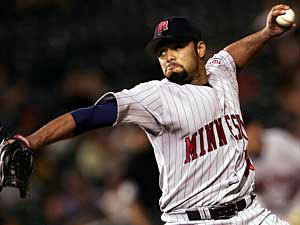 By resigning Mike Lowell and Curt Schilling the Red Sox drew a line in the sand. (I don't know, maybe winning the World Series had something to do with it as well.) They are the team to beat, not only in their own division, but in the whole American League. Every significant contributor from the 2007 Championship team has been signed for 2008, except Mike Timlin. Timlin is a valuable bullpen arm, even at age 42, but if the Red Sox decide to part ways with him permanently, it won't leave a gaping hole. Not in a bullpen that includes Jonathan Papelbon, Manny Delcarmon, Hideki Okajima, Javier Lopez, Brendon Donnelly, and Julian Tavarez. Timlin might even be seen as superfluous, with Craig Hansen, Kyle Snyder, and Devern Hansack also ready for the bigs.
As that list of relief arms suggests, not only has Boston filled the 2008 roster, they have an abundance in almost every area. Assuming Josh Beckett, Daisuke Matsuzake, and Curt Schilling are certain members of the rotation, that leaves two spots for the quartet of Clay Bucholz, Jon Lester, Tim Wakefield, and Kason Gabbard. Although they picked up his option, it isn't unlikely that 17-game-winner Wakefield may be headed back to the bullpen as a swingman and long reliever. Also, since Jacoby Ellsbury took over the starting job in centerfield during the playoffs, Coco Crisp is currently the most over-qualified fourth outfielder in baseball, joined by Brandon Moss, a young left-handed power hitter who fits the Boston mold and, at 24, after smacking 59 extra base hits in 500 AAA at-bats in 2007, appears ready for his shot in the show. The only real question mark for the Red Sox is whether they can depend on Julio Lugo as the shortstop after he abysmal showing, offensively and defensively, during the first year of his contract. Thankfully, if he starts '08 the way he started '07, they won't have to put up with it for long. Prospect Jed Lowrie was the Red Sox' Minor League Player of the Year in '07, posting an 896 OPS between AA and AAA, and sluggling above .500 at each level. Unless they deal him to Minnesota as part of a package for Johan Santana, I expect Lowrie to supplant Lugo (or, possibly, Pedroia, if he suffers a sophomore slump) sometime during the 2008 season.
While there is always a case to be made for adding a pitcher of Santana's ilk, by doing so the Red Sox would be significantly sacrificing their depth chart. Any deal would almost certainly include at least one of their young pitching studs, possibly more, and two players from the cheap, young quartet of Ellsbury, Lowrie, Pedroia, and Crisp. (ESPN is reporting the package as Lester, Crisp, and Lowrie.) A rotation featuring Santana, Beckett, Schilling, and Dice-K would be something to marvel at, but it would cost Boston the ability to compensate for injuries to position players. For a team that employs many mid-to-late-thirties veterans, selling off youth is a serious risk.
Ditto for the Yankees. According to the Times, they have officially made an offer to the Twins (an offer which does not include Joba Chamberlain). I would bet that it is comprised of some configuration of Robinson Cano, Melky Cabrera, Phil Hughes, Ian Kennedy, Shelley Duncan, Eric Duncan, and Wilson Betemit. Again, alongside Chamberlain and Chen-Ming Wang, Santana would headline a very imposing rotation. But, he would be among the first to attest that there is a sizable difference between having Melky Cabrera as your everyday centerfielder or Johnny Damon. The Yankees have finally stockpiled enough quality prospects to prevent them from having to overpay for half a dozen free agents every winter. It would be a mistake to mortgage that surplus for another veteran whose demands will likely exceed $150 Million. They were younger and more defensively sound in the Bronx during the second half of 2008. It seemed to work.
Which brings us, naturally, to the Minnesota Twins. As an organization they have been, throughout the reign of Terry Ryan, vigilant in retaining players which provide depth, especially for their pitching staff. I don't expect that to change drastically as Ryan makes way for protege, Bill Smith. The Twins seem ready for action this offseason, prepared to part ways with three high-profile players: Torii Hunter, Johan Santana, and Joe Nathan. It remains to be seen whether Santana and Nathan will get dealt. But, it appears to be a legitimate possibility, as the Yankees and Red Sox have already publicized offers. Whatever happens, don't mistake Minnesota's willingness to part with a few stars as the beginning of a long rebuilding process. Popular superstars, Justin Morneau and Joe Mauer, have two and three years left on their contracts, respectively, so the Twins will be looking to make a serious run at a championship sometime in the next two years. Such a run will mean supplanting Cleveland and Detroit atop the AL Central, neither of whom show signs of impending decline. As such, the Twins realize that they must be willing to sacrifice domination at a few positions for solidity throughout the roster.
Going into the offseason, Minnesota had glaring question marks at second base, third base, left field, center field, and designated hitter. With the two trades they've already made, acquiring Craig Monroe from the Cubs and trading Matt Garza and Jason Bartlett to the Devil Rays for Delmon Young and Brendan Harris, they addressed a couple of those positions. They could afford to trade Garza because they assume that Francisco Liriano will be recovered in time to replace him in the rotation on opening day. If the season were to start tomorrow, it seems likely that Monroe would be the everyday leftfielder and Young would play center, while Harris would replace Bartlett at short. Offensively, I expect that Young will be the equal of Torii Hunter as soon as 2009. However, while he has great speed and a strong arm, he is much better suited to right than center, which is convenient since Micheal Cuddyer, the Twins' reigning rightfielder, is much better suited to left or DH. Similarly, while Brendan Harris is at least as good with the bat as Jason Bartlett, he is defensively better suited for second or third, rather than shortstop. Craig Monroe is a career .304 hitter at the Metrodome, and has an 814 career OPS against lefthanders. He is a very decent defensive leftfielder. I imagine the Twins see him as the righthanded side of a platoon with Jason Kubel, with the ability to spell their other outfielders and hit off the bench.
I would guess that the depth chart in Bill Smith's office looks something like this:
C - Mauer
1B - Morneau
2B - Harris
3B - ?
SS - ?
LF - Kubel/Monroe
CF - ?
RF - Young
DH - Cuddyer
SP - Santana (?), Liriano, Bonser, Baker, Slowey, Perkins (?)
RP - Nathan (?), Neshek, Rincon, Guerrier, Crain, Reyes
IF - Casilla, Punto, Redmond
OF - Tyner
The Twins have some flexibility in the infield. Harris showed considerable offensive promise as a rookie in '07, hitting .286 with a 777 OPS and 12 HR and 59 RBI in 137 games with Tampa Bay, while playing respectable defense at second and thrid. Alexi Casilla struggled at the plate and in the field after replacing Luis Castillo at the end of 2007. But, he did steal eleven bases in twelve attempts, and his minor league numbers suggest he could develop into a solid lead-off hitter who plays mediocre defense at second or short. Punto provides outstanding defense at all three infield positions, but had the worst OPS of any major-leaguer in 2007, by a long shot (Punto: 562, Kendall (2nd Worst): 610). The Twins would definitely benefit most from adding a shortstop, but if none were available (for the right price), they could settle for solid offensive contributor who plays second or third.
Any package for Santana needs to include, at the minimum, a young, but major-league ready starting pitcher, a strong defensive centerfielder, and a promising infielder. Both Boston and New York have the first two pieces: Lester and Crisp from the Red Sox, Hughes and Cabrera from the Yankees. Hughes and Lester are essentially a draw in terms of quality. And, while Cabrera is probably the superior value compared to Crisp, Lowrie is likely to be the difference. He would be a Rookie of the Year candidate playing a critical position. The best the Yankees can offer is Wilson Betemit, who hasn't shown the ability to play short in the big leagues and has been an inconsistent hitter with stints in Atlanta, Los Angeles, and New York, all by the age of 25. Betemit could still turn into the superstar he was once predicted to be, but New York's best chance of beating out Boston in the Santana sweepstakes is to sweeten the offer with one of the Duncans, who could fit into the Twins' LF/DH mix. But, as I suggested earlier, a 4-for-1 swap does serious damage to a Yankees' depth.
Perhaps other teams will join the fray as the winter meetings get underway. Only a few can cobble together the pieces that would be required (including the $150 Million to sign Santana long term). The Mets are certainly interested, but by dealing Lastings Milledge to Washington, the let go of one of their best bargaining chips. They still have a couple of solid outfield prospects in Ben Johnson and Carlos Gomez. They've got major-league ready starters in Philip Humber and Mike Pelfrey (though neither is the equal of Hughes and Lester). And they have a young switch-hitting middle infielder named Anderson Hernandez. But, while the pieces are there, they would have to improve upon them in some way to beat out the Red Sox and Yankees. Would they be willing to part with John Maine?
The Dodgers, who have not been mentioned in Santana discussions, may be the darkhorse candidate. They have an abundance of young big-leaguers. Matt Kemp and Delwyn Young (Delmon's brother) can both play center field. Andy LaRoche, Tony Abreu, and Chin-Lung Hu are promising infielders (Hu is a shortstop). And, Clayton Kershaw, Chad Billingsley, and Hong-Chih Kuo are major-league ready starters. Los Angeles appears ready to deal some of their youth because they are log-jammed at several positions, but their most desperate need is a power bat. But if they fail to reel in Miguel Cabrera, they may turn their attentions elsewhere.
If Bill Smith does deal Santana, it is likely that Joe Nathan will follow, with Pat Neshek or Juan Rincon taking over closing duties in Minnesota. With Nathan as the centerpiece, Smith could craft a package to pursue a veteran like Scott Rolen (a third part would be necessary) or Miguel Tejada. Or, he could fleece a team desperate for a closer (Mikwaukee? Texas?) for several prospects and important role players.
By Opening Day 2008, I expect the Minnesota Twins will be completely redesigned. They have relied on pitching and defense in recent years. By no means do I expect them to forget the importance of either, but they will be supporting their young, promising rotation with a deep, potent lineup. Even now, the core of Mauer, Cuddyer, Morneau, and Young is nothing to scoff at. In 2009 it may be considered as good or better than the impressive quartets in Cleveland and Detroit.
Which brings us, naturally, to the Minnesota Twins. As an organization they have been, throughout the reign of Terry Ryan, vigilant in retaining players which provide depth, especially for their pitching staff. I don't expect that to change drastically as Ryan makes way for protege, Bill Smith. The Twins seem ready for action this offseason, prepared to part ways with three high-profile players: Torii Hunter, Johan Santana, and Joe Nathan. It remains to be seen whether Santana and Nathan will get dealt. But, it appears to be a legitimate possibility, as the Yankees and Red Sox have already publicized offers. Whatever happens, don't mistake Minnesota's willingness to part with a few stars as the beginning of a long rebuilding process. Popular superstars, Justin Morneau and Joe Mauer, have two and three years left on their contracts, respectively, so the Twins will be looking to make a serious run at a championship sometime in the next two years. Such a run will mean supplanting Cleveland and Detroit atop the AL Central, neither of whom show signs of impending decline. As such, the Twins realize that they must be willing to sacrifice domination at a few positions for solidity throughout the roster.
Going into the offseason, Minnesota had glaring question marks at second base, third base, left field, center field, and designated hitter. With the two trades they've already made, acquiring Craig Monroe from the Cubs and trading Matt Garza and Jason Bartlett to the Devil Rays for Delmon Young and Brendan Harris, they addressed a couple of those positions. They could afford to trade Garza because they assume that Francisco Liriano will be recovered in time to replace him in the rotation on opening day. If the season were to start tomorrow, it seems likely that Monroe would be the everyday leftfielder and Young would play center, while Harris would replace Bartlett at short. Offensively, I expect that Young will be the equal of Torii Hunter as soon as 2009. However, while he has great speed and a strong arm, he is much better suited to right than center, which is convenient since Micheal Cuddyer, the Twins' reigning rightfielder, is much better suited to left or DH. Similarly, while Brendan Harris is at least as good with the bat as Jason Bartlett, he is defensively better suited for second or third, rather than shortstop. Craig Monroe is a career .304 hitter at the Metrodome, and has an 814 career OPS against lefthanders. He is a very decent defensive leftfielder. I imagine the Twins see him as the righthanded side of a platoon with Jason Kubel, with the ability to spell their other outfielders and hit off the bench.
I would guess that the depth chart in Bill Smith's office looks something like this:
C - Mauer
1B - Morneau
2B - Harris
3B - ?
SS - ?
LF - Kubel/Monroe
CF - ?
RF - Young
DH - Cuddyer
SP - Santana (?), Liriano, Bonser, Baker, Slowey, Perkins (?)
RP - Nathan (?), Neshek, Rincon, Guerrier, Crain, Reyes
IF - Casilla, Punto, Redmond
OF - Tyner
The Twins have some flexibility in the infield. Harris showed considerable offensive promise as a rookie in '07, hitting .286 with a 777 OPS and 12 HR and 59 RBI in 137 games with Tampa Bay, while playing respectable defense at second and thrid. Alexi Casilla struggled at the plate and in the field after replacing Luis Castillo at the end of 2007. But, he did steal eleven bases in twelve attempts, and his minor league numbers suggest he could develop into a solid lead-off hitter who plays mediocre defense at second or short. Punto provides outstanding defense at all three infield positions, but had the worst OPS of any major-leaguer in 2007, by a long shot (Punto: 562, Kendall (2nd Worst): 610). The Twins would definitely benefit most from adding a shortstop, but if none were available (for the right price), they could settle for solid offensive contributor who plays second or third.
Any package for Santana needs to include, at the minimum, a young, but major-league ready starting pitcher, a strong defensive centerfielder, and a promising infielder. Both Boston and New York have the first two pieces: Lester and Crisp from the Red Sox, Hughes and Cabrera from the Yankees. Hughes and Lester are essentially a draw in terms of quality. And, while Cabrera is probably the superior value compared to Crisp, Lowrie is likely to be the difference. He would be a Rookie of the Year candidate playing a critical position. The best the Yankees can offer is Wilson Betemit, who hasn't shown the ability to play short in the big leagues and has been an inconsistent hitter with stints in Atlanta, Los Angeles, and New York, all by the age of 25. Betemit could still turn into the superstar he was once predicted to be, but New York's best chance of beating out Boston in the Santana sweepstakes is to sweeten the offer with one of the Duncans, who could fit into the Twins' LF/DH mix. But, as I suggested earlier, a 4-for-1 swap does serious damage to a Yankees' depth.
Perhaps other teams will join the fray as the winter meetings get underway. Only a few can cobble together the pieces that would be required (including the $150 Million to sign Santana long term). The Mets are certainly interested, but by dealing Lastings Milledge to Washington, the let go of one of their best bargaining chips. They still have a couple of solid outfield prospects in Ben Johnson and Carlos Gomez. They've got major-league ready starters in Philip Humber and Mike Pelfrey (though neither is the equal of Hughes and Lester). And they have a young switch-hitting middle infielder named Anderson Hernandez. But, while the pieces are there, they would have to improve upon them in some way to beat out the Red Sox and Yankees. Would they be willing to part with John Maine?
The Dodgers, who have not been mentioned in Santana discussions, may be the darkhorse candidate. They have an abundance of young big-leaguers. Matt Kemp and Delwyn Young (Delmon's brother) can both play center field. Andy LaRoche, Tony Abreu, and Chin-Lung Hu are promising infielders (Hu is a shortstop). And, Clayton Kershaw, Chad Billingsley, and Hong-Chih Kuo are major-league ready starters. Los Angeles appears ready to deal some of their youth because they are log-jammed at several positions, but their most desperate need is a power bat. But if they fail to reel in Miguel Cabrera, they may turn their attentions elsewhere.
If Bill Smith does deal Santana, it is likely that Joe Nathan will follow, with Pat Neshek or Juan Rincon taking over closing duties in Minnesota. With Nathan as the centerpiece, Smith could craft a package to pursue a veteran like Scott Rolen (a third part would be necessary) or Miguel Tejada. Or, he could fleece a team desperate for a closer (Mikwaukee? Texas?) for several prospects and important role players.
By Opening Day 2008, I expect the Minnesota Twins will be completely redesigned. They have relied on pitching and defense in recent years. By no means do I expect them to forget the importance of either, but they will be supporting their young, promising rotation with a deep, potent lineup. Even now, the core of Mauer, Cuddyer, Morneau, and Young is nothing to scoff at. In 2009 it may be considered as good or better than the impressive quartets in Cleveland and Detroit.
Subscribe to:
Posts (Atom)