AL East:
For a decade, the AL East was an annul two-horse race between the Yankees and Red Sox. In 2008, the Tampa Bay Rays force there way into playoff picture. Now, with the Blue Jays and Orioles both fielding impressive young rosters for whom winning records are very realistic, nobody looks forward to visiting any of these cities. The vaunted East is not far from being a wide-open competition.
But not this year...
I think the Jays and Rays will both be better than .500 teams, and I expect Buck Showalter's "Baby Birds" to have their best season since 2004, but when all is said and done, the Yankees and Red Sox will again be headed for the postseason.
Following an active offseason, in which Theo Epstein brought in a pair of premier hitters, Adrian Gonzalez and Carl Crawford, to add to a lineup which already promised to be buoyed by the returns of Kevin Youkilis, Dustin Pedroia, and Jacoby Ellsbury, the BoSox are the odds-on favorite not only to win the East, but also the AL Pennant, and the World Series. They've got a loaded lineup, a deep rotation, and a dynamic bullpen.
The Yankees are far less complete. They have only once truly dependable starting pitcher. They have a very uncertain catching situation. And they depend upon an aging core, several of whom are coming off down seasons. Still, they've got an abundance of talent, especially on offense, and while it would hardly surprise me if they caught a few bad breaks and fell back of the Rays and/or Jays, I'm having a hard time talking myself into making that prediction.
Boston Red Sox 97 W
New York Yankees 91 W
Toronto Blue Jays 89 W
Tampa Bay Rays 87 W
Baltimore Orioles 78 W
MVP Candidate: Kevin Youkilis, Red Sox
Cy Young Candidate: C. C. Sabathia, Yankees
Rookie of the Year: Kyle Drabek, Blue Jays
Comeback of the Year: Daisuke Matsuzaka, Red Sox
Breakout Candidates: Ricky Romero, Blue Jays; Adam Jones, Orioles; Brian Matusz, Orioles; Brett Cecil, Blue Jays; Matt Joyce, Rays; Sean Rodriguez, Rays; Jed Lowrie, Red Sox
AL Central:
Many will bet the chalk in the AL Central. The Twins had an impressive 2010 campaign and none of their divisional opponents made big splashes this offseason. The Twins do have a few things to hang their hats on. They've got a plethora of power-hitters. They've got a three-time batting champ. They've got arguably the best pitcher in the division. They've also got some serious uncertainty at the back of the rotation. They've got unproven players at three infield positions. And their cleanup hitter is still recovering from a concussion he suffered nine months ago.
Chicago relatively quietly improved themselves this offseason. Their big move was the addition of free agent, Adam Dunn, who give them a consistent power source to slide into the lineup between Paul Konerko and Carlos Quentin. They bolstered their bullpen with the addition of veteran relievers, Jesse Crain and Will Ohman. They added an inexpensive high-upside outfielder in Lastings Milledge. And they brought back clubhouse leaders Konerko, A. J. Pierzynski, and Omar Vizquel.
More importantly, however, the Sox have plenty of depth in their rotation and a handful of young players who could make much bigger contributions in 2011. Foremost among these is Gordon Beckham, the 24-year-old second-baseman who struggled mightily in the first half of his sophomore season, but made adjustments and hit .310 in the second half. The White Sox could also get substantial contributions from rookies Chris Sale and Brent Morel, and sophomores Sergio Santos and Dayan Viciedo.
I often preach the importance of depth in the marathon season. The White Sox have it. The Twins don't.
Chicago White Sox 92 W
Minnesota Twins 86 W
Detroit Tigers 77 W
Cleveland Indians 70 W
Kansas City Royals 62 W
MVP Candidate: Miguel Cabrera, Tigers
Cy Young Candidate: Francisco Liriano, Twins
Rookie of the Year: Tsuyoshi Nishioka, Twins
Comeback of the Year: Jake Peavy, White Sox
Breakout Candidates: Max Scherzer, Tigers; Gordon Beckham, White Sox; Kila Ka'aihue, Royals; Asdrubel Cabrera, Indians
AL West:
Sure, they'll miss Cliff Lee. But the rumors of the Rangers demise have been greatly exaggerated. Remember, Texas was five games up in the West and playing at a .581 clip before Lee ever threw a pitch for them in 2010.
The ever-optimistic Angels fans will rally behind their solid rotation and their improved bullpen depth, but the Angels ability to score runs remains in doubt, especially with Kendrys Morales remaining on the D.L. to begin the season and still no long-term solution at third base.
The major threat to a Texas repeat is actually the Oakland Athletics. Billy Beane helped move his offense towards respectability by adding David DeJesus and Hideki Matsui, but the A's still don't possess a legitimate middle-of-the-order hitter. However, teams like the Giants and Padres have proven that mediocre offense can be overcome by superlative pitching. The A's have potentially superlative pitching. If the rotation keeps Oakland in the race into July, expect Beane to chase impending free agent rentals.
Texas Rangers 91 W
Oakland Athletics 87 W
Los Angeles Angels 75 W
Seattle Mariners 68 W
MVP Candidate: Josh Hamilton, Rangers
Cy Young Candidate: Jered Weaver, Angels
Rookie of the Year: Chris Carter, Athletics
Comeback of the Year: Chone Figgins, Mariners
Breakout Candidates: Brett Anderson, Athletics; Julio Borbon, Rangers; Jason Vargas, Mariners

Showing posts with label New York Yankees. Show all posts
Showing posts with label New York Yankees. Show all posts
Friday, April 01, 2011


Monday, October 25, 2010
The Giants Have Suffered Since They Left New York, The Rangers Have Suffered... (World Series Preview)
All season long it seemed like we were on course for an inevitable collision.
The reigning World Champion, the Yankees, did little to dispel the notion that they were the team to beat. Very little had changed following their celebration last October. They still had the nine-figure talents of A-Rod, Teixeira, and Sabathia. They had their lucky charms: Jeter, Rivera, Pettitte, Posada. The ever-excellent lineup was perhaps even the slightest bit improved by the acquisition of Curtis Granderson and the continued development of Robinson Cano and Brett Gardner.
On the other side we had the two-time reigning NL Champs, the Philadelphia Phillies, who still boasted the league's most intimidating lineup, but had also added the league's best pitcher, Roy Halladay. His greatest appeal for Philadelphia GM, Ruben Amaro, may have been his incredible record against the team that had ousted the Phillies the previous fall.
The Yankees got out of the gates quickly. They had the best record during the first half, and finished the season just one win short of the AL's top seed. The Phillies struggled with injuries early, but by going 50-25 after the All-Star Break, they managed to finish with the best record in baseball. To many, a rematch seemed destined. Would Doc Halladay be the key to trouncing the Bombers? Would Sabathia again dominate the lefty-heavy Phillies lineup? How many big homers would be yielded by the shaky middle relief corps on either side?
Alas, we got ahead of ourselves...
And it appeared the megaliths did as well. The Yankees got owned by Colby Lewis, Cliff Lee, and Derek Holland, while the Rangers put up crooked numbers night after night after night. Texas had a dozen multirun innings against Yankees beleaguered staff. They hit nine homers and outscored the Bombers by nineteen runs over six games. Although nobody seem comfortably saying it, this was a flat-out shelling. In at least half the games, including two in their home ballpark, New York barely showed up.
In the NL, the vaunted Philadelphia lineup had no answer for Tim Lincecum in Game One, for Matt Cain in Game Three, or for Javier Lopez and Brian Wilson throughout, while the self-described conglomeration of "misfits and castoffs" manufactured runs when they needed them most, led by unlikely hero, Cody Ross, who probably wouldn't have been in the starting lineup had it not been for a neck injury which sidelined Jose Guillen. But San Francisco hardly dominated. They were actually outscored by Philadelphia over the course of the NLCS (by one run) and never led any game by more than three. It was tortuous, to borrow the sentiment of Giants announcer Duane Kuiper which has become the rallying cry of Bay Are fans, but it was enough.
And so, for the first time since 2005, when the White Sox broke the Black Sox curse against the Astros, who were representing the NL for the first time, we have a matchup of two teams who have both been waiting a very long time for some relief. To me, that's a recipe for excitement. Sure, in 2005, the White Sox managed an impressive sweep, but every game was decided by two runs or less, and one of them lasted 14 innings. In 2002, when the Giants faced off with the Angels, who were, like the Rangers, coming off their first AL Pennant, we certainly got our money's worth. There were for one-run games, including a wild 11-10 slugfest in Game Two. It was the last time we had a World Series that went to seven games.
So, the Giants have been here as recently as 2002 (which, of course, really isn't that recent), but they lost, in heartbreaking fashion (famously up 5-0 with eight outs to go). In 1989 they got swept in the infamous "Quake" series against the Bash Brothers. In 1962, they lost in seven to the Yankees. The Giants have never brought the Championship Trophy home to San Francisco, and the franchise hasn't won it period for more than half a century. Willie Mays was 23-years-old the last time they won in '54. Willie McCovey never got a ring. Juan Marichal never got a ring. Ditto for Will Clark. And, most famously, Barry Bonds.
The Rangers, an '60s expansion team, had never won a postseason series before this month. Before this weekend, they were one of only three franchises who had never won a pennant (sorry Mariners and Nationals). They joined the league as the Washington Senators in 1961, making them easily the oldest team to be making their first trip. Generally, teams look to mark such occasions by rolling out a roster of the best players in their history for photo-ops and opening ceremonies, but the Rangers history has been so thoroughly mediocre that's it's hard to imagine who, besides Nolan Ryan, would make the guest list. The hitters who top all the franchise record boards are Ivan Rodriguz, Rafael Palmeiro, and Juan Gonzalez. Pudge, of course, still plays for the Nationals, so it's hard to imagine him trotting out like an old-timer. All three have been tainted by the steroid controversy and all left the franchise on relatively bad terms. But who else do you turn to? Toby Harrah? Ruben Sierra? Don't be surprised if we get to see Kenny Rogers first World Series appearance since the infamous "dirtball" incident in 2007. Charlie Hough won 139 games for the Rangers, best in franchise history. That'd barely be good enough for 10th on the Giants list.
San Francisco will, of course, role out a cavalcade of stars. We'll likely see Hall of Famers like Mays, McCovey, and Marichal. Perhaps Orlando Cepeda. Gaylord Perry pitched for both squads. That might be interesting. Bonds threw out a first pitch during the NLCS. Will he return for another engagement with the team that refused to offer him a contract the year after he broke the home-run record?
Clearly, the Giants have the more impressive history, they've got the more diehard fan base, and, to be fair, they've waited longer. There are plenty of octogenarians in the AT&T stand who may not be able to handle another heartbreak. It's probably good news for Giants fans that there isn't a single player on the team who was even in the organization in 2002. Matt Cain and Tim Lincecum were still in high school at the time.
What promises to be great about this matchup in general is that both these teams have proven themselves utterly immune to expectations, pressure, criticism, second-guessing, and outside forces of all variety. That's partially why, when I gave my Narrative Likability grades prior to the playoffs, these two teams got the highest marks. I don't expect a whole lot of momentum swings. These teams don't work like that. The Rangers suffered one of the most brutal losses in recent postseason history in Game One of the ALCS, as the Yankees game back from five runs down in the eighth inning. The Rangers followed up on the gutwrenching loss with three straight wins by a combined score of 25 to 5. In the NLCS, the Giants led for only 43% of the innings. They easily could have been worn out waiting for the other shoe to drop, but they rallied from behind on three separate occasions to beat a team which literally everybody thought was better than them.
In the next 48 hours I hope to provide a few tidbits and a little provocative analysis regarding The Expendables and The Rangers of Redemption. I don't know that I've ever been more excited for a World Series.
Tuesday, October 19, 2010
Hey, New York, Who's Your Daddy?
As I sat, familiarly flabbergasted, amidst a bar full of equally frustrated strangers, and watched the Yankees deliver a barrage of singles, piling up runs at a tortuously slow pace, as Ron Washington tried pitcher after pitcher in an effort to tourniquet the ridiculous trickle of scoring, I recognized that, despite the fact that C. J. Wilson had absolutely stymied the most infamous lineup in baseball for seven innings and the Rangers had chased New York's only dominant pitcher in four innings, the series might well be over by the end of Game One. Even if you attempt to adhere to that Curt Schilling credo, that Mystique and Aura are just dancers at a nightclub, you cannot deny that the Yankees have a habit of getting in their opponents heads. For ages, of course, it was that way with the Red Sox (if you haven't already, hurry over to iTunes and watch ESPN's Four Days In October documentary). More recently, it's been that way with the Twins. And, now, I feared, they had the Rangers on their heels, ever waiting for New York to again assert their superiority by doing something truly improbable (like scoring five runs in an inning, off one of the best bullpens in baseball, without hitting an homer, indeed, with the help of only one extra-base hit). If the Yankees had successfully quelled the Rangers aggressive, can-do spirit, this series would be over in five.
But that didn't happen.
Instead, Texas walked away from the game with the kind of impression which would make any sabermetrician proud: "They got lucky." In baseball, no matter how good you are, the stringing together of seven consecutive baserunners is, to a significant degree, a matter of luck. Brett Gardner reached on a grounder which would be an out, even with his speed, at least 80% of the time. Jeter and A-Rod both hit the ball hard, but again, on the ground, and found that narrow, dangerous gap just inside the third base line. Thames hit was a broken-bat dying quail. If that bat stays whole, it's probably a line drive right at the left-fielder. Certainly, there's nothing wrong with these kinds of hits and the Yankees made their luck possible by working counts and, in most cases, making fairly solid contact, but even they would tell you, they got some fortuitous breaks. That night, when their inclination must've been to throw in the towel and, in the words of Pedro Martinez, call the Yankees their Daddy, Ron Washington and the Rangers instead observed that if they played hundred more games in which they entered the eighth with a five run lead, they'd probably win 95 of them.
On the bright side, they had hammered the Yankees only top-flight starting pitcher, C. C. Sabathia, and the Yankees had struggled against their second-best southpaw, C. J. Wilson. When Colby Lewis went to work on the Yankees the next afternoon and his teammates again battered the New York starter, this time Phil Hughes, you could see several Rangers (most noticeably, Elvis Andrus) smirking in the seventh and eighth innings, as if to say, "If you're so good, why don't do it again?" Facing several of the same pitchers they had chased less than 24 hours earlier, New York managed just one hit off the Rangers bullpen Sunday. On Monday night, they got another taste of Rangers best southpaw, Cliff Lee, who, in the last two postseasons, has thusfar struck out 26 Yankees while allowing only 19 baserunners, making it clear that the only solution New York has for former Cleveland Indians lefties is to pay them $150 Million.
Certainly, the ALCS is far from over, but thankfully, the Rangers were immune to the massive momentum shift that could've followed their heartbreaking loss in Game One. At this point, based on the pitching performances of the first three games and the fact that, setting aside that incredible eighth, the Yankees have scored only three runs to the Rangers twenty, one cannot see how the Yankees are favored in any of the next four games. Tommy Hunter v. A. J. Burnett has the potential to be the first slugfest of the 2010 playoffs, which could go either way. Sabathia will likely bounce back in Game Five, on normal rest, but there's no reason to believe New York's lineup will have any better answer for C. J. Wilson. Same can be said for Colby Lewis in Game Six. Most importantly, perhaps, Texas needs only one of the next three to assure that Cliff Lee gets back to the mound for Game Seven.
If anybody has gotten inside anybody else's head this postseason, it's Cliff Lee. In fact, he's been inside the Yankees heads since last October. In the clubhouse and on New York talk radio, Cliff Lee is discussed in hushed tones, like a marauding gunslinger. That's why Brian Cashman pursued him with such fervor at the trade deadline, as much to keep him off another playoff team as to put him on theirs. As he hung golden sombreros on Derek Jeter and Marcus Thames Monday night (and added a pair apiece for Posada, Granderson, and Teixeira), you could see by their expressions that this was a recurring nightmare come true.
If the ALCS goes to Game Seven, Rangers fans have every right to chant "Who's Your Daddy?" throughout the top half of every inning.
Friday, October 15, 2010
A-Roid Bankrupted The Rangers, Now Is The Time For Vengeance (ALCS Preview)
Expanding upon the superlative "Narrative Likability" grade I gave the Rangers prior to the ALDS, let's look at three reasons why the Rangers deserve to beat the Yankees:
3.) As I heard Michael Wilbon say on PTI earlier this week, "You can't give this anything but an A+." He was referring to decision by Josh Hamilton's teammates to forego the champagne in favor of ginger ale following their Game 5 victory over the Rays. The Rangers have chemistry in spades and this was just the most recent evidence of it.
2.) Dom Perignon v. Schweppes is actually a pretty good metaphor for Yankees v. Rangers. New York has, famously, the highest payroll in baseball - over $213 Million in 2010, highest in MLB history - while the Rangers have easily the lowest payroll among playoff teams. In fact, in the American League, only Oakland and Cleveland spent less than Texas this season. The Rangers combined salaries (for the 30+ players who spent time on the MLB roster this season) come in at less than $65 Million. A-Rod, C. C. Sabathia, and Derek Jeter will, by themselves, earn $76 Million in 2010.
1.) Just in case you need one more reason to call A-Rod a dick: how about the fact that he was represented on the "creditors committee" during the Rangers bankruptcy hearings earlier this year. That's right, the man whose record-setting salary helped run John Hicks and his baseball franchise into the ground (and who will make $32 Million from the Yanks in 2010) was still lobbying hard to get $24.9 Million of the $67 Million the Rangers agreed to give him just to get him off their team way back in 2004! You can bet, if Nolan Ryan were starting in this ALCS, he'd be on the lookout for timely opportunities to play some chin music for the smarmiest superstar. We'll just have to wait and see how much of the Rangers president has rubbed off on his team.
Okay, now here's three reasons the Rangers can beat the Yankees:
3.) One theory that's been leveled in the wake of the largely misunderstood Moneyball explosion is that while the Three-Outcomes approach (walk, strikeout, homers) works well over the course of the regular season, a more diverse offensive strategy is necessary in the postseason. In the first round of the ALDS, the Ranger beat a team, the Rays, who were definitely something of a Three-Outcomes team. They led the league in strikeouts and walks, were sixth in homers, and were second-to-last in batting average. The Rangers, meanwhile, topped the AL in batting average and were near the bottom in both strikeouts (11th) and walks (8th), while still getting their fair share of power (5th in HR). I had theorized that the extreme strike-throwing abilities of Cliff Lee, C. J. Wilson, and Colby Lewis might make problems for the Rays, and that was apparently the case, as the Rangers staff managed a nearly 5-to-1 K/BB ratio during the ALDS. The Yankees are not as drastically reliant on patience and power as the Rays, but they were 2nd in walks, 7th in strikeouts, 2nd in homers, and 7th in average. In the first round, 7 of the 17 Yankee RBI were created by the long ball and 3 of their 17 runs were created by walks. If the Rangers cut down on those types of production, they will dramatically improve upon Minnesota's results.
2.) In the post-PED era, speed kills. In the first round, New York matched up against a plodding team who ranked 13th in the AL in steals this season. The Twins could not expose one of New York's most apparent flaws, their inability to hold runners and prevent steals. The Yankee catching tandem led the league in errors and allowed an astounding stolen-base success rate (85.2%). You can bet the Rangers, who swiped six bags against the Rays, and were 5th in the AL in steals during the regular season, will never stop running on Jorge Posada.
1.) Of course, Cliff Lee famously baffled the Yankees last October, winning both of his World Series starts. For him to get two in this ALCS, it will require the series to get to seven games. If it get there, however, the Rangers are in good shape. Including the postseason, since 2008 (when Lee's "coming-out" began) the lefty is 6-1 against New York, with a 2.31 ERA. And, he's not the only tough lefty on the Rangers staff. C. J. Wilson is slated for a pair of starts against Yankee Ace, C. C. Sabathia. Over their last 15 starts, here's how each fared:
Sabathia: 9-4, 3.29 ERA, 1.26 WHIP, 7.85 K/9, 668 OOPS, 106.2 IP
Wilson: 8-3, 3.36 ERA, 1.24 WHIP, 8.70 K/9, 618 OOPS, 91 IP
Was Sabathia really a better pitcher? If the Texas lefties win, three of their four starts, the Rangers likely head to the World Series. So, much rides on how Wilson pitches tonight.
Saturday, September 25, 2010
"Narrative Likability Factor" & The New York Yankees
A Yankee win this evening would bring their playoff magic number to 1. With both Tampa Bay and Minnesota neck-and-neck in terms of overall record, the Bombers still need a good week to assure themselves home-field advantage, but it seems a foregone conclusion, at least, that they'll once again be part of the drama of October baseball.
Earlier this week I discussed the invention of Narrative Likability Factor, a metric for baseball humanists. NLF definitely gives priority to players and teams which have overcome obstacles and adversity, have suffered from perpetual underdog syndrome, have long-suffering fan-bases, and are replete with soulful, underrated players and coaches.
It probably goes without saying that the franchise which won last year's World Series, owns more championships than any team in professional sports history, consistently boasts the largest payrolls and revenues in the league, and caters primarily to the most affluent citizens of the nation's largest city does not score particularly high on the Narrative Likability scale. In truth, the Evil Empire acts something like an inverse curvebreaker. Their presence in the playoffs helps to raise everybody else's score. Even the Phillies, two-time reigning NL Champs boasting multiple MVP winners and Cy Young candidates, seem like pesky underdogs compared to the team that ousted them just under a year ago.
Still, it seems necessary to set this bar, no matter how low. The following narratives will probably only be appealing to that unfortunately preponderant sociopathic strain in American culture known as Yankee fandom, but here goes:
- The Boss Is Lost: He is one of the great antiheroes of baseball history, but that doesn't necessarily make George Steinbrenner's career any less compelling. We engorge ourselves on baseball villains as ravenously as on baseball's virtuous paragons. In the event that - God Forbid! - the Yankees hoist another banner in 2010, there will undoubtedly be an entertaining postmodern perversity to the posthumous treatment of the curmudgeonly demagogue with "win-one-for-the-gipper" sentimentality. His psychotic hellspawn - Hank and Hal - accept the trophy in his honor and blubber, through forced blood-tears, about their early years, hiding for weeks in tight, dark corners of the Steinbrenner mansion, quivering in response to the Boss' tendency towards filial cannibalism. "We didn't know it then," Hank whinnies, "but he was just preparing us for the reality of the business world. I will think of him most fondly every time we negotiate a new competitive-bargaining agreement."
- El Capitan: Derek Jeter has been so uncharacteristically bad this year, posting by far the lowest OPS (707) of his fifteen-year career, that even his most rabid apologists have questioned the wisdom of resigning him to the kind of outlandish contract ($15-$20 Million/year) that seemed a foregone conclusion when the season began. Several New York columnists, finding it more and more difficult to defend Jeter's performance, which has gotten progressively worse over the course of the season, have already resorted to commending him on rising to the occasion in October. Captain Clutch, we all assume, will be right back to his old exploits (980 career OPS in ALDS) when the playoffs begin. If this premonition proves accurate, prepare yourself for a even greater chokeload of Jeter love from Joe Buck and the rest mainstream media in the ALCS and World Series. Jeter's postseason prowess is the well-placed dimple which provokes a father to call his plain-jane daughter "beautiful."
- Flipping the Script: The Yankees biggest offseason acquisition, Javier Vazquez (10-9, 5.07 ERA) and Curtis Granderson (779 OPS), have had rather mediocre seasons, prompting the typical backlash from the coven of New York sportswriters who worship exclusively at the church of the trinity - Jeter, Rivera, Posada. New guys suck, basically. Granderson, who's been dogged by injuries much of the year, has quietly been very hot over the last month, with 8 HR, 22 RBI, and a 912 OPS. Vazquez has continued to struggle, fueling the pervasive "can't hack it in New York" rants which began as soon as he was re-acquired. Expect the tune to change if either or both of them step it up in October.
- Spend, Baby, Spend: In the wake of the MLB Confidential leaks at Deadspin, which suggest that teams like the Marlins may be making nearly as much in pure profit as the Yankees by merely pocketing their revenue-sharing dollars (many of which come directly out of the Yankee coffers), the "buying championships" argument is thinner than ever. If there was ever a reason to root for the Yankees, this is it. They're annually asked to subsidize their rivals, but then have to listen all year long to bitching about their $250 Million payroll while slimy owners like Jeffrey Loria trade away their best talents the moment they become eligible for arbitration. At least the Yankees profit-model, as ugly as it may be, especially in the era of Yankee Stadium III, involves putting a competitive product on the field. You'll need a sizable trust fund if you want to catch an obstructed view of that field, but you'll never have to worry about them starting Emilio Bonafacio is center-field in September.
At the end of last season, after the Yankees made relatively easy work of Minnesota, Los Angeles, and Philadelphia, I was able to take solace in the fact that if the Yankees didn't win at least one championship every decade, we might lose our sense of evil in the world. The offseason will be even darker this year if they manage to repeat.
Narrative Likability Factor: F (uck the Yankees!)
Saturday, September 11, 2010
"Do Yankees Prefer Yankees?" or "Is purebreeding consensual?"
Completely baseless pronouncements are the lifeblood of ESPN commentary. At times, I think ESPN purposely hires the most ignorant and asinine broadcasters and "journalists" in the industry explicitly because they realize that we love their network most in the moments when their "experts" reveal themselves as so vulgarly stupid and incompetent that it becomes impossible to suffer them in silence. While watching television, seemingly unmolested, you suddenly scream invectives so blue they surprise even your wife. Or, while taking a leisurely stroll along the beach, innocently listening to a podcast on your headphones, you're inspired to bark incomprehensible half-syllables like a Tourette's sufferer, frightening bikini-clad passers-by.
The brazen ineptitude of the ESPN's "talent" begat one of the best sports blogs to yet grace the internet, Fire Joe Morgan, which is now being reborn as part of Deadspin. However, ESPN's greatest contribution has definitely been making sport fans more self-aware. One is less likely to blurt out an over-ambitious and/or under-developed assumption after seeing a buddy ruin his flatscreen trying to hit John Kruk with his beer.
A pervasive and irrational fondness for the Yankees and Red Sox at ESPN is, of course, nothing new, but in recent weeks they've gone googoo-gaga all over again for the Bronx Bombers. If you're a baseball junkie like me, you won't need any proof of this, but perhaps the most egregious example was Eric Karabell and Mark Simon pronouncing on Baseball Today their assurance that the Yankees would end up winning the AL East by six or more games. I've come to expect such things from their self-aggrandizing doofus of a co-host, Seth Everett, but Karabell and especially Simon are usually more tactful and deliberate in their reasoning. In this case, however, they offered nothing in the way of evidence to support this prediction. So, I have to assume that it's based on "pedigree" alone.
Ah, yes, the Yankee pedigree. I've always found the fondness for this phrase fascinating, considering the term quite literally implies a high incidence of incest.
So, let's test their hypothesis...
First of all, at no point this season have the Yankees led the Rays by more than four games. That certainly doesn't mean it can't happen, but the landscape of the first 90% of the season would have to be radically altered.
As things stand, entering tonight's contest against Texas, the Yankees have a one-game lead over the Rays in the AL East. Both the Yankees and the Rays have 21 games remaining. We should point out, there was only one instance this season when the Yankees gained as many as five games on the Rays in so short a period of time, that was in late May and early June, during a stretch when the Rays went 7-10 while the Yanks went 12-5.
At no point this season have the Rays played 21 games and done any worse than 8-13. Assuming they won't do any worse than that down the stretch (I'll explain the safeness of this assumption momentarily), for the Yankees to gain five or more games over the Rays, they will need to win, at the very least, 12 more games.
The remaining schedule makes both sides of this postulate seem far-fetched.
New York has eighteen games left against winning teams, including seven against the Rays and six against the archrival Red Sox. So far, on the season, the Yanks have gone 5-6 against Tampa and 7-5 against Boston. They also have to travel to Toronto to play a Jays team who is actually leading them in their season series (7-8). This is hardly an easy schedule. In fact, even factoring in the lowly Orioles, who the Yankees have owned (11-4), New York has just a .566 winning percentage against these teams, barely enough to get to 12 wins in 21 games.
And, to make matters worst, they will spend most of the remaining schedule on the road, playing 14 of their remaining 21 away from the friendly confines of Yankee Stadium (for the season, New York has a .567 W% on the road, .662 at home).
The Rays, on the other hand, have 13 of their remaining contests in Tampa (.623 at home, .592 on road). More importantly, the only winning team they play the rest of the way is the Yankees (as well as one remaining game in their current series with the Jays). Even when the Rays had their worst 21-game stretch of the season, if featured opponents like Boston, Chicago, San Diego, Atlanta, and Texas. Against the teams they will actually be playing down the stretch, the Rays are 27-15 (.643).
Looking at these schedules, not only does it seem highly unlikely that the Yankees will gain significant ground over the Rays, it actually looks like it would be an impressive feat if they were able to hold off the Rays and maintain their loose hold on the division. While the Yankees last ten games come against Boston (7) and Toronto (3), the Rays will be getting rich on three worst franchises in the American League: Seattle (3), Baltimore (3), and Kansas City (4).
Friday, May 21, 2010
HippeauxNotes: On the verge of a Yankee implosion?
On Monday, the Yankees blew a five-run lead and needed two homers in the bottom of the ninth in order to walkoff against the Red Sox. The following day they did the same thing, except this time it was their closer who gave up the go-ahead run in the ninth. On Wednesday, they got stomped by Wade Davis and the Rays, yielding double-digit runs for the first time all season. And yesterday Andy Pettitte had by far his worst outing of the season and the Rays once again piled it on, with four homeruns.
There is now more distance between the Yankees and the first-place Rays (5 games) than between the Yankees and the fourth-place Red Sox (3.5 games), and the Bombers have dropped eight out of twelve. They are still on pace for 99 wins, so isn't necessarily time for desperate measures, but there are several causes for concern in the Bronx.
In the preseason, I got a lot of mileage out of the observation that the Yankees were the only team in 2009 who had eight regulars with 500+ plate appearances and four pitchers who made 30+ starts. My point was that New York was likely to face more injuries this season and, unlike the Rays and Red Sox, I wasn't sure the Yankee roster was equipped to deal with such turmoil.
Already the Yanks have had to send Jorge Posada, Curtis Granderson, Nick Johnson, Chan Ho Park, and Alfredo Aceves to the disabled list for extended stretches, while several other players, most notably Mariano Rivera, have dealt with minor injuries that have made them unavailable for a few games at a time. As a result, Marcus Thames, Francisco Cervelli, Sergio Mitre, Randy Winn, Ramiro Pena, and Juan Miranda have all seen increased playing time. The damage has been minimized by the fact that Thames (1001 OPS), Cervelli (904 OPS), and Mitre (3.32 ERA) have played exceptionally well, but the odds are certainly against them maintaining those numbers through prolonged exposure.
Injuries aren't the only cause of concern. Prior to having three hits on Thursday, Derek Jeter had endured one of the rougher slumps of his career (.190 AVG over 18 games). He has only four extra-base hits in May and his strikeout rate is way up, while his walk rate is way down. It's probably just a slump, but with Granderson and Johnson out of the lineup, it's unfortunate timing.
Javier Vazquez has been a notorious disaster. His 8.01 ERA leading to him being skipped on a couple occasions in recent weeks. In his last start he managed seven strong innings against the Tigers, easily his longest outing of the season, evidence perhaps that he's on the mend, but the New York media has been quick to scapegoat him and his dreadful second half in 2004 remains an open wound for many Yankee fans.
A. J. Burnett was dominant in April and had a 1.99 ERA after six starts, but in his last three outings he's allowed sixteen earned runs in seventeen innings of work and walked as many batters as he's struck out. Burnett has always been prone to hot and cold streaks, so this is probably nothing more than that, but again, with Vazquez struggling, Pettitte nursing a minor injury, and even Sabathia turning in a couple of poor mid-May starts, the timing has been unfortunate.
Clearly, New York has some breathing room due to their hot start, but with Boston getting healthy and Detroit surging as well, they can't continue to lose two out of every three games for too much longer. After a challenging road trip to Minnesota, the Yankees will play thirteen of their next sixteen games against Baltimore, Houston, and Cleveland, three of the four worst teams in baseball so far in 2010. They'll have a chance to get healthy and pad their record a little before heading into a relatively challenging interleague schedule (v. Phillies, v. Mets, @ D-Backs, @ Dodgers).
The next six weeks could see New York and Tampa Bay distancing themselves from everybody else in the American League on the road to becoming the first duo of team to win 100+ games in the same division since the Mariners and Athletics did it in 2001. Or, we could see the AL East's Wild Card dominance threatened. Only one time in the last seven seasons (Detroit, '06) has the AL Wild Card come from another division.
Friday, March 05, 2010
My Broke-Ass Ouija Board Says...The Yankees Eat It!
Wishful thinking, right? The Yankees, of course, when they're clicking, are the best team in the game, as they proved by posting the best record in baseball during the 2009 regular season, then winning the World Series. The thing about the '09 Yanks though...they were really, really lucky. I know, I know, there's no such thing as a "lucky" two-hundred-million-dollar team. The Steinbrenners paid handsomely for every one of those 114 wins and every one of those pretty rings which now adorn the private showrooms of their exclusive cast of aspiring billionaires. Fair enough.
What I'd like to point out, however, is that of none of the Yankees starting nine in '09 missed a significant stretch of time. Sure, A-Rod had the whole flexible hip thing (remember that?) which cost him April, but he still got 535 plate appearances and his annual 30 HR and 100 RBI. Jorge Posada missed a couple weeks midsummer, but he still got into more than twice as many games as he did in 2008. And the remainder of the starting seven all played at least 142 games. Even more importantly, four Yankee pitchers made 30+ starts. So, I'd like you to guess, how many franchises had eight players get 500+ plate appearances and four pitchers make 30+ starts in '09?
That's right, one and only one: the New York Yankees.
The Red Sox, on the other hand, got basically nothing from Daisuke Matsuzaka and John Smoltz, both of whom were supposed to be big contributors to their rotation, and Tim Wakefield missed most of the second half. The lost their starting shortstop, Jed Lowrie, for basically the whole season and got a significantly reduced effort from their starting third-baseman, Mike Lowell, whose hip injury limited him to a hobbled 434 at-bats. J.D. Drew, predictably, and Kevin Youkilis, unpredictably, also missed a few weeks apiece. And the Red Sox still managed to win 95 games.
So, imagine for a moment that New York had some similarly bad luck. Say, they lost A. J. Burnett for the season and Joba Chamberlain for half the season, as well as Melky Cabrera, and A-Rod didn't make it back until June, and even at that point, he was only half-strength. Would they have managed 95 wins? 90?
Are you willing to bet that they can repeat their clean bill of health?
Tuesday, December 22, 2009
Ancient Spirits of Evil Trade Mumm-Ra to Decepticons for Skywarp & Dreadwind; Rumors that Former ThunderCat May Sign Blood-Pact With Boston Red Sox
I'm always thrilled when my least favorite NL team makes a trade with my least favorite AL team which has the potential to make both teams better. It's not hard for me to hate the Yankees or the Braves, the two most dominant franchises of my lifetime, but it's hard to find fault with a trade like this. Brian Cashman and Frank Wren both deserve the gratitude of their fans - their evil, evil fans - this holiday seasons.
To Braves: CF Melky Cabrera (25), LHRP Michael Dunn (25), RHSP Arodys Vizcaino (19)
To Yankees: RHSP Javier Vazquez (33), LHRP Boone Logan (25)
In the words of Mr. Rosenberg at It's About The Money, well, it's all about the money. Javier Vazquez was a Cy Young contender in 2009 (he finished 4th), but he also possessed the Braves third largest salary (behind Chipper Jones and Derek Lowe). Considering Javy's age and extensive track record, it's pretty unlikely that he'll ever be more valuable than he is right now, so it made great sense for Wren to deal him this offseason, gaining the Braves both greater financial flexibility and some solid young players in return. As added incentive, Atlanta has the rare good fortune of sitting on a stockpile of quality starting pitchers, with Lowe, Tim Hudson, Tommy Hanson, and Jair Jurrjens all under contract through at least 2012.
To nobody's great surprise, the New York media has been a bit nonplused by the re-acquisition of Vazquez, who pitched for the Yankees in 2004, going 14-10 with a 4.91 ERA and 1.29 WHIP in 198 innings. Personally, I don't see a whole lot to complain about, even though the ERA was a little high. The real story, however, was Vazquez's fluky late-season slide, perhaps the result of an unreported injury. In his first 18 starts he went 10-5 with a 3.56 ERA and 7.2 K/9. But in his last fourteen he was 4-5 with a 6.92 ERA and 6.2 K/9. This was completely uncharacteristic of Vazquez, who over the course of his career has actually been a slightly better pitcher after the All-Star Break (Pre: 4.32 ERA, 1.26 WHIP, 8.0 K/9; Post: 4.04 ERA, 1.23 WHIP, 8.3 K/9). One cannot expect Javy to post anything resembling his '09 line (2.87 ERA, 1.03 WHIP, 9.8 K/9) pitching in the AL East and making half his starts at homer-happy Yankee Stadium, but with the New York lineup behind him, he's as safe a bet as anybody to again notch 15+ wins.
Clearly, the player most likely to have an immediate impact is Vazquez, but Melky Cabrera is an often overlooked and underrated player who at only 25 years of age has already played in nearly 600 major league games, including three postseasons and a World Series. He's a switch-hitter with modest power (13 HR in '09) and modest speed (10 SB in '09), who plays excellent defense, handles the bat well (only 59 K in 540 PA in '09), and still has plenty of room for development. In '09 he posted career highs in 2B, HR, SLG, and OPS, suggesting that his power, at the very least, is still trending upward. Melky's addition allows Atlanta to move Nate McLouth to left field, improving the outfield defense at two positions, and Matt Diaz to the bench, where he 921 career OPS against left-handers makes him an excellent pinch-hitter and platoon man (McLouth posted a measly 688 OPS against southpaws in '09).
At first glance, the exchange of Boone Logan and Michael Dunn seems a bit strange. They are both 25-year-old left-handed relief pitchers. Both have great strikeout rates, but problematic walk rates. Most scouts would probably tell you that their abilities are almost indistinguishable. But once again, it's all about the money. Boone Logan already has three full seasons and 164 major-league appearances under his belt with the Braves and White Sox. He'll become a millionaire through arbitration this spring. Mike Dunn, on the other hand, having been buried in an organization that rarely rushes young relievers, has logged only four innings at the major-league level, all this past September, so he won't be eligible for arbitration until 2013. Thus, the Braves are getting a pitcher who has essentially the same skills and upside as Logan, but for a much better price. The Yankees get a pitcher who has more professional experience and thus may be slightly better prepared for the pressure of pitching in the Bronx.
Finally, a full analysis of this trade won't be possible for many years to come, because the most talented player in the deal may be 19-year-old Dominican starting pitcher, Arodys Vizcaino. In the New York-Pennsylvania League last summer Vizcaino made a serious impression in ten starts. At just 18, he posted a 2.13 ERA, 1.16 WHIP, and 11.1 K/9 rate. Clearly, Vizcaino won't be ready to join the Braves rotation until at least 2012, but he could turn into a frontline starter. Or...like so many young stud pitchers, he may fizzle out as innings wear him down. We'll just have to wait and see.
Wednesday, December 09, 2009
Detroit Trades Entire Motown Catalogue; Receives Rights to Oak Ridge Boys, Jennifer Love Hewitt
 I'll admit from the start, I'm having a hard time looking at this trade objectively. For the second year in a row, there is some serious coal in my stocking. Last December, C. C. Sabathia, the big, black Buddha known for his spine-shattering clubhouse embraces as much as his incredible pitching repertoire, signed a monster contract to become just another Storm Trooper on the flight deck of the Deathstar. Coming off a performance in Milwaukee that was so soulful (and so dominant) that it conjured up thoughts of "Pops" Stargell and the late '70s Pirates, it was very painful to see "Command & Control" Sabathia grinning while holding up XXL pinstripes.
Now, exactly a year later, another handsome, charismatic brother is headed to the Bronx. Since entering the majors, Curtis Granderson has been one of my favorite players. He inspires immense joy every time he chases a liner in the gap, turns a double into a triple, smacks a ankle-high fastball into the cheap seats, or melts a sideline reporter's heart with his radiant smile. But, as with Sabathia, my enjoyment of his exploits will be seriously diminished by the fact that they will henceforth assist in spreading evil across the land. I can't help but wonder whether Brian Cashman's main objective every holiday season is pissing in my egg nog.
That said, this is a very interesting trade for all the teams involved:
Detroit
IN: RHSP Max Scherzer (25), CF Austin Jackson (23), LHRP Daniel Schlereth (24), LHRP Phil Coke (27)
OUT: CF Curtis Granderson (29), RHSP Edwin Jackson (26)
Unfortunately, the guiding factor in this trade, from the Tigers perspective, is monetary. They signed Granderson to a back-loaded contract just prior to the '08 season. The last two years he cost them only $4.5 Million. Over the next four seasons he'll cost $36.75 Million. For the Yankees, that probably looks like a relative steal. For the Tigers, who desperately need payroll flexibility, Granderson's was a contract they could actually move. Although it is a self-inflicted wound, it's hard not to feel sorry for Tigers fans who are going to spend next year watching a whole flock of albatrosses. Here are some of the commitments Detroit has in 2010.
Jeremy Bonderman [$12.5 M]
Dontrelle Willis [$12 M]
Nate Robertson [$10 M]
Carlos Guillen [$13]
Magglio Ordonez [$18 M]
Brandon Inge [$6.6 M]
That's more than $70 Million going to half a dozen players, all of whom have shown dramatic decreases in production over the last two years and present serious injury risks. There's a strong possibility half of these players hardly see the field in '10. It's hard to fault Dave Dombrowski for trying to keep together and build from the core of players who helped the Tigers go to a World Series in 2006. But right now, that seems like a long time ago.
In exchange for Granderson and Jackson (who will probably earn at least $5 Million in arbitration), the Tigers get four players who will make the league minimum for at least another year, in some cases more. Every one of these players should fit into Detroit's immediate plans. Max Scherzer is one of the most promising power pitchers in the game. He struck out 174 batter in 170 innings in '09 and posted a very respectable 4.12 ERA for Arizona. His main problem was the long ball (20 HR), which may have been exacerbated by the intimate confines of his home ballpark. Detroit is a much better place for flyball pitchers. Combined with Justin Verlander and Rick Porcello, the Tiger have the makings of an excellent rotation.
Austin Jackson is never going to have the extra-base power that Granderson offers, but other aspects of his game may be comparable. He hit .300 at AAA in '09 and features very good speed and defense. He isn't going to intimidate the way Granderson could when he was streaking, but Jackson could turn into a competent leadoff hitter.
Phil Coke and Daniel Schlereth are solid first steps towards fixing the bullpen depth issues which were a major Achilles Heel for the Tigers last season. With the two most talented relievers from '09, Fernando Rodney and Brandon Lyon, hitting the free agent market, Detroit still has a long way to go, but Coke and Schlereth are very suitable for the middle innings and could develop into more. Schlereth had a miserly 1.13 ERA in the minors and struck out a whopping 13.6 batters per nine innings.
Yankees
IN: C. Granderson
OUT: A. Jackson, P. Coke, RHSP Ian Kennedy (25)
Although I obviously appreciate the quality of Granderson as much as anybody, this looks like a very strange decision to me from New York's perspective. First and foremost, the only thing the Yankees really had an excess of this offseason were promising young centerfielders. The one thing that seemed certain about the Yankees 2010 outfield, was that it would feature at least one of the trio of Melky Cabrera, Brett Gardner, and Austin Jackson. All three of these youngsters, like Granderson, are excellent defenders, so their value is tied somewhat to their position. Cabrera and Gardner, though respectable hitters, don't offer the kind of power one would expect from Yankee corner outfielders.
My greatest fear is that this "blockbuster" is just Cashman's prequel to a deal that will net the Yankees Roy Halladay (or another big-name starting pitcher). Such a deal would undoubtedly feature Gardner, Cabrera, or both. Cabrera is younger, more experienced, has more upside, and a more complete skillset than Gardner, who is pretty much a pure slap-hitter, so Melky should be the more coveted player. However, Cabrera's switch-hitting and particularly his ability to hit left-handed pitching make him a more natural fit in the Yankees outfield/DH rotation. Granderson stuggles mightily against lefties (484 OPS in '09), so it would be nice for the Yanks to have a solid right-handed centerfielder available.
D-Backs
IN: E. Jackson, I. Kennedy
OUT: M. Scherzer, D. Schlereth
This move will draw a fair amount of criticism from scouts and fans who believe Scherzer is on the verge of becoming an legitimate Ace. The D-Backs front office, however, is clearly concerned with the violence of his delivery, and are opting instead for the reliability of Jackson, who has made 30+ starts in every season since he became a full-time starter.
The overlooked piece in the analysis of this deal is Ian Kennedy. It is easy to forget that only a couple years ago the Yankees saw Kennedy as the equal, perhaps even the better, of Phil Hughes and Joba Chamberlain, a centerpiece of their staff for years to come. Although it didn't work out that way in '08, when he posted an 8.17 ERA in nine starts and ended up having Tommy John surgery, Kennedy's potential, when healthy, remains as high as anybody involved in this trade. The Yankees have chosen to give up on him. For a team that has continually struggled to develop and maintain starting pitchers over the last decade, that may prove to be very unwise. During his minor league career, Kennedy made 43 starts and posted a miniscule 1.95 ERA with 273 K in 249 IP and a 0.99 WHIP. If Kennedy retains all his skills and Jackson merely maintains his status quo, Arizona could be the big winner in this deal.
Thursday, November 05, 2009
Offseason Prospectus #1: New York Yankees
Congrats, Yankee fans! Your team now considers its ticket-gouging practices not only justified, but inspired! Expect another price hike for 2010!
Congrats, Yankee fans! Enjoy a winter of typical smugness and self-satisfaction as you root for your other favorite franchises: Dow Jones, Exxon Mobil, Citibank, the LAPD, and the national debt clock (yay, it's up again!!!).
Little known fact, when Yankees fans watch poker, they root for the house: "Look at the rake on that hand! Damn, Harrah's stock is on the rise! Go dealer!"
To everybody else, take solace in the fact that if the Yankees don't win a couple times every decade, our spite would be unjustified. The New York Yankees are an institution, like corporate greed, political graft, abuse of power, and hate crime, which defines our sense of "evil" in the world. Without them, we might be in danger of becoming confused, apathetic, and superficial creatures, absent the ethical or moral center which guides not only our beliefs and actions, but allows us to experience the full range of human emotions, from pride and joy to fear and grief. Our entire existence would be a desperate affectation of behaviors associated with actual feeling only via observation. Our only true connection to "the real" would be the overwhelming anxiety brought about by considering the potential revelation of our monstrous inhumanity. Imagine the horror...

And thus, unfortunately, I begin my discussion of baseball's "hot stove" season...
Free Agents:
Johnny Damon (36) LF/DH
Chad Gaudin (27) RHSP
Jerry Hairston Jr. (33) IF/OF
Eric Hinske (32) PH
Hideki Matsui (35) DH/OF
Jose Molina (34) C
Xavier Nady (31) RF
Andy Pettitte (37) LHSP
Arbitration Eligible:
Brian Bruney (28) RHRP
Melky Cabrera (25) CF
Joba Chamberlain (24) RHSP
Phil Hughes (23) RHRP
Chien-Ming Wang (30) RHSP
ETA 2010?:
Francisco Cervelli (24) C
Kei Igawa (30) LHSP
Austin Jackson (23) CF
The Yankees will, of course, be considered among the favorites to win another championship going into 2010. They will also, once again, be a very active participant in the free agent market. Seven guys from their World Series roster are eligible for free agency and three of them - Hideki Matsui, Johnny Damon, and Andy Pettitte - were World Series heroes, perhaps elevating their bargaining position this offseason.
Outside their popularity with the fans and in the clubhouse, resigning Damon and Matsui doesn't make a whole lot of sense. Both have edged into their upper 30s, are basically worthless on defense, and a touch injury-prone. The Yankees have several players - Jorge Posada, Alex Rodriguez, and even Derek Jeter - who could probably stand to get a few extra games at DH to help keep them fresh throughout the season. That option will not exist if Matsui stays, as his knees made it impossible for him to play the outfield at all this season. The Yankees will likely pursue the top tier of free-agent outfielders, specifically Matt Holliday and Jason Bay. Their success in procuring either of them might spell the end for Damon and/or Matsui.
New York also has a corps of major-league ready outfielders within the system, although none who profile as power-hitting corner outfielders like Matsui or Xavier Nady. Melky Cabrera, Brett Gardner, and Austin Jackson are all probably capable of holding down a starting center-fielder job this coming season, but, obviously, they can't all do it in New York. I expect at least one from this trio will be part of a package for a starting pitcher, a corner outfielder, or for role players in the vein of the departing benchwarmers, Hinske and Hairston.
The other major offseason questions in New York will revolve around the back-end of the rotation. Andy Pettitte clearly pitched well enough to be given another year at $5,000,000 to act as the third or fourth starter, but the tears in his eyes and the tip of cap as he walked off the field last night suggested, to me at least, a man consumed with the idea that this was the conclusion of his encore performance. You can't end on a much higher note than winning the deciding game of a World Series. He is, currently, at best, a borderline Hall of Famer, but hanging on too long could do more harm than good to his legacy.
Girardi will again endure a variety of second-guessing regarding the so-called "Joba rules." I expect Chamberlain will be much better next year, in his second full season as a starting pitcher, but New York fans would clearly prefer than he be under as little pressure as possible, so finding a #3 to slot in front of him will probably be among Brian Cashman's priorities. The Yankees deep pockets make them real candidates to overpay for a high-risk/high-reward guys like Rich Harden, Erik Bedard, and Joel Pineiro.
Of relatively minor interest to the casual fan will be negotiations with Jose Molina. Francisco Cervelli looked pretty good in his limited audition in '09 and would seem a competent back up. However, because of Posada's age, the Yankees use their backup more than most teams, both as a late-inning defensive replacement, the personal catcher for A.J. Burnett, and for stretches when Posada is only capable of DH-ing. Girardi clearly highly valued Molina in that role this season (perhaps seeing a little of himself) and he remains one of the better defensive catchers in baseball.
A final note: the fact that Girardi turned to Chad Gaudin for only one inning during the entire postseason suggests that he has very little faith. However, Gaudin, despite his throughly average overall numbers (6-10, 4.64 ERA), had some flashes of brilliance this year as a starter (8 IP, 0 ER, 1 H, 9K v. Texas in June, for instance). He has already spent six seasons in the big leagues (mainly as a reliever), but will be just 27-years-old (that magic 27) on Opening Day 2010. The team who takes an inexpensive roll of the dice on him as their fourth or fifth starter could be looking at one of the year's best bargains.
Projected 2010 Opening Day Roster (Revised 1/24):
SS Derek Jeter (R)
LF Johnny Damon (L) FA
1B Mark Texeira (S)
3B Alex Rodriguez (R)
CF Curtis Granderson (L)
2B Robinson Cano (L)
RF Nick Swisher (S)
C Jorge Posada (S)
DH Nick Johnson (L)
SP C. C. Sabathia (L)
SP Javier Vazquez (R)
SP A. J. Burnett (R)
SP Andy Pettitte (L)
SP Joba Chamberlain (R)
CL Mariano Rivera (R)
SU Phil Hughes (R)
SU Damaso Marte (L)
MR David Robertson (R)
MR Alfredo Aceves (R)
LOOGY Boone Logan (L)
SWING Chad Gaudin (R)
C Francisco Cervelli (R)
1B Juan Miranda (L)
1B Juan Miranda (L)
IF Ramiro Pena (S)
OF Brett Gardner (L)
Tuesday, November 03, 2009
How much rest does a 37-year-old need?
This World Series has become, among other things, Exhibit A in the argument about pitcher's rest. There are several vocal proponents (most notably, Nolan Ryan) of the four-man rotation, a conception founded on the assumption pitchers only need three days between starts. While that is certainly the case for some pitchers (C. C. Sabathia for one, probably Ryan himself), A. J. Burnett reminded us last night that it isn't universal.
This November Charlie Manuel and Joe Girardi have elected to take opposite paths with their rotations. Manuel went with a conventional four-man rotation, meaning that his obvious Ace, Cliff Lee, will get the ball only twice (both of the game the Phillies have won) and the pivotal Game 7, if it comes to that, will fall into the hands of either Cole Hamels, Joe Blanton, or J. A. Happ, none of whom inspired a great deal of confidence in October. Girardi, on the other hand, asks his three horses - Sabathia, Burnett, and Andy Pettitte - to each go on short rest for their final start of the long season, with Sabathia slated to do it twice in a row, assuming we see a Game 7.
The Yankees are certainly still in the driver's seat with a three games to two advantage, but there was a significant momentum swing in yesterday's game when Burnett couldn't get through three innings in his second start, while a fully-rested Lee worked his way into the eighth. Now Yankee fans are faced with the recognition that Andy Pettitte didn't exactly dominate on full rest in Game 3, allowing two homers and four earned runs in six innings. And this time out, instead of getting a slumping, spiteful Cole Hamels, they get a fully rested Pedro Martinez, who pitched well enough at Yankee Stadium in Game 2 to quiet the "Who's your daddy?" douchebags (at least as much as any douchebag can be quieted). Somewhat surprisingly, the two 37-year-old potential Hall of Famers, who spent much of their careers pitching for American League rivals, have never matched up against each other in a postseason start. They've matched up six times during the regular season, with each picking up a win on three occasions. This will be a hell of a tiebreaker.
Andy Pettitte, of course, has an excellent reputation as a playoff pitcher, but his legend is as much about quantity as quality (17-9, 3.88 ERA, 161 K, 243 IP). Pettitte has started four playoff games on three days rest. Two went very well (8+ IP, 0 ER), one went very badly (3 IP, 5 ER), and one was modest, but inconclusive (6 IP, 4 ER). In the regularly season, on three days rest, he is 4-6 with a 4.15 ERA, significantly worse than his career averages. Perhaps most important, however, is that fact that he hasn't started a single game on three days rest since 2006 (with the Astros) and hasn't started a playoff game on three days rest since 2003. I think we would all concur that he's put a lot of mileage on his arm since then.
The same is true of Pedro, who, like Pettitte, is 37-years-old. But he has the benefit of his regular rest going into Game 6 and also hasn't put as much stress on his body over the course of 2009, since he didn't make his first start until August. His postseason record is about quality, not quantity (6-3, 3.22 ERA, 91 K, 92 IP). He has never gone less than six innings in a postseason start. Sure, he may still have some demons from Game 7 of the 2003 ALCS, but he has never been the losing pitcher in the deciding game of a postseason series and the meltdown in the eighth inning of that game (which prompted the firing the Grady Little) overshadows the fact that Pedro owned the Yankees for the first seven innings.
Manuel's rotation would appear to have the advantage in Game 6, but one certainly has to give Sabathia the advantage in Game 7, right?
Yes, I do think that's right, but I am concerned about the build-up of innings C. C. is facing. Girardi did a great job of keeping The Big Sleep fresh in August and September, since the Yankees ran away with their division, but with a long postseason (in which he's pitched exceptionally well) he's now up to 267 innings on the season, a massive total no matter how durable the pitcher. When Sabathia melted down in the 2008 NLDS, it was after 253 innings (and four straight starts on three days rest). In the 2007 ALCS, his meltdown came after 248 innings. Anybody who has watched him over the years knows that when he doesn't have it, he profoundly doesn't have it (see 13.50 ERA in his first four starts of 2008 or 10.45 ERA in 2007 ALCS). I hate to root for an implosion from one of my very favorite pitchers, but if it gets to a Game 7 that's exactly what I'll be doing.
Friday, October 23, 2009
The Angel Ethic
 Regardless of how the series turns out (and with a so-far utterly untouchable C. C. Sabathia looming, it is hard to get too optimistic), I'm glad it didn't come down to a "Grady Little." Obviously, Angels management and their fan base have far more loyalty to Mike Scioscia than the Red Sox ever had (or should have had) to Little. But one couldn't help thinking, as the Yankees rallied for six runs with two outs in the 7th inning of Game 5, we're seeing a train wreck which won't soon be forgotten and the blame for which will fall on the manager. Scioscia made two somewhat surprising decisions in the inning. First, he pulled John Lackey. Lackey had, certainly, worked his way into trouble. After getting two quick outs he got rattled by what he thought was a strikeout of Jorge Posada and proceeded to walk the bases loaded. Nonetheless, it was clear this was not a result of fatigue, but merely a little mental blip and an eroding strike zone (I will add, the pitch that upset Lackey, although clearly over the inside corner and above the knees according to FOX's Pitch Trax, continued to be called a ball for both teams for the remainder of the game).
I was certainly on the edge of my seat, but I saw no reason why Lackey couldn't get Texeira out. Moreover, whether you were going to stay with Lackey or not, the situation dictated a right-handed pitcher. Over the course of the season, Texeira demonstrated very little difference in his platoon splits, but during the last two weeks he has clearly been more comfortable as a right-handed hitter. His only postseason extra-base hits have come as a righty, as have half of his total hits, despite significantly few at-bats against lefties. Plus, A-Rod loomed in the on-deck circle, so a right-handed pitcher would be appropriate in the event the inning was extended.
Darren Oliver has been great this postseason and all year, but he got beat by Texeira. C'est la vie. Giving A-Rod the free pass was clearly the right move. Hideki Matsui, professional hitter that he is, put a good swing on a decent pitch down in the zone and drove home another run. And, thus, Scioscia made another suspect decision. He took out his left-handed specialist, the guy who he had deemed best suited to handle a bases-loaded situation in a must-win game only minutes earlier, despite the fact that another left-handed hitter, Robinson Cano, was coming to the plate, and he was to be followed by a switch-hitter, Nick Swisher, who, again, had no significant variance in his platoon splits. Scioscia elected to bring in Kevin Jepsen, Cano smoked a triple to right-center, and the Yankees took a two-run lead.
Thankfully, the Angels once again demonstrated their incredible resilience, immediately striking back for three runs in the bottom of the 7th and, narrowly, holding on for the remaining frames, thus Mike Scioscia's unconventional pitching changes have evaded intense media scrutiny. The fact is...they were utterly defensible moves. Mark Texeira has torched John Lackey over the course of his career (19-for-49, 2 HR, 11 RBI). Scioscia knew it. Texeira knew it. I'm certain Lackey knew it (he doth protest too much). Robinson Cano - little known fact - actually hits lefties just as well as righties, and he especially likes Mr. Oliver (to the tune of 6-for-8 lifetime).
So the only real question was why he went with Darren Oliver in the first place, instead of going directly to Jepsen. I can only surmise that Scioscia decided to ride the hot hand. Oliver hadn't given up a run in his last nine innings, six of them in the postseason, and had a 1.80 ERA dating back to the beginning of September. Not only that, but Oliver, at the age of 39 is clearly the Angels most experienced reliever. He's pitched in each of the last four postseasons and had a 3.09 postseason ERA before last night's drubbing.
My point is, Scioscia is not, like Grady Little, a pure "gut" manager. He would never rationalize a critical decision with baseball superstition or his sixth sense. He, like Girardi, in fact, utilizes all the data he has at his disposal, makes an informed interpretation, and is willing to live with the consequences. Good on 'im.
Thursday, October 22, 2009
On the road, again.
The Phillies are playing like defending champions. While the Dodgers never quite loosened up in the NLCS, Philadelphia was relaxed and confident from the outset. Once again, the deciding blow came in Game 4, when they got to the Dodgers closer, Jonathan Broxton. After that, victory was a foregone conclusion.
Although my rooting interest was resoundingly with the Dodgers, a team which I've watched mature and thrive during the four years I've been living in SoCal (see the evidence of my deep-seeded affection for Russell Martin's boys in blue here, here, and here ), after Game 4 I realized that it was in my own best interests, in the long run, to get this series over quickly. There appeared to be no way that L.A. was going to beat Pedro Martinez and Cliff Lee, even at home, if it came to that. And, for the sake of my mental health this winter, I need the Phillies to beat the Yankees (assuming that, as seems inevitable now, New York is indeed the American League representative in the World Series). Three months of offseason coverage dominated by fawning over Jeter, hypocritical A-Rod forgiveness, and general Bronxcentric self-congratulation and greed-mongering could bring on a case of Seasonal Affective Disorder unlike any I've experienced since the "Bartman incident."
So, the good news is (and there isn't a lot of it, at least not unless the Halos put a hurtin' on A. J. Burnett this evening), the well-rested Phillies stack up against the Evil Empire as well as about any team in baseball. They went to Yankee Stadium in late May and won two out of three. They might've swept if it hadn't been for one of Brad Lidge's patented meltdowns. Now, of course, the regular season doesn't mean a whole lot at this point and in late May the Yankees had only just begun playing well (they had won nine straight going into the Phillies series). All I hope to suggest is that the Phillies (unlike many potential opponents) have had some recent success against the Yanks in New York and thus might be able to muster a little extra confidence.
There are other reasons to be optimistic as well. Thanks to the brevity of the NLCS, Philadelphia will be able to throw a very well-rested Cliff Lee in Game 1, and, presumably, Game 5 as well. In his last three starts against New York, including one at Yankee Stadium earlier this year, Lee has allowed only three earned runs in nineteen innings (1.89 ERA). In his last six starts with six or more days of rest, Lee is 5-1 with a 2.25 ERA. Philadelphia can also bring Cole Hamels back for two starts. Hamels, despite his up-and-down 2009 campaign, pitched well in that series in New York in May, giving up only two earned in six innings. In his only other career start against the Yankees he allowed just two earned in seven innings.
Unfortunately, I can't suggest that the Yankees struggle against left-handed pitching generally. As a team, they were almost exactly equal in their winning percentages and hitting splits against righties and lefties in '09. As individuals, only Johnny Damon and Jorge Posada suffer significant dropoffs (50+ pts.) in OPS against lefties, which were easily compensated for by significant gains for Derek Jeter and Hideki Matsui (surprising, right). What one can postulate, however, is that good left-handed pitching (for both teams, to be fair) might make the short right-field porches in both Yankee Stadium and Citizens Bank Park slightly less of an issue, as it will turn the switch-hitters (Texeira, Swisher, Posada, and Cabrera) around and sap Damon, at least, of some of his power.
Some other good news for...everybody with a soul. The Phillies have a limited history of success against C. C. Sabathia. Rollins, Victorino, Howard, and Ruiz have all hit well over .350 against him, though none has had more than seven at-bats. Raul Ibanez, who did face Sabathia more than forty times during his tenure in the AL, has compiled a very respectable .525 SLG and 851 OPS against him. If the Yankees clinch before Game 7, you can bet Girardi will again schedule The Big Sleep for three starts in the World Series. It will be crucial that the Phillies find a way to get to him on at least one occasion.
Saturday, August 15, 2009
Bronx Tales
I'd like to admit from the very start that the Yankees are quite clearly the best team in baseball right now. They're playing confident, consistent baseball at home and on the road. They've got great depth in the lineup, decent depth on the pitching staff, and a solid defense (currently, they're 5th in the AL in fielding percentage). However, as is almost always the case when the Yankees are running hot, there are some audacious claims being made by the Yankee faithful which I'd like to address here.
1.) Derek Jeter is once again the best shortstop in the AL, both offensively and defensively.
There is no doubt that Jeter has made strides to improve his defense since declarations regarding his weakness in that facet of the game became something of a fad among sabermetricians. However, rumors of his resurgence have been greatly exaggerated. Jeter does have a positive Ultimate Zone Rating for the first time since the stat began being recorded in 2001 (quite possible for the first time in his career). However, he is still dead last among AL shortstop in range. His improvement is also assisted by the fact that his double-play partner, Robinson Cano, is also having a career year defensively. Jeter is still clearly inferior to Elvis Andrus and Marco Scutaro, and while his numbers are comparable, I would be reluctant to choose him over younger, quicker, better armed guys like Alexei Ramirez and Erick Aybar.
At the plate, Jeter is on pace for 20 HR for the first time since 2004. He's got his best OPS since he challenged for the MVP in 2006 and he's already got 20 SB, also his most since 2006. Again, notions of his resurgence should be tempered. Like most Yankees, he has been assisted dramatically by the friendly confines of their new ballpark. Jeter's OPS on the road (797) is only 20 points higher than his OPS for 2008. Only 3 of his 14 HR and 18 of his 50 RBI have come away from Yankee Stadium. Jeter remains, as he has been for the last couple years, an excellent contact hitter (.318 at home and on the road) with decent plate discipline and above average baserunning ability. Partially because the AL does not boast anybody on par with guys like Hanley Ramirez, Jose Reyes, Troy Tulowitzki, and Jimmy Rollins, Jeter is among the cream of the crop. However, Jeter fans should note that he trails Jason Bartlett of the Rays in almost ever offensive category (AVG, OBP, SLG, OPS, HR, RBI, SB, SB%, 2B, 3B). His numbers are almost identical to Marco Scutaro's, who doesn't benefit from his home ballpark.
Jeter dedication to improving his defense may mean that he will be able to remain a reasonable starter at shortstop for a couple more seasons, which will save the Yankees from a tough decision, but Jeter is still clearly in the twilight of his career and no longer among the elite at his or really any position.
2.) Mark Texeira is obviously the AL MVP.
Tex is having a great season, especially considering how poor it started and the general pressure of joining the Yankees as a mega-free agent and "future of the franchise" type player. However, let's diffuse the hyperbolic nature of this claim quickly by comparing his numbers to fellow AL first-baseman, Justin Morneau.
Texeira: .288/.385/.565, 71 R, 30 HR, 86 RBI, -0.4 UZR
Morneau: .300/.388/.562, 79 R, 28 HR, 94 RBI, -0.9 UZR
I think it's apparent from these lines that Texeira is not running away from the field, and that's not even considering the fact that Joe Mauer and Miguel Cabrera belong in the conversation as well. When one looks closer at the comparison with Morneau, Texeira picks up another disadvantage. While Morneau has very comparable numbers home and away (988 OPS/13 HR @ Home, 905 OPS/15 HR on Road), Texeira is an entirely different player away from the infamous right-field pavilion at Yankee Stadium (1031 OPS/19 HR @ Home, 867 OPS/11 HR on Road). There's nothing wrong with an 867 OPS. However, if you're going to win an MVP with that number, you better be a Gold Glove winning middle infielder (a.k.a. Pedroia in '08, Tejada in '02).
Tex is an impressive MVP candidate, but it isn't quite time to start clearing room on the shelf.
3.) The starting rotation is the best in baseball.
Yankees starters are 13th in ML in ERA, 12th in innings pitched, and tied for 7th in wins, so clearly this isn't the best rotation statistically. However, clearly what Yankees fans are excited about is the potential postseason rotation of Sabathia, Burnett, Pettitte, and (occasionally) Chamberlain. Sabathia is very quietly turning in another excellent season. His ERA (3.64) is higher than it's been since 2005, but he's on pace for 18 wins and 186 K, which are damn fine numbers. He's also currently on pace for nearly 240 IP. He's gone seven innings or more in 16 of his 25 starts. That's great news during the regular season. However, Sabathia also threw 240+ innings in '07 and '08. His heavy load may be one explanation why his postseason ERA is 7.92. New York would be well served to rest their Ace as much as possible down the stretch, a luxury it looks like they will have, so that Sabathia can enter the playoffs refreshed.
It should also be noted that their #2, A. J. Burnett, has never thrown a postseason pitch, which makes him a bit of a wild card. The Yankees top three is solid, but it isn't noticably better than the trios in San Francisco, Boston, Detroit, Philadelphia, and St. Louis.
Saturday, May 16, 2009
The New Yankee Stadium (Ad Nauseum?)
The good news (for seamheads at least) is that the prevalence of homers at the new Yankee Stadium has promoted the discussion of "park factors" in the mainstream sports media and even, in some cases, outside of sports. NPR's Talk of the Nation: Science Friday hosted a roundtable discussion this past week (check it out). While we must continue to temper our discussion until more data has been accumulated, as Jonah Keri wisely points out, what is not being properly discussed (at least in the numerous reports I've read) is why a home-run friendly ballpark is not a good thing for the Bronx Bombers. I've heard consistent speculation that perhaps the Steinbrenners slightly altered the dimensions and constructed the park in order to promote offense and sell tickets. But, of course, as we've all heard way, way too many times, what sells tickets in New York is winning. And home-run hitting parks are not particularly conducive.
Since Oriole Park at Camden Yards (generally considered the first of the "retro parks" which not predominate) was opened in 1992, baseball has introduced 20 new ballparks (18 brand-new stadiums, and 2 expansion sites) which are currently in use. From that group, I looked at the teams that played at the most friendly hitter's park and pitcher's parks. I left out the preponderance of parks which were either more or less neutral or haven't been open long enough to show a consistent advantage.
Hitter-Friendly:
Baltimore Orioles (Camden Yards) - 16 seasons, 4 winning seasons, 1 Div., 1 Wild Card, 0 Pennant, 0 World Series
Cincinnati Reds (Great America Ball Park) - 6, 0, 0, 0, 0, 0
Colorado Rockies (Coors Field) - 14, 5, 0, 2, 1, 0
Detroit Tigers (Comerica Park) - 9, 2, 0, 1, 1, 0
Houston Astros (Minute Maid Park) - 9, 7, 1, 2, 1, 0
Philadelphia Phillies (Citizen's Bank Park) - 5, 5, 2, 0, 1, 1
Texas Rangers (Ballpark at Arlington) - 14, 5, 3, 0, 0, 0
73 seasons, 28 winning (38.4%), 7 Division Titles (9.6%), 6 Wild Cards (8.2%), 13 Playoff Appearances (17.8%), 4 Pennants (5.5%), 1 Championship (1.4%)
Pitcher-Friendly:
Cleveland Indians (Progressive Field) - 14, 9, 7, 0, 2, 0
Florida Marlins (Dolphin Stadium) - 15, 5, 0, 2, 2, 2
Los Angeles Angels (Angel Stadium) - 12, 9, 4, 1, 1, 1
San Diego Padres (Petco Park) - 5, 4, 2, 0, 0, 0
San Francisco Giants (AT&T Park) - 12, 8, 3, 1, 1, 0
Seattle Mariners (Safeco Field) - 9, 5, 1, 1, 0, 0
67 seasons, 40 winning (59.7%), 17 Division Titles (25.4%), 5 Wild Cards (7.5%), 22 Playoff Appearances (32.9%), 6 Pennants (9.0%), 3 Championships (4.5%)
Obviously, many other things factor into a team's success, but when you look at this relatively large cross-section of data you can see why the Yankees and their fans would prefer that their stadium not be "Coors Field east" as some have been calling it. Teams that play in pitcher's parks are 20% more likely to have winning records, almost twice as likely to make the playoffs, and three times as likely to win World Series.
There may be several reasons for this. There is the cliche, "good pitching beats good hitting," a motto emphasized by teams like the Giants and Padres who have stayed competitive in many recent seasons despite have very mediocre offenses.
There is also the pragmatic conclusions voiced general managers in Texas and Colorado, that the top free agent pitchers don't like to go places which are inherently dangerous to their ERAs. So, teams with hitter's parks end up overpaying for guys like Mike Hampton, Kevin Millwood, and Eric Milton. Meanwhile, teams with pitcher's park get deals on pitchers trying prolong or rebuild their careers, guys like Randy Johnson, Greg Maddux, Carl Pavano, and Randy Wolf. And young pitchers can have their confidence ruined by fly balls turning into tape-measure blasts. Just ask David Nied, Jeremy Bonderman, or Brandon McCarthy.
Chicks dig the long ball, right? Inflated offensive numbers also means inflated salaries for hitters. Not only does a team like Colorado have to overpay to lure pitchers, but they have to hand out obscene contracts to keep players like Todd Helton, Matt Holliday, or Larry Walker. Great hitters all, don't get me wrong, but playing in say, San Francisco, for the bulk of their careers would've cost each of these guys millions of dollars.
While the general managers in pitcher-friendly environments can compensate to some extent by building around speed, defense, and gap-hitters and have consistent success, a similar formula has not yet been found for the hitter's park. Perhaps last year's Phillies will be the model. However, the struggles of Cole Hamels, Brett Myers, Jamie Moyer, and Brad Lidge to begin this season may be another sign of how difficult it is to win consistently in a launching pad. If Yankee Stadium maintains its current homer-happy pace, I expect their will be serious renovations in the offseason. That may be the easiest and more inexpensive way to prevent themselves from becoming a power-laden .500 team.
Friday, November 30, 2007
The Depth Chart II: Johan Santana Edition
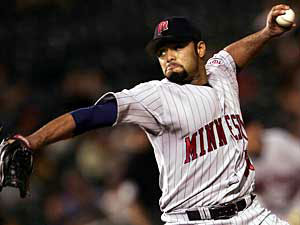 By resigning Mike Lowell and Curt Schilling the Red Sox drew a line in the sand. (I don't know, maybe winning the World Series had something to do with it as well.) They are the team to beat, not only in their own division, but in the whole American League. Every significant contributor from the 2007 Championship team has been signed for 2008, except Mike Timlin. Timlin is a valuable bullpen arm, even at age 42, but if the Red Sox decide to part ways with him permanently, it won't leave a gaping hole. Not in a bullpen that includes Jonathan Papelbon, Manny Delcarmon, Hideki Okajima, Javier Lopez, Brendon Donnelly, and Julian Tavarez. Timlin might even be seen as superfluous, with Craig Hansen, Kyle Snyder, and Devern Hansack also ready for the bigs.
As that list of relief arms suggests, not only has Boston filled the 2008 roster, they have an abundance in almost every area. Assuming Josh Beckett, Daisuke Matsuzake, and Curt Schilling are certain members of the rotation, that leaves two spots for the quartet of Clay Bucholz, Jon Lester, Tim Wakefield, and Kason Gabbard. Although they picked up his option, it isn't unlikely that 17-game-winner Wakefield may be headed back to the bullpen as a swingman and long reliever. Also, since Jacoby Ellsbury took over the starting job in centerfield during the playoffs, Coco Crisp is currently the most over-qualified fourth outfielder in baseball, joined by Brandon Moss, a young left-handed power hitter who fits the Boston mold and, at 24, after smacking 59 extra base hits in 500 AAA at-bats in 2007, appears ready for his shot in the show. The only real question mark for the Red Sox is whether they can depend on Julio Lugo as the shortstop after he abysmal showing, offensively and defensively, during the first year of his contract. Thankfully, if he starts '08 the way he started '07, they won't have to put up with it for long. Prospect Jed Lowrie was the Red Sox' Minor League Player of the Year in '07, posting an 896 OPS between AA and AAA, and sluggling above .500 at each level. Unless they deal him to Minnesota as part of a package for Johan Santana, I expect Lowrie to supplant Lugo (or, possibly, Pedroia, if he suffers a sophomore slump) sometime during the 2008 season.
While there is always a case to be made for adding a pitcher of Santana's ilk, by doing so the Red Sox would be significantly sacrificing their depth chart. Any deal would almost certainly include at least one of their young pitching studs, possibly more, and two players from the cheap, young quartet of Ellsbury, Lowrie, Pedroia, and Crisp. (ESPN is reporting the package as Lester, Crisp, and Lowrie.) A rotation featuring Santana, Beckett, Schilling, and Dice-K would be something to marvel at, but it would cost Boston the ability to compensate for injuries to position players. For a team that employs many mid-to-late-thirties veterans, selling off youth is a serious risk.
Ditto for the Yankees. According to the Times, they have officially made an offer to the Twins (an offer which does not include Joba Chamberlain). I would bet that it is comprised of some configuration of Robinson Cano, Melky Cabrera, Phil Hughes, Ian Kennedy, Shelley Duncan, Eric Duncan, and Wilson Betemit. Again, alongside Chamberlain and Chen-Ming Wang, Santana would headline a very imposing rotation. But, he would be among the first to attest that there is a sizable difference between having Melky Cabrera as your everyday centerfielder or Johnny Damon. The Yankees have finally stockpiled enough quality prospects to prevent them from having to overpay for half a dozen free agents every winter. It would be a mistake to mortgage that surplus for another veteran whose demands will likely exceed $150 Million. They were younger and more defensively sound in the Bronx during the second half of 2008. It seemed to work.
Which brings us, naturally, to the Minnesota Twins. As an organization they have been, throughout the reign of Terry Ryan, vigilant in retaining players which provide depth, especially for their pitching staff. I don't expect that to change drastically as Ryan makes way for protege, Bill Smith. The Twins seem ready for action this offseason, prepared to part ways with three high-profile players: Torii Hunter, Johan Santana, and Joe Nathan. It remains to be seen whether Santana and Nathan will get dealt. But, it appears to be a legitimate possibility, as the Yankees and Red Sox have already publicized offers. Whatever happens, don't mistake Minnesota's willingness to part with a few stars as the beginning of a long rebuilding process. Popular superstars, Justin Morneau and Joe Mauer, have two and three years left on their contracts, respectively, so the Twins will be looking to make a serious run at a championship sometime in the next two years. Such a run will mean supplanting Cleveland and Detroit atop the AL Central, neither of whom show signs of impending decline. As such, the Twins realize that they must be willing to sacrifice domination at a few positions for solidity throughout the roster.
Going into the offseason, Minnesota had glaring question marks at second base, third base, left field, center field, and designated hitter. With the two trades they've already made, acquiring Craig Monroe from the Cubs and trading Matt Garza and Jason Bartlett to the Devil Rays for Delmon Young and Brendan Harris, they addressed a couple of those positions. They could afford to trade Garza because they assume that Francisco Liriano will be recovered in time to replace him in the rotation on opening day. If the season were to start tomorrow, it seems likely that Monroe would be the everyday leftfielder and Young would play center, while Harris would replace Bartlett at short. Offensively, I expect that Young will be the equal of Torii Hunter as soon as 2009. However, while he has great speed and a strong arm, he is much better suited to right than center, which is convenient since Micheal Cuddyer, the Twins' reigning rightfielder, is much better suited to left or DH. Similarly, while Brendan Harris is at least as good with the bat as Jason Bartlett, he is defensively better suited for second or third, rather than shortstop. Craig Monroe is a career .304 hitter at the Metrodome, and has an 814 career OPS against lefthanders. He is a very decent defensive leftfielder. I imagine the Twins see him as the righthanded side of a platoon with Jason Kubel, with the ability to spell their other outfielders and hit off the bench.
I would guess that the depth chart in Bill Smith's office looks something like this:
C - Mauer
1B - Morneau
2B - Harris
3B - ?
SS - ?
LF - Kubel/Monroe
CF - ?
RF - Young
DH - Cuddyer
SP - Santana (?), Liriano, Bonser, Baker, Slowey, Perkins (?)
RP - Nathan (?), Neshek, Rincon, Guerrier, Crain, Reyes
IF - Casilla, Punto, Redmond
OF - Tyner
The Twins have some flexibility in the infield. Harris showed considerable offensive promise as a rookie in '07, hitting .286 with a 777 OPS and 12 HR and 59 RBI in 137 games with Tampa Bay, while playing respectable defense at second and thrid. Alexi Casilla struggled at the plate and in the field after replacing Luis Castillo at the end of 2007. But, he did steal eleven bases in twelve attempts, and his minor league numbers suggest he could develop into a solid lead-off hitter who plays mediocre defense at second or short. Punto provides outstanding defense at all three infield positions, but had the worst OPS of any major-leaguer in 2007, by a long shot (Punto: 562, Kendall (2nd Worst): 610). The Twins would definitely benefit most from adding a shortstop, but if none were available (for the right price), they could settle for solid offensive contributor who plays second or third.
Any package for Santana needs to include, at the minimum, a young, but major-league ready starting pitcher, a strong defensive centerfielder, and a promising infielder. Both Boston and New York have the first two pieces: Lester and Crisp from the Red Sox, Hughes and Cabrera from the Yankees. Hughes and Lester are essentially a draw in terms of quality. And, while Cabrera is probably the superior value compared to Crisp, Lowrie is likely to be the difference. He would be a Rookie of the Year candidate playing a critical position. The best the Yankees can offer is Wilson Betemit, who hasn't shown the ability to play short in the big leagues and has been an inconsistent hitter with stints in Atlanta, Los Angeles, and New York, all by the age of 25. Betemit could still turn into the superstar he was once predicted to be, but New York's best chance of beating out Boston in the Santana sweepstakes is to sweeten the offer with one of the Duncans, who could fit into the Twins' LF/DH mix. But, as I suggested earlier, a 4-for-1 swap does serious damage to a Yankees' depth.
Perhaps other teams will join the fray as the winter meetings get underway. Only a few can cobble together the pieces that would be required (including the $150 Million to sign Santana long term). The Mets are certainly interested, but by dealing Lastings Milledge to Washington, the let go of one of their best bargaining chips. They still have a couple of solid outfield prospects in Ben Johnson and Carlos Gomez. They've got major-league ready starters in Philip Humber and Mike Pelfrey (though neither is the equal of Hughes and Lester). And they have a young switch-hitting middle infielder named Anderson Hernandez. But, while the pieces are there, they would have to improve upon them in some way to beat out the Red Sox and Yankees. Would they be willing to part with John Maine?
The Dodgers, who have not been mentioned in Santana discussions, may be the darkhorse candidate. They have an abundance of young big-leaguers. Matt Kemp and Delwyn Young (Delmon's brother) can both play center field. Andy LaRoche, Tony Abreu, and Chin-Lung Hu are promising infielders (Hu is a shortstop). And, Clayton Kershaw, Chad Billingsley, and Hong-Chih Kuo are major-league ready starters. Los Angeles appears ready to deal some of their youth because they are log-jammed at several positions, but their most desperate need is a power bat. But if they fail to reel in Miguel Cabrera, they may turn their attentions elsewhere.
If Bill Smith does deal Santana, it is likely that Joe Nathan will follow, with Pat Neshek or Juan Rincon taking over closing duties in Minnesota. With Nathan as the centerpiece, Smith could craft a package to pursue a veteran like Scott Rolen (a third part would be necessary) or Miguel Tejada. Or, he could fleece a team desperate for a closer (Mikwaukee? Texas?) for several prospects and important role players.
By Opening Day 2008, I expect the Minnesota Twins will be completely redesigned. They have relied on pitching and defense in recent years. By no means do I expect them to forget the importance of either, but they will be supporting their young, promising rotation with a deep, potent lineup. Even now, the core of Mauer, Cuddyer, Morneau, and Young is nothing to scoff at. In 2009 it may be considered as good or better than the impressive quartets in Cleveland and Detroit.
Subscribe to:
Posts (Atom)