Due to my hectic summer, I haven't made an S.S.S. update for several months, but with one of the game's most prominent pitchers, Johan Santana, going under the knife, I thought it was probably an appropriate time to renew our discussion. (To track how this all began, you can go here.)
I'm going to start with the good news.
The 2010 poster-child for shoulder rehabilitation has to be Ted Lilly. Lilly was back on a major-league mound approximately seven months after having his "frayed labrum" repaired and before long he was again among the most dependent, durable, and underrated pitchers in the National League. His record for 2010 is just 8-11, due in large part to playing on a pair of teams (Cubs & Dodgers) which seem to be coming apart at the seems. Lilly's overall numbers are solid (3.83 ERA, 1.10 WHIP, 141 K, 172 IP) and very similar to what he posted immediately preceding the operation (3.10 ERA, 1.06 WHIP, 151 K, 177 IP). Lilly may be showing a little fatigue. He began his tenure with the Dodgers by winning his first five starts, but is 0-3 with a 7.47 ERA in his last four. One could speculate that this is a result of a diminished strength-building routine following the surgery last offseason, but it could also merely be the result of natural tendency towards indifference bred of being a veteran on a team that no longer has a shot at the postseason. This rough stretch aside, however, Lilly has done plenty to prove that the injury should not effect his bargaining position when he hits the free agent market this winter.
There have also been positive developments from Jeremy Bonderman. Bonderman missed well over a year following his surgery, in part because he re-injured the shoulder trying to make too quick a return. A note of caution to Santana and the Mets: Bonderman's injury was not unlike that which Johan recently suffered and, in general, there is a tendency toward re-injury following these surgeries. Bonderman struggled getting back into sync following his long layoff, posting a 6.97 ERA in April, but has steadily improved over the course of the season. Since May 1, he's 7-8 with a 4.75 ERA. That's still a far cry from the pitcher who helped the Tigers get to the World Series a few years back, but there have been glimpses of that former glory. Last week he shut down the White Sox for eight innings, allowing only three hits and striking out eight. Perhaps this is a flash of what we can expect from a fully recovered Bonderman in 2011? If not, he has still proven himself to be capable of being a back-of-the-rotation innings-eater.
Freddy Garcia played a similar role for the White Sox this season, his first full year since having his labrum repaired way back in 2007. Garcia posted a strong record, 11-6, for the ChiSox, but with modest overall numbers (4.88 ERA, 1.43 WHIP, 83 K, 144 IP) before being shut down earlier this month due to an unrelated back injury. It's apparent that, at 36, Garcia will never be the Ace he was earlier in his career, but he did manage sixteen quality starts (62%) in 2010. You might be surprised to find that's more than All-Stars like Johnny Cueto, Yovani Gallardo, Andy Pettitte, and Phil Hughes.
Nagging injuries were a prevalent issue for our survey participants, perhaps no surprise considering the long period spent away from the game following their operations. Not only could it effect their endurance, but also potentially their mechanics. Reports out of Colorado this preseason suggested that Jeff Francis was having to completely relearn his delivery. Francis continued to feel "tightness" in his pitching shoulder even after his return in mid-May, which forced him back to the D.L. after about half a season of work. In his 17 starts he has been, much like Bonderman and Garcia, respectable but unspectacular (4-5, 4.61 ERA, 1.29 WHIP, 61 K, 96 IP). He's mixed in a couple of gems (for instance, seven innings of three-hit ball against Florida in July), but also failed to get past the third inning on two occasions. The Rockies are expecting him to take over Aaron Cook's spot in the rotation for the next two weeks. We'll see whether he can rise to the occasion following a month of rest.
Sadly, considering how modest these results are, that's the end of the "good" news. Of the eight players we began tracking at the beginning of the season, only these four managed to make it back to the mound in 2010. The Mariners were cautiously optimistic that Erik Bedard would be ready by the All-Star Break, but he also fell victim to the urgency of his rehab and ended up having a "setback" which resulted in yet another surgery, this time to remove a bone spur. As yet, there's still no timetable for his return. The same can be said of Brandon Webb and Chien-Ming Wang, two other former All-Stars who may never fully recover from their injuries. Webb is tentatively hoping to make a couple of relief appearances before the end of the season, but the D-Backs have been slow to confirm that report. Having now missed almost two full seasons, it is impossible to predict what the former Cy Young winner will look like if he is indeed ready for Opening Day in 2011. The future of Wang, the former Yankee Ace, is even more uncertain. Same for Dustin McGowan, the promising young Blue Jays starter, who also had an additional surgery in June and is unlikely to be ready in time for Opening Day 2011.
All told, that's a pretty dismal picture of Johan's prospects. Of these eight pitchers, seven of them missed a season or more rehabbing after surgery. Of the four who have made it back to the mound, only one has come anywhere near his previous level of effectiveness. While Santana isn't dealing with major labrum or rotator cuff repairs, the "torn capsule" is the same thing which Bonderman and Wang were treated for, and both missed well over a season. It would be wise, based on this track record, if the Mets reconsidered their intentions of trying to have him ready in the first half of 2011. That seems fairly far-fetched. And, as we saw with several of these cases, the urgency to return can actually prolong and exacerbate the injury, even to the point to requiring additional surgery. I would not expect Santana to be ready before August of next year. Even then it is unlikely he will immediately pitch like an Ace. Unfortunately, he may never again look like the perennial Cy Young candidate we've come to expect.

Showing posts with label Johan Santana. Show all posts
Showing posts with label Johan Santana. Show all posts
Saturday, September 18, 2010


Sunday, March 07, 2010
21st-Century Cy
Not every year does a relatively unheralded pitcher come, as though from out of nowhere, to win his profession's most prestigious award. It has happened, however, in each of the last two seasons, and seven times in the last decade (during which, of course, twenty Cy Youngs have been awarded.)
Way back in 2002, a 24-year-old Barry Zito won 23 games in what has proved to be the best season of his career. The season prior to it he had been very good (17-8, 3.49 ERA), but certainly not superlative, and going into '02 he was still considered the #3 starter on his own team.
In 2004, Johan Santana "arrived." Although his arm had been gaining him notoriety for a couple years, he had spent most of his career prior to '04 in the bullpen. That year, however, he made 34 starts, won 20 of them, and led the league in strikeouts (265) and ERA (2.61).
The very next year, a 30-year-old Chris Carpenter, after seven seasons floundering with the Blue Jays and struggling with injuries and control, suddenly became one of the best pitchers in baseball, going 21-5 with a 2.83 ERA in his second year under the tutelage of Dave Duncan in St. Louis.
There was another first-time Cy Young vote-getter in 2006, when Brandon Webb won the award with his 16 wins and 3.10 ERA.
And, most recently, as you will remember, Cliff Lee and Zack Greinke finished their somewhat unlikely ascents to the top of the American League, and Tim Lincecum won the NL version of the award in his first full season in the majors in '08.
So, who's going to be the next unexpected Cy? Here are some criteria for making the prediction. With the exception of Cliff Lee, none of the pitchers discussed above had placed in the Cy Young voting prior to the year they won it, but all were coming off pretty solid seasons, in which they won at least 12 games and had an ERA lower than 3.80 (Lincecum didn't get enough starts to meet this criteria in his rookie year, but in all likelihood he would've easily matched it).
Although Lee had a notoriously bad run in '06 and '07, he had previously logged three seasons with 14 or more wins and finished as high as fourth in Cy Young voting in 2005. So, what I'm looking for primarily, is a player who won 12-15 games in '09 and posted an ERA between 3.50 and 4.00 with some positive trends in his other numbers.
I'm also looking for somebody in their mid-twenties who was, at one point or another, even if it was five or six years ago, considered a top prospect. Four of my seven Cys were first-round picks and Santana certainly would have been (he signed as an amateur free agent out of Venezuela). Five won the award for the first time between the ages of 24 and 27, while Lee won it at 29 and Carpenter was 30. With those factors in mind, here are the top candidates:
Way back in 2002, a 24-year-old Barry Zito won 23 games in what has proved to be the best season of his career. The season prior to it he had been very good (17-8, 3.49 ERA), but certainly not superlative, and going into '02 he was still considered the #3 starter on his own team.
In 2004, Johan Santana "arrived." Although his arm had been gaining him notoriety for a couple years, he had spent most of his career prior to '04 in the bullpen. That year, however, he made 34 starts, won 20 of them, and led the league in strikeouts (265) and ERA (2.61).
The very next year, a 30-year-old Chris Carpenter, after seven seasons floundering with the Blue Jays and struggling with injuries and control, suddenly became one of the best pitchers in baseball, going 21-5 with a 2.83 ERA in his second year under the tutelage of Dave Duncan in St. Louis.
There was another first-time Cy Young vote-getter in 2006, when Brandon Webb won the award with his 16 wins and 3.10 ERA.
And, most recently, as you will remember, Cliff Lee and Zack Greinke finished their somewhat unlikely ascents to the top of the American League, and Tim Lincecum won the NL version of the award in his first full season in the majors in '08.
So, who's going to be the next unexpected Cy? Here are some criteria for making the prediction. With the exception of Cliff Lee, none of the pitchers discussed above had placed in the Cy Young voting prior to the year they won it, but all were coming off pretty solid seasons, in which they won at least 12 games and had an ERA lower than 3.80 (Lincecum didn't get enough starts to meet this criteria in his rookie year, but in all likelihood he would've easily matched it).
Although Lee had a notoriously bad run in '06 and '07, he had previously logged three seasons with 14 or more wins and finished as high as fourth in Cy Young voting in 2005. So, what I'm looking for primarily, is a player who won 12-15 games in '09 and posted an ERA between 3.50 and 4.00 with some positive trends in his other numbers.
I'm also looking for somebody in their mid-twenties who was, at one point or another, even if it was five or six years ago, considered a top prospect. Four of my seven Cys were first-round picks and Santana certainly would have been (he signed as an amateur free agent out of Venezuela). Five won the award for the first time between the ages of 24 and 27, while Lee won it at 29 and Carpenter was 30. With those factors in mind, here are the top candidates:
Wednesday, December 30, 2009
Jason Bay v. Cynicism
It has been reported that the Mets are on the verge of signing a long-term contract with Jason Bay, the left-fielder, most recently of the Red Sox, who is probably most famous as the guy who Manny Ramirez got traded for. New York has reportedly given Bay $66 Million over four years, with a vesting option which could add a fifth year at $14 Million.
So, while Bay will not become baseball's 20th Hundred Million Dollar Man (if recent reports are accurate, that title will fall to Matt Holliday), if the fifth year vests, his contract would be among the largest dozen or so ever given to an outfielder, just behind Torii Hunter (5 yr./$90 Mil.) and just ahead of J. D. Drew (5 yr./$70 Mil.).
Several commentators, including a fair number of Mets fans, have criticized the Bay signing. Rob Neyer calls Bay a "slow power hitter who can't really play the outfield." And while I'm usually prone to agree with Rob and I share his skepticism to some extent, I'm generally quite surprised by all the negativity. Jason Bay, it would appear to me, is the kind of guy who deserves to get paid. In six full seasons, he has never played less than 120 games. Four times he's topped 30 HR and 100 RBI. In only one season (2007) did his OPS dip below 895. He's soft-spoken and popular with his teammates. When he came over to Boston, in the middle of a highly-scrutinized pennant race, replacing one of the best players in the franchise's history, he really rose to the occasion, hitting .315 with 29 RBI in his first month with the team. What's not to like?
Well, there is the question of his "slowness." Early in his career Bay was a 20/20 man, who even played a little centerfield, but a knee surgery in 2006 has limited him somewhat. It shouldn't go unnoticed, however, that Bay is still a smart and effective baserunner. He stole ten bases in '08 without being caught and thirteen in '09 (only being caught three times), bringing his career stolen base rate to an admirable 82.5%. He may not be a burner, but this isn't exactly Paul Konerko either.
Bay's defense is also considered a liability, and there is more substantial proof to that effect. He's always had a noodle arm, but in recent years his overall outfield performance has really gone in the tank. In his first three years with the Pirates, his UZR stayed right around the league average, perfectly acceptable for a hitter of his quality, but from '07 to '09 he has posted Ultimate Zone Ratings of -11.5, -18.4, and -13.0. Pure faith in UZR would probably lead us to rank him as quite possibly the worst everyday left-fielders in all of baseball, and left field isn't exactly a position known for defense. Of course, for half of that time he was playing left field at Fenway, which is probably the single most abnormal positional space in the whole league, so I think we have to question the reliability of his recent defensive metrics. Is he a Gold-Glover? Absolutely not. Is he as bad as Adam Dunn or Raul Ibanez? I sincerely doubt it.
Buster Olney sagely points out that last year the Mets primary left-fielders were Gary Sheffield and Daniel Murphy, neither of whom will probably ever play the position again, so Jason Bay is a considerable upgrade. The Mets other outfielders, Carlos Betran and Jeff Francoeur, are both excellent defenders (especially Beltran), which should compensate slightly for whatever range Bay lacks.
In the same column, Olney carefully analyzes Bay's homers from '09 on Hit Tracker, responding to the other major criticism against Bay, that his power won't translate to spacious Citi Field. He concludes that Bay would've still hit 30 HR as a Met, rather than the 36 he hit as a Red Sock (sp?). I think the Mets would be perfectly happy with that total.
Last week I argued that the Mets best course of action this offseason was to "stand pat," rather than pursue expensive free agents like Bay and Joel Pineiro. I knew they wouldn't go that route, but I thought it made for a nice hypothetical. I still don't think they have the firepower to catch the Phillies, because even if they follow the Bay signing with the acquisition of Pineiro, Ben Sheets, or Erik Bedard, they won't have the rotational depth of a serious contender. In the end, regardless of the what the Mets do for the remainder of the offseason, they are going to need everything to go right in 2010 if they are even to have a shot at the Wild Card in a division which features the powerhouse Phillies and two other solid franchises, the Braves and the Marlins.
Whether or not New York gets the resurgence of power they expect from Bay and David Wright (who hit only 10 HR in '09) is dependent mainly on the health of Carlos Beltran (81 games in '09) and Jose Reyes (36 games in '09). If both are fully healthy, than the Mets lineup looks like something to be reckoned with. If not, than Bay and Wright will be consistently pitched around, just as Wright and Sheffield were in '09, and the run-scoring will slow to a trickle. Even more important is the health of Johan Santana, who missed the final six weeks of '09 with an elbow injury which required surgery. If the Mets have to enter next season without their horse, the season will be over before it begins.
Friday, November 30, 2007
The Depth Chart II: Johan Santana Edition
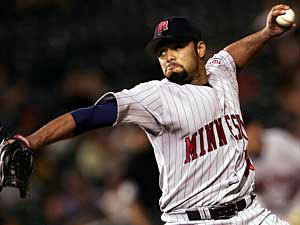 By resigning Mike Lowell and Curt Schilling the Red Sox drew a line in the sand. (I don't know, maybe winning the World Series had something to do with it as well.) They are the team to beat, not only in their own division, but in the whole American League. Every significant contributor from the 2007 Championship team has been signed for 2008, except Mike Timlin. Timlin is a valuable bullpen arm, even at age 42, but if the Red Sox decide to part ways with him permanently, it won't leave a gaping hole. Not in a bullpen that includes Jonathan Papelbon, Manny Delcarmon, Hideki Okajima, Javier Lopez, Brendon Donnelly, and Julian Tavarez. Timlin might even be seen as superfluous, with Craig Hansen, Kyle Snyder, and Devern Hansack also ready for the bigs.
As that list of relief arms suggests, not only has Boston filled the 2008 roster, they have an abundance in almost every area. Assuming Josh Beckett, Daisuke Matsuzake, and Curt Schilling are certain members of the rotation, that leaves two spots for the quartet of Clay Bucholz, Jon Lester, Tim Wakefield, and Kason Gabbard. Although they picked up his option, it isn't unlikely that 17-game-winner Wakefield may be headed back to the bullpen as a swingman and long reliever. Also, since Jacoby Ellsbury took over the starting job in centerfield during the playoffs, Coco Crisp is currently the most over-qualified fourth outfielder in baseball, joined by Brandon Moss, a young left-handed power hitter who fits the Boston mold and, at 24, after smacking 59 extra base hits in 500 AAA at-bats in 2007, appears ready for his shot in the show. The only real question mark for the Red Sox is whether they can depend on Julio Lugo as the shortstop after he abysmal showing, offensively and defensively, during the first year of his contract. Thankfully, if he starts '08 the way he started '07, they won't have to put up with it for long. Prospect Jed Lowrie was the Red Sox' Minor League Player of the Year in '07, posting an 896 OPS between AA and AAA, and sluggling above .500 at each level. Unless they deal him to Minnesota as part of a package for Johan Santana, I expect Lowrie to supplant Lugo (or, possibly, Pedroia, if he suffers a sophomore slump) sometime during the 2008 season.
While there is always a case to be made for adding a pitcher of Santana's ilk, by doing so the Red Sox would be significantly sacrificing their depth chart. Any deal would almost certainly include at least one of their young pitching studs, possibly more, and two players from the cheap, young quartet of Ellsbury, Lowrie, Pedroia, and Crisp. (ESPN is reporting the package as Lester, Crisp, and Lowrie.) A rotation featuring Santana, Beckett, Schilling, and Dice-K would be something to marvel at, but it would cost Boston the ability to compensate for injuries to position players. For a team that employs many mid-to-late-thirties veterans, selling off youth is a serious risk.
Ditto for the Yankees. According to the Times, they have officially made an offer to the Twins (an offer which does not include Joba Chamberlain). I would bet that it is comprised of some configuration of Robinson Cano, Melky Cabrera, Phil Hughes, Ian Kennedy, Shelley Duncan, Eric Duncan, and Wilson Betemit. Again, alongside Chamberlain and Chen-Ming Wang, Santana would headline a very imposing rotation. But, he would be among the first to attest that there is a sizable difference between having Melky Cabrera as your everyday centerfielder or Johnny Damon. The Yankees have finally stockpiled enough quality prospects to prevent them from having to overpay for half a dozen free agents every winter. It would be a mistake to mortgage that surplus for another veteran whose demands will likely exceed $150 Million. They were younger and more defensively sound in the Bronx during the second half of 2008. It seemed to work.
Which brings us, naturally, to the Minnesota Twins. As an organization they have been, throughout the reign of Terry Ryan, vigilant in retaining players which provide depth, especially for their pitching staff. I don't expect that to change drastically as Ryan makes way for protege, Bill Smith. The Twins seem ready for action this offseason, prepared to part ways with three high-profile players: Torii Hunter, Johan Santana, and Joe Nathan. It remains to be seen whether Santana and Nathan will get dealt. But, it appears to be a legitimate possibility, as the Yankees and Red Sox have already publicized offers. Whatever happens, don't mistake Minnesota's willingness to part with a few stars as the beginning of a long rebuilding process. Popular superstars, Justin Morneau and Joe Mauer, have two and three years left on their contracts, respectively, so the Twins will be looking to make a serious run at a championship sometime in the next two years. Such a run will mean supplanting Cleveland and Detroit atop the AL Central, neither of whom show signs of impending decline. As such, the Twins realize that they must be willing to sacrifice domination at a few positions for solidity throughout the roster.
Going into the offseason, Minnesota had glaring question marks at second base, third base, left field, center field, and designated hitter. With the two trades they've already made, acquiring Craig Monroe from the Cubs and trading Matt Garza and Jason Bartlett to the Devil Rays for Delmon Young and Brendan Harris, they addressed a couple of those positions. They could afford to trade Garza because they assume that Francisco Liriano will be recovered in time to replace him in the rotation on opening day. If the season were to start tomorrow, it seems likely that Monroe would be the everyday leftfielder and Young would play center, while Harris would replace Bartlett at short. Offensively, I expect that Young will be the equal of Torii Hunter as soon as 2009. However, while he has great speed and a strong arm, he is much better suited to right than center, which is convenient since Micheal Cuddyer, the Twins' reigning rightfielder, is much better suited to left or DH. Similarly, while Brendan Harris is at least as good with the bat as Jason Bartlett, he is defensively better suited for second or third, rather than shortstop. Craig Monroe is a career .304 hitter at the Metrodome, and has an 814 career OPS against lefthanders. He is a very decent defensive leftfielder. I imagine the Twins see him as the righthanded side of a platoon with Jason Kubel, with the ability to spell their other outfielders and hit off the bench.
I would guess that the depth chart in Bill Smith's office looks something like this:
C - Mauer
1B - Morneau
2B - Harris
3B - ?
SS - ?
LF - Kubel/Monroe
CF - ?
RF - Young
DH - Cuddyer
SP - Santana (?), Liriano, Bonser, Baker, Slowey, Perkins (?)
RP - Nathan (?), Neshek, Rincon, Guerrier, Crain, Reyes
IF - Casilla, Punto, Redmond
OF - Tyner
The Twins have some flexibility in the infield. Harris showed considerable offensive promise as a rookie in '07, hitting .286 with a 777 OPS and 12 HR and 59 RBI in 137 games with Tampa Bay, while playing respectable defense at second and thrid. Alexi Casilla struggled at the plate and in the field after replacing Luis Castillo at the end of 2007. But, he did steal eleven bases in twelve attempts, and his minor league numbers suggest he could develop into a solid lead-off hitter who plays mediocre defense at second or short. Punto provides outstanding defense at all three infield positions, but had the worst OPS of any major-leaguer in 2007, by a long shot (Punto: 562, Kendall (2nd Worst): 610). The Twins would definitely benefit most from adding a shortstop, but if none were available (for the right price), they could settle for solid offensive contributor who plays second or third.
Any package for Santana needs to include, at the minimum, a young, but major-league ready starting pitcher, a strong defensive centerfielder, and a promising infielder. Both Boston and New York have the first two pieces: Lester and Crisp from the Red Sox, Hughes and Cabrera from the Yankees. Hughes and Lester are essentially a draw in terms of quality. And, while Cabrera is probably the superior value compared to Crisp, Lowrie is likely to be the difference. He would be a Rookie of the Year candidate playing a critical position. The best the Yankees can offer is Wilson Betemit, who hasn't shown the ability to play short in the big leagues and has been an inconsistent hitter with stints in Atlanta, Los Angeles, and New York, all by the age of 25. Betemit could still turn into the superstar he was once predicted to be, but New York's best chance of beating out Boston in the Santana sweepstakes is to sweeten the offer with one of the Duncans, who could fit into the Twins' LF/DH mix. But, as I suggested earlier, a 4-for-1 swap does serious damage to a Yankees' depth.
Perhaps other teams will join the fray as the winter meetings get underway. Only a few can cobble together the pieces that would be required (including the $150 Million to sign Santana long term). The Mets are certainly interested, but by dealing Lastings Milledge to Washington, the let go of one of their best bargaining chips. They still have a couple of solid outfield prospects in Ben Johnson and Carlos Gomez. They've got major-league ready starters in Philip Humber and Mike Pelfrey (though neither is the equal of Hughes and Lester). And they have a young switch-hitting middle infielder named Anderson Hernandez. But, while the pieces are there, they would have to improve upon them in some way to beat out the Red Sox and Yankees. Would they be willing to part with John Maine?
The Dodgers, who have not been mentioned in Santana discussions, may be the darkhorse candidate. They have an abundance of young big-leaguers. Matt Kemp and Delwyn Young (Delmon's brother) can both play center field. Andy LaRoche, Tony Abreu, and Chin-Lung Hu are promising infielders (Hu is a shortstop). And, Clayton Kershaw, Chad Billingsley, and Hong-Chih Kuo are major-league ready starters. Los Angeles appears ready to deal some of their youth because they are log-jammed at several positions, but their most desperate need is a power bat. But if they fail to reel in Miguel Cabrera, they may turn their attentions elsewhere.
If Bill Smith does deal Santana, it is likely that Joe Nathan will follow, with Pat Neshek or Juan Rincon taking over closing duties in Minnesota. With Nathan as the centerpiece, Smith could craft a package to pursue a veteran like Scott Rolen (a third part would be necessary) or Miguel Tejada. Or, he could fleece a team desperate for a closer (Mikwaukee? Texas?) for several prospects and important role players.
By Opening Day 2008, I expect the Minnesota Twins will be completely redesigned. They have relied on pitching and defense in recent years. By no means do I expect them to forget the importance of either, but they will be supporting their young, promising rotation with a deep, potent lineup. Even now, the core of Mauer, Cuddyer, Morneau, and Young is nothing to scoff at. In 2009 it may be considered as good or better than the impressive quartets in Cleveland and Detroit.
Which brings us, naturally, to the Minnesota Twins. As an organization they have been, throughout the reign of Terry Ryan, vigilant in retaining players which provide depth, especially for their pitching staff. I don't expect that to change drastically as Ryan makes way for protege, Bill Smith. The Twins seem ready for action this offseason, prepared to part ways with three high-profile players: Torii Hunter, Johan Santana, and Joe Nathan. It remains to be seen whether Santana and Nathan will get dealt. But, it appears to be a legitimate possibility, as the Yankees and Red Sox have already publicized offers. Whatever happens, don't mistake Minnesota's willingness to part with a few stars as the beginning of a long rebuilding process. Popular superstars, Justin Morneau and Joe Mauer, have two and three years left on their contracts, respectively, so the Twins will be looking to make a serious run at a championship sometime in the next two years. Such a run will mean supplanting Cleveland and Detroit atop the AL Central, neither of whom show signs of impending decline. As such, the Twins realize that they must be willing to sacrifice domination at a few positions for solidity throughout the roster.
Going into the offseason, Minnesota had glaring question marks at second base, third base, left field, center field, and designated hitter. With the two trades they've already made, acquiring Craig Monroe from the Cubs and trading Matt Garza and Jason Bartlett to the Devil Rays for Delmon Young and Brendan Harris, they addressed a couple of those positions. They could afford to trade Garza because they assume that Francisco Liriano will be recovered in time to replace him in the rotation on opening day. If the season were to start tomorrow, it seems likely that Monroe would be the everyday leftfielder and Young would play center, while Harris would replace Bartlett at short. Offensively, I expect that Young will be the equal of Torii Hunter as soon as 2009. However, while he has great speed and a strong arm, he is much better suited to right than center, which is convenient since Micheal Cuddyer, the Twins' reigning rightfielder, is much better suited to left or DH. Similarly, while Brendan Harris is at least as good with the bat as Jason Bartlett, he is defensively better suited for second or third, rather than shortstop. Craig Monroe is a career .304 hitter at the Metrodome, and has an 814 career OPS against lefthanders. He is a very decent defensive leftfielder. I imagine the Twins see him as the righthanded side of a platoon with Jason Kubel, with the ability to spell their other outfielders and hit off the bench.
I would guess that the depth chart in Bill Smith's office looks something like this:
C - Mauer
1B - Morneau
2B - Harris
3B - ?
SS - ?
LF - Kubel/Monroe
CF - ?
RF - Young
DH - Cuddyer
SP - Santana (?), Liriano, Bonser, Baker, Slowey, Perkins (?)
RP - Nathan (?), Neshek, Rincon, Guerrier, Crain, Reyes
IF - Casilla, Punto, Redmond
OF - Tyner
The Twins have some flexibility in the infield. Harris showed considerable offensive promise as a rookie in '07, hitting .286 with a 777 OPS and 12 HR and 59 RBI in 137 games with Tampa Bay, while playing respectable defense at second and thrid. Alexi Casilla struggled at the plate and in the field after replacing Luis Castillo at the end of 2007. But, he did steal eleven bases in twelve attempts, and his minor league numbers suggest he could develop into a solid lead-off hitter who plays mediocre defense at second or short. Punto provides outstanding defense at all three infield positions, but had the worst OPS of any major-leaguer in 2007, by a long shot (Punto: 562, Kendall (2nd Worst): 610). The Twins would definitely benefit most from adding a shortstop, but if none were available (for the right price), they could settle for solid offensive contributor who plays second or third.
Any package for Santana needs to include, at the minimum, a young, but major-league ready starting pitcher, a strong defensive centerfielder, and a promising infielder. Both Boston and New York have the first two pieces: Lester and Crisp from the Red Sox, Hughes and Cabrera from the Yankees. Hughes and Lester are essentially a draw in terms of quality. And, while Cabrera is probably the superior value compared to Crisp, Lowrie is likely to be the difference. He would be a Rookie of the Year candidate playing a critical position. The best the Yankees can offer is Wilson Betemit, who hasn't shown the ability to play short in the big leagues and has been an inconsistent hitter with stints in Atlanta, Los Angeles, and New York, all by the age of 25. Betemit could still turn into the superstar he was once predicted to be, but New York's best chance of beating out Boston in the Santana sweepstakes is to sweeten the offer with one of the Duncans, who could fit into the Twins' LF/DH mix. But, as I suggested earlier, a 4-for-1 swap does serious damage to a Yankees' depth.
Perhaps other teams will join the fray as the winter meetings get underway. Only a few can cobble together the pieces that would be required (including the $150 Million to sign Santana long term). The Mets are certainly interested, but by dealing Lastings Milledge to Washington, the let go of one of their best bargaining chips. They still have a couple of solid outfield prospects in Ben Johnson and Carlos Gomez. They've got major-league ready starters in Philip Humber and Mike Pelfrey (though neither is the equal of Hughes and Lester). And they have a young switch-hitting middle infielder named Anderson Hernandez. But, while the pieces are there, they would have to improve upon them in some way to beat out the Red Sox and Yankees. Would they be willing to part with John Maine?
The Dodgers, who have not been mentioned in Santana discussions, may be the darkhorse candidate. They have an abundance of young big-leaguers. Matt Kemp and Delwyn Young (Delmon's brother) can both play center field. Andy LaRoche, Tony Abreu, and Chin-Lung Hu are promising infielders (Hu is a shortstop). And, Clayton Kershaw, Chad Billingsley, and Hong-Chih Kuo are major-league ready starters. Los Angeles appears ready to deal some of their youth because they are log-jammed at several positions, but their most desperate need is a power bat. But if they fail to reel in Miguel Cabrera, they may turn their attentions elsewhere.
If Bill Smith does deal Santana, it is likely that Joe Nathan will follow, with Pat Neshek or Juan Rincon taking over closing duties in Minnesota. With Nathan as the centerpiece, Smith could craft a package to pursue a veteran like Scott Rolen (a third part would be necessary) or Miguel Tejada. Or, he could fleece a team desperate for a closer (Mikwaukee? Texas?) for several prospects and important role players.
By Opening Day 2008, I expect the Minnesota Twins will be completely redesigned. They have relied on pitching and defense in recent years. By no means do I expect them to forget the importance of either, but they will be supporting their young, promising rotation with a deep, potent lineup. Even now, the core of Mauer, Cuddyer, Morneau, and Young is nothing to scoff at. In 2009 it may be considered as good or better than the impressive quartets in Cleveland and Detroit.
Subscribe to:
Posts (Atom)