It's very early in the offseason to be evaluating the prospects of next year's teams. Despite the weakness of the free agent class, almost every franchise will sign a contributer before the beginning of next season. And, with the potential availability of such superstars as Johan Santana, Miguel Cabrera, and Miguel Tejada, there are likely to be numerous trades as well.
But, despite the likelihood of roster fluctuation well into 2008, some teams are clearly in better shape than others. As I discussed prior to last season, I believe that success over the course of the grueling major-league season is less about the quality of the opening day lineup and rotation, and more about a franchise's preponderance of practical replacements when those players suffer from injuries or unexpectedly poor production.
I'm not saying that teams which lack depth never make it to the postseason. Often they do, but it usually requires a tremendous run of good luck. The White Sox had it when they had four starters pitch upward of 200 innings in 2005. The Giants had it when they had five players 34 and older play 140 games or more in 2002, plus a 37-year-old Catcher who made 126 starts. And, Colorado had it this year when they won 21 of 22 in late September and early October, facing elimination on a daily basis. Teams like these make it thanks to tremendous play and consistently good breaks. Teams with depth can make it in spite of the breaks.
Based on their depth, I predicted that Detroit and Cleveland would be the two best teams in the majors in 2007. While neither proved to be the equal to the Red Sox, both were among the best teams in the AL, Cleveland finishing one win short of the World Series and Detroit winning 88 games, the best record any club falling short of the playoffs. They were able to succeed to they extent that they did largely because of their depth.
The bullpen which had been the strength of Detroit's AL Championship team in '06 was decimated by injuries to flame-throwing middle-relievers Joel Zumaya and Fernando Rodney. Certainly, those two are irreplaceable, unless you've got the capability of acquiring Billy Wagner and Brad Lidge midseason. However, Jim Leyland was able to look to the trio of Bobby Seay, Tim Byrdak, and Zach Miner to soften the blow. Between them, they threw 145 innings, accumulated 27 holds, and a 2.86 ERA. They solidified a bullpen that was almost exactly league-average:
Detroit Bullpen: 4.37 ERA, 26 W, 44 SV, 515 IP, 736 vOPS
AL Average Bullpen: 4.30 ERA, 24 W, 40 SV. 493 IP, 732 vOPS
Ask Ozzie Guillen of the White Sox or Sam Perlozzo, formerly of the Orioles, if they would have been happy with a league-average bullpen? Each of them suffered from a similar rash of injuries to their relief corps in 'o7, and finished with bullpen ERAs of 5.47 and 5.71 respectively.
In Cleveland, it was depth which saved their rotation. Their Opening Day rotation was C. C. Sabathia, Cliff Lee, Jake Westbrook, Jeremy Sowers, and Paul Byrd. Only Sabathia and Byrd made more than 25 starts. Westbrook missed much of the first half with an injury, and Sowers and Lee struggled so mightily that they were both demoted to AAA for significant portions of the season, neither making more than 16 big-league starts, and both finished with ERAs above 6.00. Luckily for the Indians, they had Fausto Carmona waiting for just such an opportunity. He joined the rotation in the middle of April, lost his first two appearances, and then with 19-6 the rest of the way, finishing 4th in Cy Young voting. They also got a modestly impressive late-season run from Aaron Laffey, who went 4-2 with a 4.56 ERA in nine starts. They were never even tempted to promote their 22-year-old future-stud, Adam Miller. Despite 29 dismal starts from Lee and Sowers, Cleveland had a league-leading 4.19 Starter's ERA.
Although I didn't think they'd be the equal of Cleveland and Detroit, Boston also entered 2007 with an impressive depth chart. It proved critical for them when Curt Schilling and Jon Lester were vacant from the rotation for extended spells, and when Manny Ramirez and J.D. Drew made somewhat predictable trips to the D.L. Jacoby Ellsbury is the most obvious example, with his 926 OPS in September and his 949 OPS in October. But, former Rookie of the Year, Eric Hinske, pounded out 21 extra-base hits and a respectable 714 OPS in limited playing time, fielded three different position admirably, and, most importantly, hit .286 with a 933 OPS in games that he filled in for Manny Ramirez in left field.
Depth is not something which can be accumulated in a single offseason, which is why it is one factor that can be realistically evaluated in November. Look at your team. How many critical holes do they have to fill? Do they have any reasonable options available within the organization? Does the loss of any one player cripple the lineup or rotation? Perhaps, more importantly, look up and down the division. How many significant question marks do your competitors have to address by comparison. Before the Hot Stove League get really rolling at the winter meeting, I hope to address which teams come to Orlando with significant advantages thanks to depth within their own systems. Some of them are predictable. Others might surprise you.

Monday, November 19, 2007


Tuesday, November 13, 2007
Where'd have all the Cubbies gone?
 In two weeks, the Chicago Cubs have gone from having an excess of veteran outfielders to a shortage. When the regular season ended, the Cubs forty-man roster included Alfonso Soriano, Jacque Jones, Cliff Floyd, Craig Monroe, and Daryle Ward, all over the age of 30. In the last week, however, they declined Floyd's option for 2008, dealt Jones (a former Twin) to the Tigers, and Monroe (a former Tiger) to the Twins. Obviously Soriano isn't going anywhere and Chicago picked up an option on Ward, who performed quite admirably as a pinch-hitter/utilityman in 2007. But Ward is not a everyday player, so we must assume that either the Cubs are ready to entrust outfield duties to Sam Fuld and Felix Pie, or they are gearing up to make some sort of free agent splash. What the Cubs need is a productive left-handed bat (Soriano, Derrek Lee, and Aramis Ramirez provide an abundance of right-handed power). The only premier left-handed hitting outfielder on the market this offseason is Kosuke Fukudome. Steve Stone has been predicting the Cubs interest in Fukudome for several weeks. It appears they are setting themselves up to make a run on him.
This makes sense for several reasons besides its potential effects on Lou Pinella's lineup. Forbes ranks the Cubs as the fifth most valuable franchise in baseball. Of those top five, they are the only team which hasn't tried their luck with the Japanese market. The Yankees (Hideki Matsui), Mets (Kazuo Matsui), Red Sox (Daisuke Matsuzake), and Dodgers (Takashi Saito, Hideo Nomo) have all made major Japanese acquisitions. And, for all but the Mets, the payoffs have been positive, both on the field and in the marketing department. If they can attract Fukudome, it will open up new revenue streams, which can't hurt the impending sale of the team by the Tribune Company. Following Boston's lead (not a bad idea), they may attempt to import a pair of Japanese stars. Hiroki Kuroda could fit into the back-end of the Cubs rotation (where Jason Marquis and Sean Marshall remain question marks) and provide a friendly face to aid Fukudome's transition process. Another option might be signing one of the two Japanese free agents who are already acclimated to the American game, Kazuo Matsui and Tadahito Iguchi. Unfortunately, both are middle-infielders, and might shy away from splitting time with Mark DeRosa, Ryan Theriot, and Omar Infante.
Although he is likely to be very expensive, I expect the Cubs to make a concerted run on Fukudome. If for no other reason than that the other left-handed outfielders on the market leave much to be desired. Milton Bradley could be a real deal. He's a switch-hitter who hit above .300 from both sides of the plate in '07, with a high OBP, low strikeout rate, and good range in the outfield, but his history of injuries and surliness might be a little too reminiscent of Cliff Floyd for Jim Hendry's taste. Nonetheless, a full season of Bradley is likely as good or better than any other outfielder on the market, including Fukudome, Torii Hunter, and Andruw Jones. The catch is that Bradley has only played one full season in his career, in 2004.
Beyond Bradley, the options are truly limited: Geoff Jenkins, Brad Wilkerson, and Kenny Lofton. I explained in the second part of my Center Field Shuffle post why I thought Lofton was a good fit, but only as part of a center field conglomeration with Fuld and Pie. Wilkerson and Jenkins don't match well, because although they provide left-handed power and decent defense (especially Jenkins), they both strike out at alarming rates. The one argument for Wilkerson is that although he was utterly terrible in Texas, the last time he was a member of an NL franchise, the Nationals/Expos, he had four straight seasons with an OBP above .350 (three above .370).
If Fukudome falls through, Hendry will likely explore some trade options to acquire a left-handed bat. The problem here is that Chicago doesn't have a lot of tradeable commodities. They have a glut of middle infielders (DeRosa, Theriot, Infante, Mike Fontenot, Ronny Cedeno, and top-prospect Eric Patterson), of which only DeRosa and Patterson probably have significant value. They have some depth in the bullpen with Ryan Dempster, Carlos Marmol, and Bobby Howry all closer-ready, and Scott Eyre, Kevin Hart, and Micheal Wuertz valuable arms, but I would rather frame that as strength than excess.
What they also have is Matt Murton. Matt Murton is a high-average and OBP guy, who could develop decent power given the chance to play everyday (think Micheal Cuddyer). He plays a mean left field, but really struggled in right last season, and has absolutely no place in center. He is also a right-handed bat, of which the Cubs have plenty. At 26-years-old, the former first-round pick still has plenty of upside and several years of arbitration. He could make a lot of sense for a team on the mend, looking to get younger (Oakland or Baltimore) or building from within (Washington or Kansas City). Murton probably won't bring a solid veteran left-handed bat by himself, but he could fit into a three-way trade or bring pieces which make the Cubs more willing to deal what they have. Even if they succeed in bring Fukudome to the north side, I don't expect to see Murton in Chicago next year. They have Fuld, Pie, and Angel Pagan to fulfill the fourth and fifth outfielder roles. All are better defenders, as young as Murton, and possess nearly as much offensive upside.
Sophomore Slump?!?!
Ryan Braun - 3B - Milwaukee Brewers (2007 Rookie of the Year)
There is one, and perhaps only one, reason to predict that Braun might take a step backwards in his second season. That reason goes by the name of Jeff Francoeur. In 2005 Francoeur was called up to the major leagues midseason and immediately started pounding National League pitchers. In his first 200 at-bats he slugged a dozen homers, drove in 39 runs, and racked up a 957 OPS. Like Braun, Francoeur was treated during the offseason as though he was one of the league's premier hitters. In 2006, however, he hit only .260 and managed only a 742 OPS, despite 29 HR and 103 RBI, because opposing pitcher exploited his refusal to draw a walk. He struck out 132 times and had a Pedro Feliz-like .293 OBP in '06.
Braun also likes to hack. He drew only 29 walks and struck out 112 times in 113 games this past season. However, unlike Francoeur, who puts the ball in play on the first two pitches nearly half the time, Braun has shown a lot more ability to work the count. He had 23 extra-base hits with two strikes in '07 (more than Manny Ramirez). Also, unlike Francoeur, he continued to hit even after the league had become familiar with his free-swinging ways. While Francoeur suffered a dramatic decline his third and fourth months in the league (695 & 601 OPS, respectively), Braun kept his OPS above 900 in August and September, driving in and scoring more runs in September than in any month previous to it.
There is one, and perhaps only one, reason to predict that Braun might take a step backwards in his second season. That reason goes by the name of Jeff Francoeur. In 2005 Francoeur was called up to the major leagues midseason and immediately started pounding National League pitchers. In his first 200 at-bats he slugged a dozen homers, drove in 39 runs, and racked up a 957 OPS. Like Braun, Francoeur was treated during the offseason as though he was one of the league's premier hitters. In 2006, however, he hit only .260 and managed only a 742 OPS, despite 29 HR and 103 RBI, because opposing pitcher exploited his refusal to draw a walk. He struck out 132 times and had a Pedro Feliz-like .293 OBP in '06.
Braun also likes to hack. He drew only 29 walks and struck out 112 times in 113 games this past season. However, unlike Francoeur, who puts the ball in play on the first two pitches nearly half the time, Braun has shown a lot more ability to work the count. He had 23 extra-base hits with two strikes in '07 (more than Manny Ramirez). Also, unlike Francoeur, he continued to hit even after the league had become familiar with his free-swinging ways. While Francoeur suffered a dramatic decline his third and fourth months in the league (695 & 601 OPS, respectively), Braun kept his OPS above 900 in August and September, driving in and scoring more runs in September than in any month previous to it.
So Far, So Good

In a somewhat unusual feat of good judgment, the sportswriters have made three excellent selections for the major 2007 awards thusfar. Only Dustin Pedroia was an easy choice, as AL Rookie of the Year. Pedroia led all qualifying AL Rookies in Average, Slugging, OPS, Doubles, and Runs Scored. He was second in Hits and OBP, and fifth in RBI. Pedroia's case is certainly somewhat aided by his postseason performance and his position in one of the league's best lineups, but there are glaring holes in the campaigns of all the other logical candidates. Delmon Young led AL Rookies in RBI with 93 and Josh Field led in Home Runs with 23, but both struggled with the strikezone, accumulating over 125 strikeouts apiece and OBPs under .320. That said, I bet Boston would trade Pedroia straight up for either one of them, in a heartbeat.
It seemed likely, when Colorado advanced to the postseason and then to the World Series, especially, that their lauded shortstop, Troy Tulowitzki, was inevitably boosting his Rookie of the Year chances. Thankfully, Ryan Braun's gaudy regular season numbers were too much to overlook. Here's how the two broke down:
Tulowitski: .291/.359/.479 104R 177H 24HR 99RBI 7SB
Braun: .324/.370/.634 91R 146H 34HR 97RBI 15SB
Tulowitzki hangs with Braun in the counting stats because he had two more months in the majors. If we extrapolate Braun's stats to match Tulowitski's plate appearances, he would have approximately 120 R, 45 HR, 130 RBI, and 20 SB. In other words, he'd be running a step ahead of Holliday, Fielder, and Rollins in the MVP race.
While I'm sympathetic to the opinion that Tulowitski's excellent defense at a critical position (compared to Braun's sub-par defense at third base) helps his cause, I think Braun's counterargument is that he hit third in Milwaukee's lineup from the moment he reached the bigs. While Tulowitski's slumps were chastened by the fact that he hit in front or behind that quartet of Holliday, Helton, Atkins, and Hawpe, it was Braun who was the picture of consistency in Milwaukee. Along with Prince Fielder he compensated for the up-and-down performances of J. J. Hardy, Corey Hart, Bill Hall, and Rickie Weeks, by churning out an OPS above 900 in every full month after he arrived.
It was also a tough choice between C. C. Sabathia and Josh Beckett. Sabathia would surely be willing to trade his hardware for Beckett's World Series ring. Unfortunately, that is sort of what it came down to. Sabathia made four more starts and pitched forty more innings than Beckett during the regular season, perhaps his fatigue contributed to his lackluster playoff performances against Boston. However, he carried his team down the stretch, going 6-1 with a 2.48 ERA in August and September. Beckett didn't exactly coast, going 7-2 with a 3.01 ERA, but he did take one less turn in the final two months, pitch twelve fewer innings, and delivered 59 fewer pitches. He also was allotted five days rest before each of his last three regular season starts. Very likely two more quality starts could have made the difference for Beckett as a Cy Young candidate, but it also may have prevented him from racking up four wins and 35 Ks in 30 innings in October.
Monday, November 12, 2007
The Center Field Shuffle (Part 2)
This week we take a look at the NL:
Philadelphia Phillies
The recent trade for Brad Lidge reveals a great deal about the Phillies offseason plans. By sending Michael Bourn and Mike Costanzo to the Astros, Philadelphia unloaded their two best in-house candidates for the offensive openings in center and at third base. They also resigned J. C. Romero to bolster the revamped bullpen and allow Brett Myers to move back to the starting rotation. Although they still need to answer some questions at the back end of the rotation, I expect the Phillies will turn their immediate attention to either resigning Aaron Rowand, or acquiring a top-flight third baseman. Beyond A-Rod, who Philadelphia is unlikely to attract, possible matches could be Mike Lowell, Joe Crede, Chad Tracy, or Pedro Feliz. If the Phillies aren't willing to outbid the Rangers and White Sox for Rowand, expect them to pursue cheaper alternatives like Mike Cameron, Kenny Lofton, or Corey Patterson. Patterson, especially, might make a good fit in Philadelphia. He has the defensive talent to patrol the space separating club-footed Pat Burrell and Shane Victorino, and the depth of the Phillies lineup with take the pressure off of him offensively, possibly priming him for a breakout campaign. Another possibility might be moving Victorino to center and signing a corner outfielder like Geoff Jenkins or Jose Guillen.
Second Choice: Milton Bradley
Chicago Cubs
 The Cubs also showed their hands a little by sending Jacque Jones to Detroit after giving them a very productive second half in center. Both Sam Fuld and Felix Pie appear to be on the verge of contributing at the major-league level. Both are excellent defensively, but may require more development at the plate. The Cubs definitely have more important holes to fill in right field and the rotation, but they might be a good candidate for a stop-gap option like Kenny Lofton. Lofton came to Chicago for the final third of the season in 2003 and put on one of the best performances of his career, batting .327, pounding twenty extra-base hits, and stealing twelve bases in 56 games. His speed, his left-handedness, his .372 career OBP, and his ability to put the ball in play all play well to the Cubs needs.
Second Choice: Fuld & Pie
San Francisco Giants
The Giants will undoubtedly make a concerted run for A-Rod. If they fall short, they may resort to desperate measures. With Barry Bonds leaving and Barry Zito coming off the worst season of his career, they Giants are without a bonafide star. What they should do, barring the acquisition of Rodriquez, is hang tight and see what develops from their promising rotation and the mid-level prospects Kevin Frandsen, Dan Ortmeier, Fred Lewis, and Rajai Davis. However, Brian Sabean may be tempted to overpay for marquee player with drawing power, like Andruw Jones or Torii Hunter, neither of whom can single-handedly carry an offense the way Bonds and A-Rod do. Signing a centerfielder would force them to bench Davis, and take playing time away from Lewis, both of whom have shown promise when given the opportunity to play everyday. The Giants best option is to give Davis, Lewis, Ortmeier, and Dave Roberts chances in center and left, while attempting to draw a strong player in the infield, like Miguel Cabrera, Miguel Tejada, or Hank Blalock.
Second Choice: Andruw Jones
San Diego Padres
I wouldn't be surprised if the Padres chose to bring back both Mike Cameron and Milton Bradley, both of whom would probably agree to stay for slightly under their market price. However, Andruw Jones also make a great deal of sense in San Diego, especially if he's willing to sign a short-term deal - one or two years - to bring up his value after an extremely sub-par 2007 season. San Diego's interest is raised by Jones spectacular numbers at the supremely pitcher-friendly Petco Park. Jones has .394/.477/.964 splits with 9 homers in fifteen games at Petco during his career, including .545/.615/1.000 in '07. Sounds like exactly the right place to jump-start Jones' hitting, and San Diego could definitely benefit from an influx of power and protection for Adrian Gonzalez.
Second Choice: Mike Cameron
Atlanta Braves
I believe that the Braves will regret letting go of Andruw, but I can understand how they might've become frustrated with his in poor performance this season. After coming back up to his career norms in July and August, Jones had quite possibly his worst month in September, when the Braves were trying to make their playoff push. His defense will definitely be missed, but his range has been declining consistently since 2001. Still, the only comparable defensive centerfielder on the market this season is Torii Hunter, who is more of a risky acquisition than Jones. Mike Cameron is similarly a premier defender on the decline, but he could provide compensation for Jones' power and he should come at a reduced price because of his age, injuries, and suspension problems, leaving the Braves with extra money to spend on their rotation and resigning Mark Texeira.
Second Choice: Aaron Rowand
St. Louis Cardinals, Pittsburgh Pirates, Florida Marlins, Washington Nationals
Although the Nationals have been rumored to be wooing Jones, none of these teams are likely to make a big investment this offseason. Nonetheless, they all have question marks in center. Nook Logan plays spectacular defense in Washington and can steal bases, but his 649 OPS is a pretty accurate representation of his offensive potential. Jim Edmonds is desperately in need of the Ken Griffey Jr. treatment to protect his knees and back, but unless Colby Rasmus proves himself ready for the bigs during spring training, the Cardinals will be stuck playing So Taguchi everyday. Pittsburgh is waiting for Andrew McCutcheon, who they're hyping at the best Pirate prospect since Barry Bonds. Nate McLouth can hit, but doesn't field. Nyjer Morgan can field, but his hitting is in question (he did go .299/.359/.430 during his 100 AB trial this past September). They will probably fight for the spot until McCutcheon arrives in late 2008. The Marlins will test Alejandro De Aza and Todd Linden as replacements for Alfredo Amezega, who has great range, but at age 30 hasn't yet had an OPS over 700. While none of these teams are likely to be active on the free agent market, all of them have tradeable commodities. Some of them might chase expendable mid-level centerfielders like Coco Crisp, Dave Roberts, Willy Taveras, and Juan Pierre.
Philadelphia Phillies
The recent trade for Brad Lidge reveals a great deal about the Phillies offseason plans. By sending Michael Bourn and Mike Costanzo to the Astros, Philadelphia unloaded their two best in-house candidates for the offensive openings in center and at third base. They also resigned J. C. Romero to bolster the revamped bullpen and allow Brett Myers to move back to the starting rotation. Although they still need to answer some questions at the back end of the rotation, I expect the Phillies will turn their immediate attention to either resigning Aaron Rowand, or acquiring a top-flight third baseman. Beyond A-Rod, who Philadelphia is unlikely to attract, possible matches could be Mike Lowell, Joe Crede, Chad Tracy, or Pedro Feliz. If the Phillies aren't willing to outbid the Rangers and White Sox for Rowand, expect them to pursue cheaper alternatives like Mike Cameron, Kenny Lofton, or Corey Patterson. Patterson, especially, might make a good fit in Philadelphia. He has the defensive talent to patrol the space separating club-footed Pat Burrell and Shane Victorino, and the depth of the Phillies lineup with take the pressure off of him offensively, possibly priming him for a breakout campaign. Another possibility might be moving Victorino to center and signing a corner outfielder like Geoff Jenkins or Jose Guillen.
Second Choice: Milton Bradley
Chicago Cubs
 The Cubs also showed their hands a little by sending Jacque Jones to Detroit after giving them a very productive second half in center. Both Sam Fuld and Felix Pie appear to be on the verge of contributing at the major-league level. Both are excellent defensively, but may require more development at the plate. The Cubs definitely have more important holes to fill in right field and the rotation, but they might be a good candidate for a stop-gap option like Kenny Lofton. Lofton came to Chicago for the final third of the season in 2003 and put on one of the best performances of his career, batting .327, pounding twenty extra-base hits, and stealing twelve bases in 56 games. His speed, his left-handedness, his .372 career OBP, and his ability to put the ball in play all play well to the Cubs needs.
Second Choice: Fuld & Pie
San Francisco Giants
The Giants will undoubtedly make a concerted run for A-Rod. If they fall short, they may resort to desperate measures. With Barry Bonds leaving and Barry Zito coming off the worst season of his career, they Giants are without a bonafide star. What they should do, barring the acquisition of Rodriquez, is hang tight and see what develops from their promising rotation and the mid-level prospects Kevin Frandsen, Dan Ortmeier, Fred Lewis, and Rajai Davis. However, Brian Sabean may be tempted to overpay for marquee player with drawing power, like Andruw Jones or Torii Hunter, neither of whom can single-handedly carry an offense the way Bonds and A-Rod do. Signing a centerfielder would force them to bench Davis, and take playing time away from Lewis, both of whom have shown promise when given the opportunity to play everyday. The Giants best option is to give Davis, Lewis, Ortmeier, and Dave Roberts chances in center and left, while attempting to draw a strong player in the infield, like Miguel Cabrera, Miguel Tejada, or Hank Blalock.
Second Choice: Andruw Jones
San Diego Padres
I wouldn't be surprised if the Padres chose to bring back both Mike Cameron and Milton Bradley, both of whom would probably agree to stay for slightly under their market price. However, Andruw Jones also make a great deal of sense in San Diego, especially if he's willing to sign a short-term deal - one or two years - to bring up his value after an extremely sub-par 2007 season. San Diego's interest is raised by Jones spectacular numbers at the supremely pitcher-friendly Petco Park. Jones has .394/.477/.964 splits with 9 homers in fifteen games at Petco during his career, including .545/.615/1.000 in '07. Sounds like exactly the right place to jump-start Jones' hitting, and San Diego could definitely benefit from an influx of power and protection for Adrian Gonzalez.
Second Choice: Mike Cameron
Atlanta Braves
I believe that the Braves will regret letting go of Andruw, but I can understand how they might've become frustrated with his in poor performance this season. After coming back up to his career norms in July and August, Jones had quite possibly his worst month in September, when the Braves were trying to make their playoff push. His defense will definitely be missed, but his range has been declining consistently since 2001. Still, the only comparable defensive centerfielder on the market this season is Torii Hunter, who is more of a risky acquisition than Jones. Mike Cameron is similarly a premier defender on the decline, but he could provide compensation for Jones' power and he should come at a reduced price because of his age, injuries, and suspension problems, leaving the Braves with extra money to spend on their rotation and resigning Mark Texeira.
Second Choice: Aaron Rowand
St. Louis Cardinals, Pittsburgh Pirates, Florida Marlins, Washington Nationals
Although the Nationals have been rumored to be wooing Jones, none of these teams are likely to make a big investment this offseason. Nonetheless, they all have question marks in center. Nook Logan plays spectacular defense in Washington and can steal bases, but his 649 OPS is a pretty accurate representation of his offensive potential. Jim Edmonds is desperately in need of the Ken Griffey Jr. treatment to protect his knees and back, but unless Colby Rasmus proves himself ready for the bigs during spring training, the Cardinals will be stuck playing So Taguchi everyday. Pittsburgh is waiting for Andrew McCutcheon, who they're hyping at the best Pirate prospect since Barry Bonds. Nate McLouth can hit, but doesn't field. Nyjer Morgan can field, but his hitting is in question (he did go .299/.359/.430 during his 100 AB trial this past September). They will probably fight for the spot until McCutcheon arrives in late 2008. The Marlins will test Alejandro De Aza and Todd Linden as replacements for Alfredo Amezega, who has great range, but at age 30 hasn't yet had an OPS over 700. While none of these teams are likely to be active on the free agent market, all of them have tradeable commodities. Some of them might chase expendable mid-level centerfielders like Coco Crisp, Dave Roberts, Willy Taveras, and Juan Pierre.
Wednesday, November 07, 2007
I can't believe I'm saying this...
 ...but your team needs to take a chance on Jeff Weaver.
I know he looks like an unbelievable douchebag, he's played on seven teams in the last six years, and he began last season by going 0-6 with a 14.32 ERA, a run of previously unparalleled ineptitude to begin a season.
However, while his haircuts and his gold chains do suggest that he's something of a moron, there doesn't seem to be any reason to believe that he is a clubhouse cancer.
For a veteran free agent pitcher, he will come cheap. The last two seasons he signed one-year contracts for around $8.25 Million, and he could be willing to sign for less in 2008. When you consider that many expect Carlos Silva to get four years and $40 Million, Weaver begins to look like a bargain. Silva has won 47 games over the last four seasons. Weaver: 42.
Most importantly, however, for teams looking to rebuild their rotations in a year when the free agent class of starters is extraordinarily weak, Weaver represents a pitcher who could provide stretches of greatness. From June 9th to August 23rd, a string of 14 starts, during which the Mariners were still in the thick of the pennant race, Weaver went 6-4 with a 3.38 ERA . Not only that, but he pitched two shutouts during that span and pitched into the 8th six times. Silva pitched into the 8th only five times all season. And, of course, there was Weaver's outstanding postseason performance with the Cardinals in 2006, when he had a 2.43 ERA in 30 innings and a 7.00 K/BB in two World Series outings.
They will undoubtedly be maligned by some of their own fans when they do it, but a team with aspirations to contend will take a chance on Weaver in '08. The perfect fit is somebody with an outstanding pitching coach and a relatively big ballpark, as well as a reason to resort to desperate measures with their rotation. Sounds like Atlanta to me. Bobby Cox and his staff have a history of resurrecting the careers of veteran cast-offs and, of course, the legendary Leo Mazzone is currently unemployed. He might end up back in his old stomping grounds.
Weaver could also return to St. Louis, where he had considerable success working under La Russa and Dave Duncan. The Cardinals will need to assemble a rotation behind Adam Wainwright (with Cris Carpenter likely out for all of '08) and currently they have nothing but spare parts and lots of question marks (Mark Mulder, Anthony Reyes, Braden Looper, Joel Pineiro, etc.). This has been Duncan's specialty in the past, but he needs a few more pieces to choose from.
Expect Weaver to return to the NL, in any case, where he has a career winning record. Some other possibilities include Milwaukee, San Diego, Los Angeles, Chicago, and Arizona.
Friday, November 02, 2007
The Center Field Shuffle
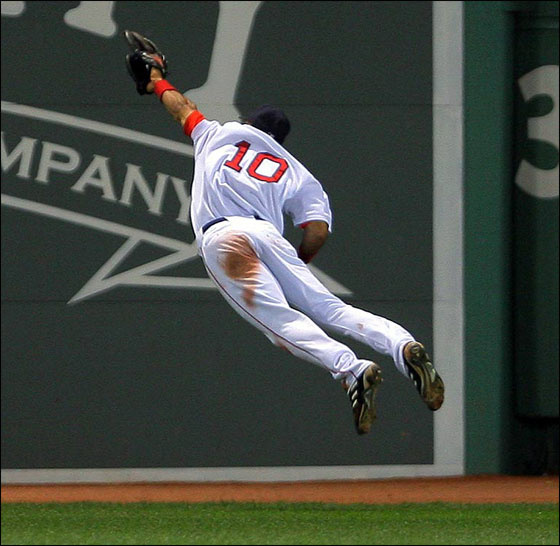
A-Rod's decision to file for free agency will undoubtedly buoy the drama of the 2007-2008 offseason. I predict that his super-agent, Scott Boras, will prolong their decision until at least the holidays. As a result, the other marquee free agents - Torii Hunter, Andruw Jones, Mike Lowell (if he doesn't resign with the Red Sox), etc. - won't begin seriously negotiating with potential employers until early next year. The logic behind this is simple. No matter how much of Scott Boras is smoke and mirrors, other agents will figure that whoever loses out on A-Rod, from amongst the likely suitors there will be somebody who is then wiling to pay more for their client(s). Unfortunately, this means teams like the Giants and Dodgers, for whom A-Rod might actually make sense, might end up chasing a guy like Jones out of desperation, even though he really doesn't make sense.
Once A-Rod signs, the winter dance craze among MLB GMs is going to be the Center Field Shuffle. Besides Jones and Hunter, there are a litany of solid centerfielders available this offseason. Mike Cameron, Aaron Rowand, Milton Bradley, Kenny Lofton, and Corey Patterson are all free agents. Additionally, Coco Crisp, Boston's gold-glove-caliber switch-hitting speedster lost his position to Jacoby Ellsbury during the playoffs and will undoubtedly be used by the Red Sox as part of a trade package to replace Curt Schilling or Mike Lowell. Tampa Bay could be shopping Rocco Baldelli and/or Carl Crawford as well.
One might think that this glut of players on the market in one position would drive prices down, but quite the opposite might turn out to be true. No less than fourteen teams enter the offseason with serious questions about who will be captaining their outfields come 2008. The center field scene has undergone a considerable renovation in the last couple of seasons. Marquee names and perennial gold-glovers like Ken Griffey Jr. and Jim Edmonds have reached the point in their careers where they can no long cover the real estate, forcing moves to right field. Because of the shortage of talent at this critical position, teams have resorted to converting infielders and corner outfielder, with varying degrees of success. Bill Hall, B. J. Upton, Jacque Jones, Alfonso Soriano, and Ichiro Suzuki all became centerfielders by necessity. Only nineteen players started more than 90 games in center in 2007 (the lowest since 2000). Compare that to the other key defensive positions; 28 players started at least 90 games at shortstop, 25 at second base, and 27 at catcher. Many teams will be looking to the 2007 class of centerfielders to improve themselves, both defensively and offensively.
Let's start in the AL:
Chicago White Sox
The White Sox haven't had any stability in center field since Aaron Rowand left after their World Series championship in 2005. Since then five players have gotten 38 or more starts. The Sox have two young players who are more than adequate defensively, Brian Anderson and Jerry Owens, but neither showed a glimmer of offensive ability during extended big league tryouts in 2006 and 2007. Chicago will undoubtedly sign one of the free agents. Look for them to make a serious run on Hunter. They've been on the wrong end of his highlight reel more than their fair share as a rival to Minnesota in the AL Central, so they no how well he plays at Cellular Field (828 OPS for his career) and how well he brings balls back in a cozy confines. Hunter's bat fits perfectly into the White Sox lineup behind Konerko, Thome, and Dye. Despite his career year in 2007, competitive teams should not expect him to be better than their fourth or fifth best hitter.
Second Choice: Aaron Rowand
Minnesota Twins
With the breakdown in discussions earlier this week and the impending free agency of Johan Santana (then Morneau, then Mauer), it seems safe to say that Torii Hunter won't be returning to the Twins. We can speculate on an on about where Hunter might end up, but the more important question for Minnesota's fans is who will replace him, considering that the franchise will is unlikely to shill out for other free agents as well. Hunter has played center in Minnesota for nine season and won six gold gloves. Those are some tough turf shoes to fill. I don't think the Twins have any intention of filling them. Look for Minnesota to publicize the spring training competition between Denard Span, Darnell McDonald, and Jason Tyner. Tyner is a thirty-year-old journeyman utility outfielder most famous for beginning his career by going 1,220 at-bats without a homer. Darnell McDonald has spent a decade in the minor leagues, but is still only 29, and has shown dramatic improvements in the last couple seasons. He has outstanding speed, modest power, and decent plate discipline. Bet on him to be the Opening Day starter. Span has the most upside, at age 23. He's a slap-hitting speedster who could develop modest power. But his .267 average and 678 OPS at AAA in 2007 don't bode well for him being ready for the show.
Second Choice: Kenny Lofton
Texas Rangers
Marlon Byrd was a welcome surprise during an otherwise disappointing season in Dallas in 2007. When the Rangers dealt Kenny Lofton to the Indians in late July, Byrd was batting .358 with a .928 OPS. He was handed the starting center field job. Unfortunately, Marlon Byrd is not a centerfielder. Not only did he play poor defense during the season's final two months, his offensive numbers suffered as well. He hit only .266 with a 721 OPS after Lofton was traded. It seems likely that Byrd will assume a corner spot in '08, while the Rangers attempt acquire a true centerfielder. They will certainly make an offer to Torii Hunter. But even if they are willing to pay more than the White Sox, Braves, or Twins, their cause may be hurt by their inability to make the playoffs. If Hunter signs elsewhere, expect John Hicks to become enamored with Aaron Rowand, a gritty hustler coming off a career year. Even if they do overpay, Rowand could be a good match for Texas. The ballpark will suit him both offensively and defensively. He's been to the playoffs twice in the last three seasons, winning a ring in '05 with the White Sox. He could provide a much-needed spark in the Rangers clubhouse.
Second Choice: Corey Patterson
Oakland Athletics
Mark Kotsay is an outstanding, underrated defensive outfielder, but his offensive production has declined dramatically every season since his first year in Oakland (2004) and he's missed extensive time to injuries almost every season. Nick Swisher is an excellent rightfielder, but in center he is average at best. Oakland will likely give Chris Denorfia a shot in 2008 as well. Denorfia, acquired from Cincinnati for reliever Marcus MacBeth, hasn't been given a fair shot in the big leagues yet. His minor-league stats suggest he should hit for a high average, draw quite a few walks, and will probably develop moderate power (15-20 HR). As such, he fits perfectly into the Oakland lineup as Kotsay's replacement, assuming he can hold his own defensively. Nonetheless, don't be surprised if Billy Beane deals one of his top starters, Haren or Blanton, to Boston for Coco Crisp and a couple of pitching prospects.
Second Choice: Coco Crisp
Baltimore Orioles
It seems unlikely that Baltimore will renew Corey Patterson's contract. He showed signs in 2006 that he might again be on the verge of realizing his always incredible potential, but took another step backward again in 2007. Undoubtedly there will be a GM, manager, or hitting coach somewhere who will believe that they can make Corey into a late-blooming superstar, but the Orioles have had their chance. That said, while the Orioles may have the desire and even the funds to chase a premier free agent like Hunter or Jones, they have been labeled one of the most undesirable franchises in baseball because of their pushy, overzealous owner and their propensity for firing managers and racking up steroid allegations. In order to get somebody to take a chance on them, they're going to have to take a chance as well. One option would be Mike Cameron, an outstanding defender with good power coming off of an injury and a stimulant suspension. However, I think Baltimore should go as high-risk high-reward as possible. After all, there are three teams with significant advantages over them in their division. And nobody says high-risk high-reward quite like Milton Bradley.
Second Choice: Mike Cameron
Monday, October 29, 2007
5 Things I Learned From the 2007 Series
- Regular season broadcasters really aren't that bad.
I often find myself growing frustrated by the inanities of color commentators like Bob Brenly (Cubs) and Rex Hudler (Angels), but I yearn for them when faced with the prospect of watching several games in a row with Joe Buck and Tim McCarver. I often find myself wondering if they even pay any attention to the regular season. I know that they are catering to an audience that may only watch baseball in October, but doesn't that make it all the more important that they provide a rich context for what makes the World Series worth watching. I don't expect anybody to be Vin Scully, but based on their broadcast, it's hard to tell if they do any preparation at all. When they do bring up a tidbit of moderate interest, like Manny Ramirez' average with two strikes or Troy Tulowitzki's likely Rookie of the Year candidacy, we get pounded with it at-bat after at-bat, night after night. Baseball is a game of nuance and almost hypnotic attention of detail. The broadcast should help bring that to life for both the baseball novice and the fanatic. Buck only sounds enthusiastic when he's making an ill-timed plug for one of their sponsors. Fox's broadcasters are neanderthals. If Fox wants to raise World Series ratings, I would start with something that they can change, instead of complaining about the prevalence of land-locked franchises in the playoffs. I was pleasantly surprised by the TBS broadcast team during the Division Series and the NLCS. Maybe that's an indication of a welcome change on the horizon.
- Dice-K needs to make some adjustments...and so do the Red Sox.
I was disappointed that Francona elected to remove Dice-K with one out in the sixth in Game 3. He had yet to give up a run, he had only allowed three hits and three walks, and Boston had a six-run lead! However, I did suffer through several of his late-season starts in which everything appeared to going smoothly before he suddenly got lit-up in the middle innings, so I can imagine what Francona was thinking.
I would argue that Dice-K's rookie year has been a success. Perhaps he has not fully lived up to the phenomenal expectations, but he pitched 200 innings, won 16 games, and was among the league leaders in strikeouts. And, there is no reason to believe that next year won't be even better. He is a smart pitcher and a fearsome competitor. I don't think he would've elected to join the MLB if he didn't think it was going to be a challenge. What is critical, I think, is that the Red Sox also make some changes to accomodate his idiosyncratic style and routines. I'm no saying they should be letting him throw 200 pitch bullpen sessions, but maybe they should let him get up to 120 more often. That is what his arm is used to, after all.
- Something really is wrong with the National League.
See previous post.
- Todd Helton deserves all those Gold Gloves, and another one in 2007.
Much has been made of the Rockies defense, and justifiably so. As the postseason wore on, announcers, particularly Buck and McCarver, became more and more enamored with the play of Colorado shortstop, Troy Tulowitzki. Again, justifiably so. However, what often got overlooked, was that the Rockies record-setting team fielding percentage could not have been achieved without Todd Helton. Sure, Helton has the typical lumbering physique of an aging first basemen. His range is not what it used to be. But, he is extraordinarily agile, his footwork is remarkable, and he has an amazing knack for reeling in wayward throws, whether they're in the dirt, over his head, or well off the bag. I think Tulowitzki and third baseman Garrett Atkins are pretty good glove men and they have extremely strong arms, but neither is particularly accurate. They don't have to be.
- Manny Ramirez is underrated.
It's strange to make such a remark about the fourth highest-paid player in the league, who is the clean-up hitter for one the best publicized teams in all of sports, but it's true. Sure, Manny has his adventures in left field, but he also turns in his fair share of web gems, especially when he's playing at home. His throw to cut down Kenny Lofton in a critical situation during Game 7 of the ALCS is a perfect example. Buck and McCarver don't like that his intentionally knocks off his helmet when he's on the basepaths or lingers to admire his atmospheric home runs. We're never going to confuse him with David Eckstein, but Manny doesn't exactly dog it either. His antics, which I can't help but find endearing for the most part, and the increasingly epic persona of David Ortiz, overshadow the fact that Manny Ramirez may be the best pure hitter in baseball right now. He works the count. He has power to all fields. He walks as often as he strikes out. He murders lefties and righties, even the best in the game. He hits situationally. You never see him swinging for the fences in an RBI situation, even though he often ends up clearing them nonetheless. And, of course, he's money when it counts most. In his four postseasons since joining the Sox, Manny is batting .321 with a 980 OPS and 38 RBIs in 43 games.
I often find myself growing frustrated by the inanities of color commentators like Bob Brenly (Cubs) and Rex Hudler (Angels), but I yearn for them when faced with the prospect of watching several games in a row with Joe Buck and Tim McCarver. I often find myself wondering if they even pay any attention to the regular season. I know that they are catering to an audience that may only watch baseball in October, but doesn't that make it all the more important that they provide a rich context for what makes the World Series worth watching. I don't expect anybody to be Vin Scully, but based on their broadcast, it's hard to tell if they do any preparation at all. When they do bring up a tidbit of moderate interest, like Manny Ramirez' average with two strikes or Troy Tulowitzki's likely Rookie of the Year candidacy, we get pounded with it at-bat after at-bat, night after night. Baseball is a game of nuance and almost hypnotic attention of detail. The broadcast should help bring that to life for both the baseball novice and the fanatic. Buck only sounds enthusiastic when he's making an ill-timed plug for one of their sponsors. Fox's broadcasters are neanderthals. If Fox wants to raise World Series ratings, I would start with something that they can change, instead of complaining about the prevalence of land-locked franchises in the playoffs. I was pleasantly surprised by the TBS broadcast team during the Division Series and the NLCS. Maybe that's an indication of a welcome change on the horizon.
- Dice-K needs to make some adjustments...and so do the Red Sox.
I was disappointed that Francona elected to remove Dice-K with one out in the sixth in Game 3. He had yet to give up a run, he had only allowed three hits and three walks, and Boston had a six-run lead! However, I did suffer through several of his late-season starts in which everything appeared to going smoothly before he suddenly got lit-up in the middle innings, so I can imagine what Francona was thinking.
I would argue that Dice-K's rookie year has been a success. Perhaps he has not fully lived up to the phenomenal expectations, but he pitched 200 innings, won 16 games, and was among the league leaders in strikeouts. And, there is no reason to believe that next year won't be even better. He is a smart pitcher and a fearsome competitor. I don't think he would've elected to join the MLB if he didn't think it was going to be a challenge. What is critical, I think, is that the Red Sox also make some changes to accomodate his idiosyncratic style and routines. I'm no saying they should be letting him throw 200 pitch bullpen sessions, but maybe they should let him get up to 120 more often. That is what his arm is used to, after all.
- Something really is wrong with the National League.
See previous post.
- Todd Helton deserves all those Gold Gloves, and another one in 2007.
Much has been made of the Rockies defense, and justifiably so. As the postseason wore on, announcers, particularly Buck and McCarver, became more and more enamored with the play of Colorado shortstop, Troy Tulowitzki. Again, justifiably so. However, what often got overlooked, was that the Rockies record-setting team fielding percentage could not have been achieved without Todd Helton. Sure, Helton has the typical lumbering physique of an aging first basemen. His range is not what it used to be. But, he is extraordinarily agile, his footwork is remarkable, and he has an amazing knack for reeling in wayward throws, whether they're in the dirt, over his head, or well off the bag. I think Tulowitzki and third baseman Garrett Atkins are pretty good glove men and they have extremely strong arms, but neither is particularly accurate. They don't have to be.
- Manny Ramirez is underrated.
It's strange to make such a remark about the fourth highest-paid player in the league, who is the clean-up hitter for one the best publicized teams in all of sports, but it's true. Sure, Manny has his adventures in left field, but he also turns in his fair share of web gems, especially when he's playing at home. His throw to cut down Kenny Lofton in a critical situation during Game 7 of the ALCS is a perfect example. Buck and McCarver don't like that his intentionally knocks off his helmet when he's on the basepaths or lingers to admire his atmospheric home runs. We're never going to confuse him with David Eckstein, but Manny doesn't exactly dog it either. His antics, which I can't help but find endearing for the most part, and the increasingly epic persona of David Ortiz, overshadow the fact that Manny Ramirez may be the best pure hitter in baseball right now. He works the count. He has power to all fields. He walks as often as he strikes out. He murders lefties and righties, even the best in the game. He hits situationally. You never see him swinging for the fences in an RBI situation, even though he often ends up clearing them nonetheless. And, of course, he's money when it counts most. In his four postseasons since joining the Sox, Manny is batting .321 with a 980 OPS and 38 RBIs in 43 games.
Thursday, October 25, 2007
What's wrong with the National League?
Don't get me wrong. I'm not ready to pronounce the Rockies dead just because they got pummeled in Game 1. It was a game they were destined to lose. That much-discussed eight day reprieve was the inevitable end of their magical streak. Not only that, they had to fight off the cobwebs in the inhospitable Fenway Park against the hottest postseason pitcher since Bob Gibson. Regardless of the magic, I don't think anybody would've picked Colorado to win Game 1. However, the drubbing the Red Sox gave their Ace, Jeff Francis, was certainly cause for concern.
Colorado's Game 2 starter, Ubaldo Jimenez, has enough talent to be competitive against anybody, so long as he is effectively wild. But, after that, the Rockies counter Dice-K and Jon Lester with the pedestrian Josh Fogg and the rehabilitating Aaron Cook, neither of whom can be expected to perform better, or even as well as, Francis. I don't believe the Rockies' bats will remain quiet, especially once the series moves back to Coors Field, but the always potent Boston lineup is truly running on all cylinders. Even disappointing free agent signees J. D. Drew and Julio Lugo have gotten involved in the last several Red Sox victories. If Jimenez loses Thursday, I fear another World Series sweep may be imminent.
If it unfolds as I'm suggesting, or even if Colorado extends it to five games, we will start the offseason with more discussion of the growing divide between the quality of teams (and players) in the American and National leagues. While the NL's disadvantage in the Fall Classic hasn't been that remarkable (they've been represented by five of the twelve champions between 1995 and 2006), they have lost eleven consecutive All-Star games and have been trounced in interleague play each of the last three seasons. In 2007, all four playoff franchises from the AL won more games than the best team in the NL.
Not long ago any discussion of the most valuable players in baseball was focused in the National League, where Barry Bonds, Ken Griffey Jr., Sammy Sosa, Mark McGwire, Gary Sheffield, and Vladimir Guerrero all resided as of 2000. Now Sheffield, Sosa, and Guerrero have defected, with Bonds and Griffey likely soon to follow, and the same discussion revolves around A-Rod and a couple of players from the Red Sox. Five of the six highest-paid players in 2007 were American Leaguers.
Although we have been taught by Billy Beane (or, maybe more accurately, Terry Ryan) that building a team is about more than money, it is telling that the NL has only three of the top ten payrolls in Major League Baseball, and six of the bottom seven. It seems strange then that ten teams in the senior circuit had attendance figures over $2.7 Million, compared to only four in the AL. Notoriously, the Chicago Cubs have sold out Wrigley Field regardless of the quality of team on the field or the amount of the Tribune Company's commitment. In recent years, while the Cubs have spent more, other NL franchises have learned to milk their traditions.
The Atlanta Braves spent nearly $20 Million less in 2007 than they did in 2002, even though the average major league player's salary has gone up half a million dollars during that time. The Braves '07 payroll was their lowest since 2000. To put that in perspective: in 2000, the Yankees only spent $93 Million, less than half what they did in '07. The Braves have not exactly been keeping up with the Joneses.
Similarly, the Giants, Cardinals, and Pirates, all among the oldest and most storied franchises in the National League, have authorized only fractional increases (or even decreases) in their payrolls over the last fives seasons. Conversely, the elder statesmen of the AL - the Yankees, Red Sox, White Sox, Orioles, Athletics, and Tigers - have all raised their payrolls by $20 Million or more over the same span. All told, the American League pays more than 52% of all player salaries in baseball, despite the fact that they have two fewer franchises!
If the explanation for the difference between the leagues isn't money, what is the explanation? Is it that the DH rule allows the American League to retain great players longer? It is true that guys like Frank Thomas and Jim Thome continue to contribute to contenders into their forties. It is also true that David Ortiz, Sheffield, and Guerrero got many more at-bats this season, despite nagging injuries, than they would've if they were required to play the field everyday. In the '70s and '80s, when the Designated Hitter first came into play, teams usually filled the role with the equivalent of a top pinch-hitter, a guy who was at best the sixth or seventh best hitter on the team, or, occasionally, a veteran with considerably diminished skills. In 2007, more than half American League teams regularly batted their DH in the middle-of-the-order, third or fourth, employing him explicitly for the purpose of anchoring their lineup. One must wonder whether Ortiz or Travis Hafner would've had careers in the era before the DH was invented. Or, whether Thomas and Thome could've built convincing cases for the Hall of Fame. Nonetheless, this is hardly an acceptable explanation for the difference between the leagues. After all, the National League faired just fine during the '90s, when teams were beginning to understand the DH and excellent hitters like Edgar Martinez, Paul Moliter, Albert Belle, Harold Baines, and Jose Canseco were exploiting it to improve their contracts and prolong their careers.
Do quality free agent pitchers prefer the AL because they don't have to bat? Their may be some truth to the theory that power pitchers like Clemens and Beckett can pitch inside more comfortably in the AL because they don't have to fear retribution when they step into the batter's box. Additionally, some veteran pitchers - say a Curt Schilling or a David Wells - may feel that staying off of the basepaths and away from the lumber keeps them from humiliating themselves, hurting their teams, or spending time on the DL. But, then again, just as many pitchers prefer the NL, either because the like to hit (Livan Hernandez, Carlos Zambrano, etc.), they are comfortable with the NL style (Greg Maddux, Tom Glavine, etc.), or they hope to revitalize their careers by facing weaker lineups (Barry Zito, Ted Lilly, etc.).
I am the first to agree that teams should be focusing on drafting and developing their own players, and showing prudence on the free-agent market. However, the lesson to be learned from teams like Oakland, Minnesota, and Cleveland is not that you have to spend like those teams to play like those teams. National League teams seem prone to using the success of small-market franchises as an excuse for excessive frugality.
Colorado's Game 2 starter, Ubaldo Jimenez, has enough talent to be competitive against anybody, so long as he is effectively wild. But, after that, the Rockies counter Dice-K and Jon Lester with the pedestrian Josh Fogg and the rehabilitating Aaron Cook, neither of whom can be expected to perform better, or even as well as, Francis. I don't believe the Rockies' bats will remain quiet, especially once the series moves back to Coors Field, but the always potent Boston lineup is truly running on all cylinders. Even disappointing free agent signees J. D. Drew and Julio Lugo have gotten involved in the last several Red Sox victories. If Jimenez loses Thursday, I fear another World Series sweep may be imminent.
If it unfolds as I'm suggesting, or even if Colorado extends it to five games, we will start the offseason with more discussion of the growing divide between the quality of teams (and players) in the American and National leagues. While the NL's disadvantage in the Fall Classic hasn't been that remarkable (they've been represented by five of the twelve champions between 1995 and 2006), they have lost eleven consecutive All-Star games and have been trounced in interleague play each of the last three seasons. In 2007, all four playoff franchises from the AL won more games than the best team in the NL.
Not long ago any discussion of the most valuable players in baseball was focused in the National League, where Barry Bonds, Ken Griffey Jr., Sammy Sosa, Mark McGwire, Gary Sheffield, and Vladimir Guerrero all resided as of 2000. Now Sheffield, Sosa, and Guerrero have defected, with Bonds and Griffey likely soon to follow, and the same discussion revolves around A-Rod and a couple of players from the Red Sox. Five of the six highest-paid players in 2007 were American Leaguers.
Although we have been taught by Billy Beane (or, maybe more accurately, Terry Ryan) that building a team is about more than money, it is telling that the NL has only three of the top ten payrolls in Major League Baseball, and six of the bottom seven. It seems strange then that ten teams in the senior circuit had attendance figures over $2.7 Million, compared to only four in the AL. Notoriously, the Chicago Cubs have sold out Wrigley Field regardless of the quality of team on the field or the amount of the Tribune Company's commitment. In recent years, while the Cubs have spent more, other NL franchises have learned to milk their traditions.
The Atlanta Braves spent nearly $20 Million less in 2007 than they did in 2002, even though the average major league player's salary has gone up half a million dollars during that time. The Braves '07 payroll was their lowest since 2000. To put that in perspective: in 2000, the Yankees only spent $93 Million, less than half what they did in '07. The Braves have not exactly been keeping up with the Joneses.
Similarly, the Giants, Cardinals, and Pirates, all among the oldest and most storied franchises in the National League, have authorized only fractional increases (or even decreases) in their payrolls over the last fives seasons. Conversely, the elder statesmen of the AL - the Yankees, Red Sox, White Sox, Orioles, Athletics, and Tigers - have all raised their payrolls by $20 Million or more over the same span. All told, the American League pays more than 52% of all player salaries in baseball, despite the fact that they have two fewer franchises!
If the explanation for the difference between the leagues isn't money, what is the explanation? Is it that the DH rule allows the American League to retain great players longer? It is true that guys like Frank Thomas and Jim Thome continue to contribute to contenders into their forties. It is also true that David Ortiz, Sheffield, and Guerrero got many more at-bats this season, despite nagging injuries, than they would've if they were required to play the field everyday. In the '70s and '80s, when the Designated Hitter first came into play, teams usually filled the role with the equivalent of a top pinch-hitter, a guy who was at best the sixth or seventh best hitter on the team, or, occasionally, a veteran with considerably diminished skills. In 2007, more than half American League teams regularly batted their DH in the middle-of-the-order, third or fourth, employing him explicitly for the purpose of anchoring their lineup. One must wonder whether Ortiz or Travis Hafner would've had careers in the era before the DH was invented. Or, whether Thomas and Thome could've built convincing cases for the Hall of Fame. Nonetheless, this is hardly an acceptable explanation for the difference between the leagues. After all, the National League faired just fine during the '90s, when teams were beginning to understand the DH and excellent hitters like Edgar Martinez, Paul Moliter, Albert Belle, Harold Baines, and Jose Canseco were exploiting it to improve their contracts and prolong their careers.
Do quality free agent pitchers prefer the AL because they don't have to bat? Their may be some truth to the theory that power pitchers like Clemens and Beckett can pitch inside more comfortably in the AL because they don't have to fear retribution when they step into the batter's box. Additionally, some veteran pitchers - say a Curt Schilling or a David Wells - may feel that staying off of the basepaths and away from the lumber keeps them from humiliating themselves, hurting their teams, or spending time on the DL. But, then again, just as many pitchers prefer the NL, either because the like to hit (Livan Hernandez, Carlos Zambrano, etc.), they are comfortable with the NL style (Greg Maddux, Tom Glavine, etc.), or they hope to revitalize their careers by facing weaker lineups (Barry Zito, Ted Lilly, etc.).
I am the first to agree that teams should be focusing on drafting and developing their own players, and showing prudence on the free-agent market. However, the lesson to be learned from teams like Oakland, Minnesota, and Cleveland is not that you have to spend like those teams to play like those teams. National League teams seem prone to using the success of small-market franchises as an excuse for excessive frugality.
Wednesday, October 17, 2007
The World Series is next week! But who cares?!? Let's talk about the Yankees.
The Indians and Red Sox have reached the winner-takes-all moment in a series which featured, among other things, a seven run 11th-inning explosion, back-to-back-to-back homers, and the 35th stolen base of a postseason career. All are historic firsts.
The Rockies have won 21 of their last 22, including seven straight in the playoffs. They're headed to their first World Series.
But, naturally, most of the baseball headlines are concerned with the Yankees off-season plans. Will A-Rod opt-out? Will Joe Torre still be welcome in the Bronx? What part will Hank and Hal Steinbrenner's reclusive younger brother, Huck, have in the day-to-day baseball operations of the franchise? Does Jorge Posada look more like David Schwimmer or a Teenage Mutant Ninja Turtle?
Well, I have nothing more to say about the postseason at present, except that I'm enjoying it more and more the further it moves inland, so I may as well hop on the bandwagon. Obviously, I've got no insider information (despite my close relationship with Don Mattingly's second cousin). As one of the many Yankee-haters who will be watching the headlines of the next several weeks maniacally anticipating the worst fate for all things pinstriped, the best I can offer is what I hope will happen.
Brian Cashman & the Steinbrenners, the barbershop quartet auditioning for the next season of The Next Great American Band, will finish their secretive rehearsals in Florida and, unwilling to go back on George's word, fail to offer Joe Torre a reasonable contract, perhaps belittling his accomplishments during a widely-publicized press conference. You know, "He hasn't really proved himself in this millenium."
Against the recommendation of Cashman and others, the Steinbrenners will replace Torre with current bench coach, Don Mattingly, assuming that this offer of moderate stability will prevent an all-out desertion by the potential free-agent class that includes Jorge Posada, Mariano Rivera, Andy Pettitte, and Alex Rodriguez.
Rodriguez will, predictably, opt-out and end up on the West Coast, probably in San Francisco. Mariano Rivera will follow, perhaps even joining the same team.
At this point, probably around December, the Stooges will begin to get anxious, as it dawns on them that they may actually end up with a worse team in 2008 than they had in '07, and one without an experienced manager or a confident clubhouse to help them overcome their annual spring slump. Hank and Hal don't want to give their father yet another reason to call them losers. They pick up the option on Bobby Abreu. They convince Pettitte to hang on for another year. And, in order to prevent Posada from defecting to the Mets, they offer him way more money than he's worth, something in the neighborhood of three years and $35 Million. (Cashman starts having Javy Lopez nightmares.)
Still, even with three dynastic (a.k.a., old and overrated) pieces of the puzzle in place (Posada, Pettitte, Jeter), the roster seems to have gaping holes in it. The Red Sox have lost next to nothing as they shore up their rotation with Clay Bucholz and Dontrelle Willis (in return for Coco Crisp and a prospect). Suddenly, as desperation fuels fantasy, members of the weak free-agent class begin to look tempting. The heroes of yesteryear, men who have haunted them in postseasons past: Schilling, Rogers, Lofton, Piazza, Glavine, Colon, Jones. Who could possibly replace A-Rod? Maybe, with rested knees and a revitalized lineup around him, maybe Barry Bonds? Who could possibly replace Rivera? Maybe Eric Gagne? Who could possible replace Roger Clemens? Well, maybe the Rocket has another year in him after all? They sign player after player on whim after whim, regardless of price, priority, or position. Melky Cabrera is once-again relegated to reserve duty. Ian Kennedy and Phil Hughes are forced to fight over the one remaining spot in the rotation (Joba Chamberlain is, as Hank promised, inserted as the fourth starter). Out of necessity, Johnny Damon learns to play third base. As usual, the bullpen gets overlooked.
The season starts well. The Steinbrenner boys strut around the yard, the Yankees are still atop the division at the end of May. But, the tide turns. Leads are blown, repeatedly. Injuries plague key players. They stumble into the All-Star break around .500. Still, they say, "better than last year."
Chamberlain loses it in the second half, overworked and under-prepared. Posada's average dives toward .250. One after another, players land on the D.L. Without Torre's steady hand, the cookie crumbles. Even Jeter begins to look anxious at the plate. He argues with umpires, drops double play balls. Yankees fans wonder aloud, "Didn't he use to have more range on his right?" Only Robinson Cano lives up to expectations, exceeds them even. He smiles and, beginning to look more and more like Alfonso Soriano (if Soriano could really play second base), contemplates his looming free agency.
At the end of the year, the Yankees make a grand push. They finish above .500 for the 16th consecutive season. The Red Sox win the division. The Blue Jays finish second. Mattingly is summarily dismissed, like many great Yankee players before him (Martin, Pinella, Berra, Michael), he failed to live up to the Steinbrenner conception of managerial greatness. Torre, having taken a year off to work as an ESPN commentator (ala Pinella and Dusty Baker), is offered $8 Million to return. Instead he takes a job in St. Louis, as La Russa's bench coach.
-----
That's what I hope will happen and, no matter what your loyalty, I think you'll agree that it isn't an entirely absurd prediction. The much more difficult question is, what should happen?
Even in the best of circumstance, with nobody looking over his shoulder and only moderate expectation, Cashman would have a hell of a lot of work to do this offseason. He has three potential holes in his everyday lineup (first base, third base, catcher), as well as a clusterfuck at designated hitter (Damon, Giambi, Duncan). He is probably looking at three rookies (or, practically rookies) in the starting rotation (Chamberlain, Hughes, Kennedy) and only one reliable arm in the bullpen (Vizcaino). And, like I said before, his fiercest rival in the division (the team with the best record in baseball in 2007) only loses one contributer (Schilling).
It won't happen, but the Yankees should commit to rebuilding, with or without Torre. Unlike teams like Pittsburgh or Kansas City, this would probably only take them a year, during which they would still be respectable. This would mean letting Posada, Rivera, Clemens, and Rodriguez go. Cabrera, Duncan, Betemit, Kennedy, and Hughes would all be expected to take on everyday roles. Perhaps they acquire underrated, lower-tier guys to shore up first base (somebody like Adam LaRoche), catcher (maybe Micheal Barrett), and closer (say Borowski or Dotel).
At the end of 2008 they will be relieved of their huge contractual commitments to Giambi, Abreu, and Mike Mussina. There will be a much stronger free agent class, probably including marquee guys like Johan Santana, C. C. Sabathia, Mark Texeira, and Vladimir Guerrero. Most importantly, perhaps, they will have a better sense of what they need. Are Hughes, Kennedy, and Chamberlain all dependable starters? Can either Duncan or Betemit be valuable day in and day out? Do they have any other valuable prospects on the horizon?
The next Yankees dynasty is not far off, will they have the patience to wait for its arrival? Or will they compromise it in order to win 90 games next year?
The Rockies have won 21 of their last 22, including seven straight in the playoffs. They're headed to their first World Series.
But, naturally, most of the baseball headlines are concerned with the Yankees off-season plans. Will A-Rod opt-out? Will Joe Torre still be welcome in the Bronx? What part will Hank and Hal Steinbrenner's reclusive younger brother, Huck, have in the day-to-day baseball operations of the franchise? Does Jorge Posada look more like David Schwimmer or a Teenage Mutant Ninja Turtle?
Well, I have nothing more to say about the postseason at present, except that I'm enjoying it more and more the further it moves inland, so I may as well hop on the bandwagon. Obviously, I've got no insider information (despite my close relationship with Don Mattingly's second cousin). As one of the many Yankee-haters who will be watching the headlines of the next several weeks maniacally anticipating the worst fate for all things pinstriped, the best I can offer is what I hope will happen.
Brian Cashman & the Steinbrenners, the barbershop quartet auditioning for the next season of The Next Great American Band, will finish their secretive rehearsals in Florida and, unwilling to go back on George's word, fail to offer Joe Torre a reasonable contract, perhaps belittling his accomplishments during a widely-publicized press conference. You know, "He hasn't really proved himself in this millenium."
Against the recommendation of Cashman and others, the Steinbrenners will replace Torre with current bench coach, Don Mattingly, assuming that this offer of moderate stability will prevent an all-out desertion by the potential free-agent class that includes Jorge Posada, Mariano Rivera, Andy Pettitte, and Alex Rodriguez.
Rodriguez will, predictably, opt-out and end up on the West Coast, probably in San Francisco. Mariano Rivera will follow, perhaps even joining the same team.
At this point, probably around December, the Stooges will begin to get anxious, as it dawns on them that they may actually end up with a worse team in 2008 than they had in '07, and one without an experienced manager or a confident clubhouse to help them overcome their annual spring slump. Hank and Hal don't want to give their father yet another reason to call them losers. They pick up the option on Bobby Abreu. They convince Pettitte to hang on for another year. And, in order to prevent Posada from defecting to the Mets, they offer him way more money than he's worth, something in the neighborhood of three years and $35 Million. (Cashman starts having Javy Lopez nightmares.)
Still, even with three dynastic (a.k.a., old and overrated) pieces of the puzzle in place (Posada, Pettitte, Jeter), the roster seems to have gaping holes in it. The Red Sox have lost next to nothing as they shore up their rotation with Clay Bucholz and Dontrelle Willis (in return for Coco Crisp and a prospect). Suddenly, as desperation fuels fantasy, members of the weak free-agent class begin to look tempting. The heroes of yesteryear, men who have haunted them in postseasons past: Schilling, Rogers, Lofton, Piazza, Glavine, Colon, Jones. Who could possibly replace A-Rod? Maybe, with rested knees and a revitalized lineup around him, maybe Barry Bonds? Who could possibly replace Rivera? Maybe Eric Gagne? Who could possible replace Roger Clemens? Well, maybe the Rocket has another year in him after all? They sign player after player on whim after whim, regardless of price, priority, or position. Melky Cabrera is once-again relegated to reserve duty. Ian Kennedy and Phil Hughes are forced to fight over the one remaining spot in the rotation (Joba Chamberlain is, as Hank promised, inserted as the fourth starter). Out of necessity, Johnny Damon learns to play third base. As usual, the bullpen gets overlooked.
The season starts well. The Steinbrenner boys strut around the yard, the Yankees are still atop the division at the end of May. But, the tide turns. Leads are blown, repeatedly. Injuries plague key players. They stumble into the All-Star break around .500. Still, they say, "better than last year."
Chamberlain loses it in the second half, overworked and under-prepared. Posada's average dives toward .250. One after another, players land on the D.L. Without Torre's steady hand, the cookie crumbles. Even Jeter begins to look anxious at the plate. He argues with umpires, drops double play balls. Yankees fans wonder aloud, "Didn't he use to have more range on his right?" Only Robinson Cano lives up to expectations, exceeds them even. He smiles and, beginning to look more and more like Alfonso Soriano (if Soriano could really play second base), contemplates his looming free agency.
At the end of the year, the Yankees make a grand push. They finish above .500 for the 16th consecutive season. The Red Sox win the division. The Blue Jays finish second. Mattingly is summarily dismissed, like many great Yankee players before him (Martin, Pinella, Berra, Michael), he failed to live up to the Steinbrenner conception of managerial greatness. Torre, having taken a year off to work as an ESPN commentator (ala Pinella and Dusty Baker), is offered $8 Million to return. Instead he takes a job in St. Louis, as La Russa's bench coach.
-----
That's what I hope will happen and, no matter what your loyalty, I think you'll agree that it isn't an entirely absurd prediction. The much more difficult question is, what should happen?
Even in the best of circumstance, with nobody looking over his shoulder and only moderate expectation, Cashman would have a hell of a lot of work to do this offseason. He has three potential holes in his everyday lineup (first base, third base, catcher), as well as a clusterfuck at designated hitter (Damon, Giambi, Duncan). He is probably looking at three rookies (or, practically rookies) in the starting rotation (Chamberlain, Hughes, Kennedy) and only one reliable arm in the bullpen (Vizcaino). And, like I said before, his fiercest rival in the division (the team with the best record in baseball in 2007) only loses one contributer (Schilling).
It won't happen, but the Yankees should commit to rebuilding, with or without Torre. Unlike teams like Pittsburgh or Kansas City, this would probably only take them a year, during which they would still be respectable. This would mean letting Posada, Rivera, Clemens, and Rodriguez go. Cabrera, Duncan, Betemit, Kennedy, and Hughes would all be expected to take on everyday roles. Perhaps they acquire underrated, lower-tier guys to shore up first base (somebody like Adam LaRoche), catcher (maybe Micheal Barrett), and closer (say Borowski or Dotel).
At the end of 2008 they will be relieved of their huge contractual commitments to Giambi, Abreu, and Mike Mussina. There will be a much stronger free agent class, probably including marquee guys like Johan Santana, C. C. Sabathia, Mark Texeira, and Vladimir Guerrero. Most importantly, perhaps, they will have a better sense of what they need. Are Hughes, Kennedy, and Chamberlain all dependable starters? Can either Duncan or Betemit be valuable day in and day out? Do they have any other valuable prospects on the horizon?
The next Yankees dynasty is not far off, will they have the patience to wait for its arrival? Or will they compromise it in order to win 90 games next year?
Monday, October 08, 2007
The 1990's Expansion Series: Colorado v. Arizona
 I'm guessing this is not what Ted Turner was envisioning when TBS purchased the rights to the NLCS (and the rest of the playoffs up to the World Series) prior to the 2007 season. The clubs from two top markets - Chicago and the Philadelphia/Tri-State area - both with strong, loyal followings eliminated in the first four days of postseason play. And, to make matters worse, eliminated by a pair of teams from out west, not from L.A. or San Francisco or Seattle, but from that pesky Mountain Time Zone, separated from the vast majority of the American television-watching baseball-following population by at least an hour, and hundreds of miles of scenic wilderness.
The Diamondbacks, despite accumulating the best record in the National League, had a difficult time drawing fans from Arizona in 2007, much less attention from the coasts. They were 12th in the NL in attendance. The Rockies didn't fair much better. They were 11th. Only the bottom-feeding Reds, Pirates, Marlins, and Nationals had less support than the NL's two best franchises, and they averaged 19 fewer wins. One will notice, however, when the series shifts back to Colorado, that Rockies fans have turned out en masse since their team started its historic late-season run. Coors Field was as loud as any baseball stadium west of the Bronx during the epic one-game playoff between the Rockies and Padres. It will be interesting to see, on the other hand, whether Arizona can fill its ballpark without the thousands of Cubs fans which turned up in Phoenix for the Division Series.
You've probably heard it multiple times now in reference to the Diamondbacks, especially: "This was supposed to be a rebuilding year." The Baby Backs have nine rookies on their postseason roster and fourteen players who are 27-years-old or younger. Their "grizzled" veteran leaders include Eric Byrnes, who at the ripe old age of 31 is in his fifth full season in the majors; Brandon Webb, also in his fifth season, at the age of 28; and Tony Clark, who, at 35, is the D-Backs oldest regular (pinch-hitter Jeff Cirillo is three years older).
What you may not realize is, the Rockies aren't exactly riddled with experience either. They are carrying nine players who weren't alive when Reagan was elected, including seven rookies. Their starters for games two and three of the NLCS will have a combined age less than that of Roger Clemens, and a total of 7 career wins in 24 career starts. Their Ace, Jeff Francis, a baby-faced 26-year-old who undoubtedly still gets carded for beer everywhere outside of Denver, has more innings pitched this season than the rest of the rotation combined (assuming Mark Redman gets the Game 4 nod over Josh Fogg). Only Redman, Latroy Hawkins, and Todd Helton have more than five seasons of major-league experience.
As Dane Cook so astutely predicted in that TBS commercial that has been running through every televised game for the last eight weeks, "The future is now!" Let me introduce you to a few of the Baby Backs and Rookie Rocks.
Stephen Drew - SS
In about a third of a season in 2006, the younger brother of J.D. Drew batted .316 with 25 extra base hits, while playing above average defense at a critical up-the-middle position. That, along with about 148 games worth of minor-league stats that added up to a .299 average with 27 HR and 103 RBI, made the 24-year-old Drew a fantasy favorite prior to the season. In 2007, his defense lived up to expectations, but little else. He hit only .238, slugged a measly .370, and struck out 100 times. While the strikeouts are unlikely to go away, Drew is a much better hitter than these number indicate, and he showed as much in the Division series. Drew batted .500 with a double, a triple, two home runs, four runs scored, and four RBI in three games against the Cubs, while making several slick defensive plays at short. Like his older brother, Drew seems to have more psychological weaknesses, than physical ones. He has the skills to hit even the most dominating pitchers (i.e. Carlos Marmol in Game 1). With renewed confidence to go along with his outstanding talent, Drew is a likely candidate to make some big splashes against Colorado.
Troy Tulowitzki - SS
You've probably already heard a good deal about Tulowitzki, who will celebrate his 23rd birthday the day before the NLCS. He's becoming the fashionable choice for NL Rookie of the Year. He's surpassed Milwaukee's Ryan Braun mainly because of the playoff platform which always gives award contenders a boost. He is, however, by no means an illegitimate candidate. You probably haven't heard all the reasons why. Yes, he batted .291 with an 838 OPS, 104 Runs, 24 HR, and 99 RBI, but Braun nearly equaled or surpassed all of those numbers in 200 fewer plate appearances, so counting offensive stats hardly seems to be to Tulowitzki's advantage. Where the Troy the Tool Box really excelled was in the field. He has the best fielding percentage among shortstops in all of baseball. Better than Omar Vizquel, better than Orlando Cabrera, better than Jimmy Rollins, better even than Derek Jeter (who, by the way, finished 16th among 24 qualifying candidates). He also has the best Range Factor, this by a long shot. Range factor figures the number of assists plus the number of putouts, divided by the number of innings played.
Ubaldo Jimenez - SP
It's one of the overlooked postseason storylines: Ubaldo Jimenez, age 23, who in his last outing gave up only three hits over 6+ innings against the powerful Phillies in their home ballpark. Jimenez has the nasty stuff - a power fastball and a sharp overhand curveball - which can help a young, largely unknown pitcher rise to the occasion in October (i.e. Josh Beckett in 2003 or Justin Verlander last year). Jimenez has even less experience than those examples, having only reached the bigs as of July 19. His overall numbers (4-4, 4.28) are modest enough, but he's hitting his stride at just the right time. On the last scheduled day of the regular season, in a game the Rockies had to win in order to force a one-game playoff with the Padres, Jimenez through 6 1/3 innings, allowing only one hit and striking out ten. The opponent? The Arizona Diamondbacks.
Chris Young - CF
I sang his praises prior to the Division Series and he blasted a pair of key homers. Young is probably not ever going to be a prototypical lead-off hitter, however, he showed some ability to adapt during the second half. In exactly the same number of plate appearance he drew nearly twice as many walks (raising his OBP from .277 to .314), hit for a slightly better average (.242, as compared to .233), stole twice as many bases (18), and, most importantly, didn't compromise his strength, which is, quite literally, strength. He hit 13 HR prior to the All-Star break, and 19 after (raising his SLG% from .427 to .509). Young has awesome power. At 24, he has the chance to unfurl a Prince Fielder-esque blitzkrieg during his sophomore season in 2008, especially if he continues to show improved plate discipline. If Augie Ojeda continues to get on base from the bottom of the order and Drew stays hot in the two-hole, Colorado's pitchers will have to pitch more aggressively to Young (many teams have exploited him outside the strike zone) and his assault could start earlier. We could see some very impressive Coors Field moonshots.
Micah Owings - SP
The D-Backs hoped beyond hope for the return of the Big Unit of old, back in the desert for 2007. And, for a few weeks at least, it looked like their risk was going to pay off. In ten starts, Randy Johnson went 4-3 with a respectable 3.81 ERA, including a stretch of four consecutive wins across five starts during which he averaged six innings, four hits, one earned run, and nine strikeouts per outing. Alas, his back had failed him by the beginning of July and he could not manage a second-half comeback. Many doubted that a surprising Arizona ballclub could rebound from losing their #2 starter. However, the D-Backs turned to another man of imposing stature. Micah Owings is a 6'5", 225 lb. 25-year-old who, like teammate Livan Hernandez, believes that National League pitchers are allowed to bat for a reason, and it isn't so that their opponent has an easy out. Besides racking up a 3.02 ERA and a .195 OAVG in the season's final two months, Owings hit a staggering .483 with seven doubles, three homers, and eleven RBIs in 27 at-bats. The rookie finished the season with a respectable 8-8 record and a 4.30 ERA in over 150 innings. Nothing jaw-dropping, but also no small feat. As Arizona's Game 4 starter, he draws a favorable match-up against either Mark Redman or Josh Fogg, and he gets to swing his big stick in the thin mountain air. In a game which could turn into a high-scoring affair, look for Owings to give his team a solid outing. He finished the season on a 15 inning scoreless streak.
Manny Corpas - CL
From June 22nd to July 1, Colorado's closer-in-residence, Brian Fuentes, who had saved 81 games since the beginning of 2005, gave up ten earned runs in 3 1/3 innings, took four losses (imagine how much easier Colorado's road to the playoffs might have been!), and was promptly placed on the disabled list. 24-year-old rookie Manny Corpas, who had been excelling in a set-up role, took Fuentes' place, permanently (Fuentes has pitched well as a set-up man since returning). Since then, including the Division Series, Corpas has converted 22 saves in 23 chances, won two games in relief, and compiled a 1.28 ERA with a .191 Opponent's Average in 41 games. The Rockies are 36-5 (.878) in games he's made an appearance since becoming the closer. Compare that to, say, Trevor Hoffman (50-11, .820), Mariano Rivera (54-13, .806), and Jonathan Papelbon (50-9, .847) and you begin to see just how special Manny Corpas has been.
Jose Valverde - CL
As good as Corpas has been, Valverde's been better. The Diamondbacks have been trying to install the 6'4", 250 lb. Valverde as their closer since he was 23, in 2003. In '06 he got off to an outstanding start, at one point converting twelve saves in succession, before the wheels fell off. During one fourteen game stretch in May and June he had a 15.07 ERA and a .408 OAVG. He was demoted, as one might expect. He returned in the middle of August as a different pitcher. Since August 15, 2006, Jose Valverde has converted 52 saves (in 60 chances), stuck out 108 batters (in 86 innings), posted a 2.40 ERA, a .191 OAVG, and a 1.05 WHIP. His 47 saves during the 2007 regular season led the major leagues. The team which he converted the most saves against? Colorado. 7 times.
Saturday, October 06, 2007
The Right Way to Lose
 Yes, like every Cubs fan, I'm in mourning. It isn't often that we come so close. But, in all honesty, we weren't really that close. The Cubs entered the postseason with a record five games worse than any other playoff contender. And they didn't exactly surge into October. They were an unspectacular 17-12 in the final month (even though they faced only one team with a winning record) and 2-4 in the final week (including three straight losses against the worst team in the NL East).
Against their first round competitor, the Diamondbacks, who sported the league's best record, the Cubs had gone 2-4 during the regular season and 8-19 since 2004. The D-Backs top three - Webb, Davis, and Livan - had combined to go 21-12 against the lovable losers in their careers. While the Cubs top three - Zambrano, Lilly, and Hill - had gone 2-5. Not exactly the best possible draw. There was very little besides sentimentality to give a Cubs fan hope. But, then again, we're rarely armed with anything more than that.
The beauty of this year's Cubs failure is that they were never within an out, an inning, or a game of advancing. They had only one lead. And it lasted less than an inning. No D-Backs outfielder kept a critical home run out of the stands. There were no black cats, no botched grounders, no unearned runs, and, thank goodness, no fan interference. The Cubs lost this the old-fashioned way. They stranded 54 runners in three games. Their three best hitters - Soriano, Ramirez, and Lee - combined to hit .158 with one run and no RBIs, striking out in an astounding 33% of their plate appearances. Their best reliever, Carlos Marmol - he of the 1.43 regular season ERA - gave up two homers in three innings pitched. Marmol had allowed three dingers in 69 innings during the regular season. Their Game 2 starter, Ted Lilly, had by far his worst (and shortest) outing of the year, walking four and giving up six earned runs in 3 1/3 innings.
All in all, the Cubs recipe of mediocre pitching and bad situational hitting makes for a pretty predictable early exit. No curse required.
Thursday, October 04, 2007
Who's gonna stop the Rockies!?!
We hear a lot about the possible advantages wildcard teams have because they enter the postseason on a roll. 60% of the World Series participants the last five season entered the postseason as wildcards. Well, has any team ever entered the playoffs as hot as the Colorado Rockies? After taking two straight from the Phillies (in Philadelphia!?!), the Rockies have won 16 of their last 17 games. It's an amazing accomplishment in and of itself. It's made significantly more amazing by the fact that all but one of those games (the first one, against the Marlins) was played against a team with a winning record, including four against the Padres, the team fighting them for a wildcard berth, and three against the team with the best record in the NL, the Diamondbacks. The Rockies faced only two losing teams after August 29, the Marlins and the Giants, yet nonetheless went 24-8. The Phillies have shown no signs of stymieing their momentum, despite throwing Cole Hamels at them in Game 1 and getting good nights from Jimmy Rollins and Ryan Howard in Game 2. Assuming the Rockies win one of their next three and advance to the NLCS, who has the best chance of slowing them down?
The Diamondbacks lost four out of their six series with the Rockies this season, including all of them after May 17. That triumvirate at the center of Colorado's lineup - Holliday, Helton, and Hawpe (The Killer H's?) - all hit better than .350 against Arizona. Even the indomitable Brandon Webb went 1-3 with a 5.77 ERA against Colorado, by far his worst performance against any club. The Diamondbacks best match-up is Livan Hernandez, who managed a 1-0 record with a 1.54 ERA in five starts against the Rockies in 2007.
The Cubs faired significantly better, sweeping the Rockies during a three-game series at the end of June and gaining a split in a four-game series in mid-August. The Cubs' Aces, Zambrano and Lilly, went 3-0 with a 4.00 ERA against Colorado. However, the Rockies only two wins were the last two games between the teams, two games during which the Rockies outscored the Cubs 21-5.
It would seem, at this moment, with the Cubs dangerously close to falling behind the Diamondbacks 0-2, the Rockies - who weren't on anybody's rader a month ago - have to be the odds-on favorite to win the NL Pennant. How will Colorado fair against their "stronger" American League opponent? Well, the Rockies had the second-best record in the NL during interleague play (10-8), including a three-game sweep of the Yankees and a series win against Boston, if that's any indication.
The Diamondbacks lost four out of their six series with the Rockies this season, including all of them after May 17. That triumvirate at the center of Colorado's lineup - Holliday, Helton, and Hawpe (The Killer H's?) - all hit better than .350 against Arizona. Even the indomitable Brandon Webb went 1-3 with a 5.77 ERA against Colorado, by far his worst performance against any club. The Diamondbacks best match-up is Livan Hernandez, who managed a 1-0 record with a 1.54 ERA in five starts against the Rockies in 2007.
The Cubs faired significantly better, sweeping the Rockies during a three-game series at the end of June and gaining a split in a four-game series in mid-August. The Cubs' Aces, Zambrano and Lilly, went 3-0 with a 4.00 ERA against Colorado. However, the Rockies only two wins were the last two games between the teams, two games during which the Rockies outscored the Cubs 21-5.
It would seem, at this moment, with the Cubs dangerously close to falling behind the Diamondbacks 0-2, the Rockies - who weren't on anybody's rader a month ago - have to be the odds-on favorite to win the NL Pennant. How will Colorado fair against their "stronger" American League opponent? Well, the Rockies had the second-best record in the NL during interleague play (10-8), including a three-game sweep of the Yankees and a series win against Boston, if that's any indication.
Sunday, September 30, 2007
Soulful Second Season
Hard to believe that the Cubs were the first National League team to secure a spot in the National League Division Series. Harder still to believe that neither San Diego nor New York will be there. I'm past predictions.
Prince Fielder has rocket-launched his final moonshot of 2007. Curtis Granderson has chased down his final scorching line drive. Russell Martin is finally, hopefully, going to give his weary knees a rest. Brandon Phillips, Jose Reyes, and Barry Bonds are all headed home. Don't fret, this is an opportunity. Get to know best of the rest. Here's your guide to the most soulful players still in contention.
Mike Lowell - 3B - Boston Red Sox
Two years ago, after a season which has proved to be an utter aberration, the Marlins made Mike Lowell a throw-in, alongside Josh Beckett, in the trade that brought them Hanley Ramirez. One cannot fault them for this move, however, I doubt anybody in Florida (or Boston, for that matter) would have predicted that Lowell would finish any season with more RBIs (124) and a higher batting average (.324) than Miguel Cabrera. His RBIs set a Red Sox record. He made Manny Ramirez' late-season DL stint largely inconsequential.
Chris Young - CF - Arizona Diamondbacks
He finished only three stolen bases short of becoming the first rookie to ever join the 30/30 club. Even if he had made it, he probably wouldn't have won the Rookie of the Year because of Troy Tulowitski and Ryan Braun. He had five multi-homer games. He is the best bet to have a Prince Fielder-like sophomore season. He might start as early as Wednesday. Every facet of his game improved as the season progressed.
Livan Hernandez - SP - Arizona Diamondbacks
He's easily forgotten these days. Casual fans will be surprised to see him when he trots out to the mound in Game 3 of the NLDS between Chicago and Arizona. He's been "reduced" to nothing more than a middle-of-the-rotation starter on what was supposed to be a middle-of-the-division team, a team that failed to score as many runs as their opponents, but somehow won more games than anybody in the National League. But he's a middle-of-the-rotation starter who's logged 200 innings in ten consecutive seasons, and 11 or more wins for eight in a row. He is a middle-of-the-rotation starter who has a 4-0 record and a 1.99 ERA in the NLDS and NLCS, a NLCS MVP, and a World Series MVP. He was undefeated in the postseason (6-0) until the World Series in 2002. He is a middle-of-the-rotation starter with a career 2.96 ERA in 9 starts at Wrigley Field in Chicago. Livan has quietly become one of the most reliable pitchers of his generation. He never tires, and somehow he always seems to be able to reach back for something extra when it matters most.
Daisuke Matsuzaka - SP - Boston Red Sox
Nobody east of McCovey Cove has had more attention directed his way during the 2007 season than Dice-K. In addition to the media frenzy, Dice-K was introduced to a different theory of pitching, a different size of ball, and, let us not forget, a different level of hitter in the world's best baseball division, the AL East. His performance was very uneven during his rookie year, but he did achieve 15 wins, 200 Ks, and 200 innings (only six other pitchers managed as much), marks that would have been more than sufficient for any other rookie. During one six-start stretch in June and July, Dice-K had a 1.29 ERA with 51 K in 42 IP. When Dice-K stays in the strikezone, away from the big inning, he can be as dominant as any pitcher in the postseason. One thing is for certain, he is just as exciting as advertised.
Alfonso Soriano - LF - Chicago Cubs
Fonzi began the season in much the same way as fellow Hundred Million Dollar Men, Barry Zito and Vernon Wells. Unlike BZ and VW, Soriano followed his .270/0 HR April by batting .303 with 33 HR the rest of the way, including a historic September which carried the Cubbies into the postseason. If his quad injury hadn't cost him his speed and much of August, Soriano would be on pace to match most of the gaudy numbers from 2006 that gained him his massive contract.
Chone Figgins - Anywhere & Everywhere - Los Angeles Angels
On the morning of May 31, Chone was batting .133. His manager had been forced to sit him for two important games against Seattle in favor of a power-hitting utilityman, Robb Quinlan, and promising rookie infielder, Erick Aybar. The Angels won both games. If Chone wanted to start on a contending team, he was going to have to step it up. He had three hits on May 31 and three more on June 1. From that point until September 22, a span of 83 games, he hit .405, scored 69 runs, and stole 37 bases. He also started at four different positions. Despite playing only 115 games, he finished with some of the best overall numbers of his career. His play-anywhere, do-anything, take-whatever-they'll-give-you-and-more style epitomizes Scioscia's Angels.
Kenny Lofton - LF - Cleveland Indians
The active triples and stolen base leader, K-Lo, has played for nine different teams in the past six years, a stretch which inspired a DHL commercial and makes Reggie Sanders' career seem like the picture of stability. Like Sanders, Lofton's transience is inexplicable. During those six seasons he's batted .293, averaged 80 runs and 24 stolen bases per year, and made four trips to the postseason, all while playing solid defense and being an unmistakably positive veteran presence in the clubhouse. Now, he's finally back where he belongs, in Cleveland, where he was a five-time All-Star and four-time Gold Glove winner between '93 and '99. No Indian will be more eager to break Cleveland's 59-year World Series drought. Lofton has 349 postseason at-bats. The rest of the Indians have combined for 61. Since acquiring Lofton, the Indians are 54-35. Kenny probably won't be making starts against tough lefties this October, but against righthanders this season Lofton is batting .313 with an 838 OPS, so you can bet he'll be the left-fielder against the likes of Clemens, Wang, and Mussina in the Division Series.
Derrek Lee - 1B - Chicago Cubs
Like Alfonso, D-Lee got hot at the right time. He followed his first-half power outage (6 HR) by hitting as many homers (17 HR) after the All-Star Break as Adam Dunn, Albert Pujols, or Miguel Cabrera. He hit .365 in September, which bodes well for October. D-Lee is the face of the Cubs, the "new look" Cubs. Ironically, as a Marlin, he was a big part of destroying the Cubs chances the last time they made it this far, in 2003. Hopefully he can impart that never-say-die attitude upon his new teammates, many of whom have little or no postseason experience.
C. C. Sabathia - SP - Cleveland Indians
Just don't miss his start on Thursday afternoon. Baseball's best pitcher facing baseball's best lineup in a playoff situation. This is when the soul rises.
Jimmy Rollins - SS - Philadelphia Phillies
On July 8th, at a time when neither team could really imagine themselves facing off in the postseason, the Phillies were playing the Rockies. In the third inning, with the Rockies leading 4-2, driving rain and gusty wind forced a delay. The Colorado grounds crew had trouble with the tarp, one member being tossed around and dragged by sudden bursts of powerful high-altitude winds. Jimmy Rollins led his entire team out onto the field and, rainsoaked, they helped the opposing grounds crew secure the tarp. At the end of the delay the Phillies mounted a comeback, led by Rollins going 3-for-3 with 2 RBI. Not enough can possible be said about Rollins' historic MVP season, in which, among other things, he will play upwards of 165 games at the sports' most demanding position. He has led the Phillies wire-to-wire and into the playoffs, just as he predicted. Don't expect this to be the last of his heroics.
Prince Fielder has rocket-launched his final moonshot of 2007. Curtis Granderson has chased down his final scorching line drive. Russell Martin is finally, hopefully, going to give his weary knees a rest. Brandon Phillips, Jose Reyes, and Barry Bonds are all headed home. Don't fret, this is an opportunity. Get to know best of the rest. Here's your guide to the most soulful players still in contention.
Mike Lowell - 3B - Boston Red Sox
Two years ago, after a season which has proved to be an utter aberration, the Marlins made Mike Lowell a throw-in, alongside Josh Beckett, in the trade that brought them Hanley Ramirez. One cannot fault them for this move, however, I doubt anybody in Florida (or Boston, for that matter) would have predicted that Lowell would finish any season with more RBIs (124) and a higher batting average (.324) than Miguel Cabrera. His RBIs set a Red Sox record. He made Manny Ramirez' late-season DL stint largely inconsequential.
Chris Young - CF - Arizona Diamondbacks
He finished only three stolen bases short of becoming the first rookie to ever join the 30/30 club. Even if he had made it, he probably wouldn't have won the Rookie of the Year because of Troy Tulowitski and Ryan Braun. He had five multi-homer games. He is the best bet to have a Prince Fielder-like sophomore season. He might start as early as Wednesday. Every facet of his game improved as the season progressed.
Livan Hernandez - SP - Arizona Diamondbacks
He's easily forgotten these days. Casual fans will be surprised to see him when he trots out to the mound in Game 3 of the NLDS between Chicago and Arizona. He's been "reduced" to nothing more than a middle-of-the-rotation starter on what was supposed to be a middle-of-the-division team, a team that failed to score as many runs as their opponents, but somehow won more games than anybody in the National League. But he's a middle-of-the-rotation starter who's logged 200 innings in ten consecutive seasons, and 11 or more wins for eight in a row. He is a middle-of-the-rotation starter who has a 4-0 record and a 1.99 ERA in the NLDS and NLCS, a NLCS MVP, and a World Series MVP. He was undefeated in the postseason (6-0) until the World Series in 2002. He is a middle-of-the-rotation starter with a career 2.96 ERA in 9 starts at Wrigley Field in Chicago. Livan has quietly become one of the most reliable pitchers of his generation. He never tires, and somehow he always seems to be able to reach back for something extra when it matters most.
Daisuke Matsuzaka - SP - Boston Red Sox
Nobody east of McCovey Cove has had more attention directed his way during the 2007 season than Dice-K. In addition to the media frenzy, Dice-K was introduced to a different theory of pitching, a different size of ball, and, let us not forget, a different level of hitter in the world's best baseball division, the AL East. His performance was very uneven during his rookie year, but he did achieve 15 wins, 200 Ks, and 200 innings (only six other pitchers managed as much), marks that would have been more than sufficient for any other rookie. During one six-start stretch in June and July, Dice-K had a 1.29 ERA with 51 K in 42 IP. When Dice-K stays in the strikezone, away from the big inning, he can be as dominant as any pitcher in the postseason. One thing is for certain, he is just as exciting as advertised.
Alfonso Soriano - LF - Chicago Cubs
Fonzi began the season in much the same way as fellow Hundred Million Dollar Men, Barry Zito and Vernon Wells. Unlike BZ and VW, Soriano followed his .270/0 HR April by batting .303 with 33 HR the rest of the way, including a historic September which carried the Cubbies into the postseason. If his quad injury hadn't cost him his speed and much of August, Soriano would be on pace to match most of the gaudy numbers from 2006 that gained him his massive contract.
Chone Figgins - Anywhere & Everywhere - Los Angeles Angels
On the morning of May 31, Chone was batting .133. His manager had been forced to sit him for two important games against Seattle in favor of a power-hitting utilityman, Robb Quinlan, and promising rookie infielder, Erick Aybar. The Angels won both games. If Chone wanted to start on a contending team, he was going to have to step it up. He had three hits on May 31 and three more on June 1. From that point until September 22, a span of 83 games, he hit .405, scored 69 runs, and stole 37 bases. He also started at four different positions. Despite playing only 115 games, he finished with some of the best overall numbers of his career. His play-anywhere, do-anything, take-whatever-they'll-give-you-and-more style epitomizes Scioscia's Angels.
Kenny Lofton - LF - Cleveland Indians
The active triples and stolen base leader, K-Lo, has played for nine different teams in the past six years, a stretch which inspired a DHL commercial and makes Reggie Sanders' career seem like the picture of stability. Like Sanders, Lofton's transience is inexplicable. During those six seasons he's batted .293, averaged 80 runs and 24 stolen bases per year, and made four trips to the postseason, all while playing solid defense and being an unmistakably positive veteran presence in the clubhouse. Now, he's finally back where he belongs, in Cleveland, where he was a five-time All-Star and four-time Gold Glove winner between '93 and '99. No Indian will be more eager to break Cleveland's 59-year World Series drought. Lofton has 349 postseason at-bats. The rest of the Indians have combined for 61. Since acquiring Lofton, the Indians are 54-35. Kenny probably won't be making starts against tough lefties this October, but against righthanders this season Lofton is batting .313 with an 838 OPS, so you can bet he'll be the left-fielder against the likes of Clemens, Wang, and Mussina in the Division Series.
Derrek Lee - 1B - Chicago Cubs
Like Alfonso, D-Lee got hot at the right time. He followed his first-half power outage (6 HR) by hitting as many homers (17 HR) after the All-Star Break as Adam Dunn, Albert Pujols, or Miguel Cabrera. He hit .365 in September, which bodes well for October. D-Lee is the face of the Cubs, the "new look" Cubs. Ironically, as a Marlin, he was a big part of destroying the Cubs chances the last time they made it this far, in 2003. Hopefully he can impart that never-say-die attitude upon his new teammates, many of whom have little or no postseason experience.
C. C. Sabathia - SP - Cleveland Indians
Just don't miss his start on Thursday afternoon. Baseball's best pitcher facing baseball's best lineup in a playoff situation. This is when the soul rises.
Jimmy Rollins - SS - Philadelphia Phillies
On July 8th, at a time when neither team could really imagine themselves facing off in the postseason, the Phillies were playing the Rockies. In the third inning, with the Rockies leading 4-2, driving rain and gusty wind forced a delay. The Colorado grounds crew had trouble with the tarp, one member being tossed around and dragged by sudden bursts of powerful high-altitude winds. Jimmy Rollins led his entire team out onto the field and, rainsoaked, they helped the opposing grounds crew secure the tarp. At the end of the delay the Phillies mounted a comeback, led by Rollins going 3-for-3 with 2 RBI. Not enough can possible be said about Rollins' historic MVP season, in which, among other things, he will play upwards of 165 games at the sports' most demanding position. He has led the Phillies wire-to-wire and into the playoffs, just as he predicted. Don't expect this to be the last of his heroics.
Jimmy History
 Though J-Roll has recently become the fashionable pick for NL MVP among sportswriters and ESPN analysts, and they have duly noted his historical 20-20-20-20 season, but they've failed to recognize just how historical it is. Yes, there have been only four 4:20 seasons, but one of these things is not quite like the others. Let's line them up side-by-side.
1. Frank Sculte (1911) .300/.384/.534 105 R, 30 2B, 21 3B, 21 HR, 23 SB, 107 RBI
2. Willie Mays (1957) .333/.407/.626 112 R, 26 2B, 20 3B, 35 HR, 38 SB, 97 RBI
3. Curtis Granderson (2007) .302/.361/.552/ 122 R, 38 2B, 23 3B, 23 HR, 26 SB, 74 RBI
4. Jimmy Rollins (2007) .296/.344/.531 139 R, 38 2B, 20 3B, 30 HR, 41 SB, 94 RBI
While I grant that J-Roll is last in this quartet in all of the percentage stats, his counting stats are significantly better than the rest. Rollins didn't just go 20-20-20-20, he went 30-20-30-40. There aren't just very few seasons like it. There are none.
This, of course, doesn't even factor in the fact that Rollins' final two stolen bases and his last triple were critical plays in the season's final game which clinched the Phillies division title over the Mets. Rollins famously predicted, almost six months ago, that Philadelphia was "the team to beat."
Friday, September 28, 2007
Hu's on first? Second? Third?
The Dodger's second-half collapse does include a few sources of optimism. Most obviously one can look to the performances of outfielders Andre Ethier and Matt Kemp, and first baseman James Loney, all of whom should probably have been given starting assignments earlier in the season.
Loney's 32 RBIs in September is best in all of baseball, and his overall numbers (.337 - 15 - 67) would have undoubtedly garnered him some MVP consideration if he weren't barely ineligible (102 AB in 2006). The 6' 3" Loney is an athletic first baseman who has always hit for average, increasingly for power, works the count, and plays excellent defense. He is very reminiscent of Derrek Lee, and could be even better than D-Lee, who developed rather slowly at the big league level, seeing as Loney is only 23.
Kemp (.333 - 10 - 40) matured dramatically over the course of the last season. He will probably never be a particularly patient hitter, but his plate coverage means he doesn't have to be, and he is no longer chasing everything from his nose to his toes, as he did during his up-and-down tenure with the Dodger in 2006. Kemp is also just 23-years-old, so it is not unfair to expect another dramatic improvement given a full season at the major league level.
Ethier spent the entirety of the 2007 season with the Dodgers, unlike Kemp and Loney, but for some reason Grady Little has been reluctant to make Andre an everyday player. His modest numbers (.288 - 13 - 64) look better when considering that he got only 441 ABs, posted a strong .352 OBP, and had an identical average against righties and lefties. Next year he will have the first shot as the starting left-fielder, with Gonzo undoubtedly moving on, but he will still have to prove himself, as Delwyn Young has looked pretty good during his August/September cup-'0-coffee.
The Dodgers primary problem has been the rotation. No Jason Schmidt. No Randy Wolf. No Hong-Chih Kuo. The staff ERA since the All-Star Break is 4.61. Surprisingly, of their emergency acquisitions, it has been David Wells who has been stronger (4-1) than Esteban Loaiza (1-4). Nonetheless, a healthy Loaiza could comprise the back-end of an excellent rotation in 2008. Hopefully Schmidt and Kuo will return. Brad Penny has turned himself into a perennial Cy Young candidate. Derek Lowe is the prototype workhorse, registering 32 starts and at least 12 wins for six consecutive years. And there will be high expectations for the young Chad Billingsley who has gone 8-5 with a 2.71 ERA since the beginning of July.
The biggest question this offseason could be whether or not the Dodgers should pick up Jeff Kent's $9,000,000 option. Kent is still a productive player when he's in the lineup. In 2007 he has 20 HR, 78 R, and 79 RBI, with a .302 AVG and 875 OPS. Only Chase Utley, Brandon Phillips, and Robinson Cano are obviously better offensive option at second base, while Kent falls squarely in a class with Placido Polanco, Brian Roberts, Orlando Hudson, and Dan Uggla. If he want to, Kent will play somewhere in 2008. Will it be Los Angeles?
They don't have any obvious replacements. However, they do have the 2007 Futures Game MVP, Chin-Lung Hu, an excellent defensive shortstop, who hit .364 in 127 minor league games this season between AA and AAA. Will he have to wait for Rafael Furcal's contract to expire at the end of next year? Or will he perhaps share time with Wilson Valdez at 2B and Andy LaRoche at 3B in 2008?
One thing is certain, the Dodgers need a power boost.
Loney's 32 RBIs in September is best in all of baseball, and his overall numbers (.337 - 15 - 67) would have undoubtedly garnered him some MVP consideration if he weren't barely ineligible (102 AB in 2006). The 6' 3" Loney is an athletic first baseman who has always hit for average, increasingly for power, works the count, and plays excellent defense. He is very reminiscent of Derrek Lee, and could be even better than D-Lee, who developed rather slowly at the big league level, seeing as Loney is only 23.
Kemp (.333 - 10 - 40) matured dramatically over the course of the last season. He will probably never be a particularly patient hitter, but his plate coverage means he doesn't have to be, and he is no longer chasing everything from his nose to his toes, as he did during his up-and-down tenure with the Dodger in 2006. Kemp is also just 23-years-old, so it is not unfair to expect another dramatic improvement given a full season at the major league level.
Ethier spent the entirety of the 2007 season with the Dodgers, unlike Kemp and Loney, but for some reason Grady Little has been reluctant to make Andre an everyday player. His modest numbers (.288 - 13 - 64) look better when considering that he got only 441 ABs, posted a strong .352 OBP, and had an identical average against righties and lefties. Next year he will have the first shot as the starting left-fielder, with Gonzo undoubtedly moving on, but he will still have to prove himself, as Delwyn Young has looked pretty good during his August/September cup-'0-coffee.
The Dodgers primary problem has been the rotation. No Jason Schmidt. No Randy Wolf. No Hong-Chih Kuo. The staff ERA since the All-Star Break is 4.61. Surprisingly, of their emergency acquisitions, it has been David Wells who has been stronger (4-1) than Esteban Loaiza (1-4). Nonetheless, a healthy Loaiza could comprise the back-end of an excellent rotation in 2008. Hopefully Schmidt and Kuo will return. Brad Penny has turned himself into a perennial Cy Young candidate. Derek Lowe is the prototype workhorse, registering 32 starts and at least 12 wins for six consecutive years. And there will be high expectations for the young Chad Billingsley who has gone 8-5 with a 2.71 ERA since the beginning of July.
The biggest question this offseason could be whether or not the Dodgers should pick up Jeff Kent's $9,000,000 option. Kent is still a productive player when he's in the lineup. In 2007 he has 20 HR, 78 R, and 79 RBI, with a .302 AVG and 875 OPS. Only Chase Utley, Brandon Phillips, and Robinson Cano are obviously better offensive option at second base, while Kent falls squarely in a class with Placido Polanco, Brian Roberts, Orlando Hudson, and Dan Uggla. If he want to, Kent will play somewhere in 2008. Will it be Los Angeles?
They don't have any obvious replacements. However, they do have the 2007 Futures Game MVP, Chin-Lung Hu, an excellent defensive shortstop, who hit .364 in 127 minor league games this season between AA and AAA. Will he have to wait for Rafael Furcal's contract to expire at the end of next year? Or will he perhaps share time with Wilson Valdez at 2B and Andy LaRoche at 3B in 2008?
One thing is certain, the Dodgers need a power boost.
Saturday, September 22, 2007
A Soulful Soriano September
 Amid accusations of being selfish, lazy, overrated, and overpaid, Alfonso Soriano is quietly carrying the Chicago Cubs through the season's final month. With two homers this afternoon, Soriano has an even dozen with seven September games remaining.
 Sure, he refused to relinquish the leadoff spot to Ryan Theriot when he returned from a quadriceps injury which is still clearly affecting his running, but he is demonstrating those skills which give him the hutzpah to make such demands. I think you'd be hard-pressed to find a Cubs fan who'd want to change a single thing about Soriano these last couple weeks. He's scored 19 runs and driven in 23 since returning from his injury on August 28th. No, he hasn't stolen a base during that span, assuring that he will fall well short of his third straight 30/30 season, but his production is hard to argue with.
Morover, he seems to have jump-started a Cubs lineup that sputtered at times during his absence. Since August 28, Aramis Ramirez is batting .335 with 8 HR and 21 RBI, Derrek Lee is batting .351, and the Cubs are on pace to have by far their best offensive month at the time when it matters most, something which north-siders certainly aren't accustomed to. All in all, the Cubs are 16-10 since Soriano's return, and perhaps most importantly, 7-2 in 1-run games.
Despite an extended stay on the disabled list, Soriano has accumulated 31 HR this season, has a good chance of scoring 100 runs for the third year in a row and the fifth time in his career, and has his best batting average (.297) since 2002. We'd all like to see those numbers go up in a fully healthy season next year, but down the stretch he's already looking very much like a $100 Million man.
Thursday, September 20, 2007
MVP? (or NYC)

I like David Wright. I certainly like him a lot more than Derek Jeter. But with all the promotion of him for NL MVP, I'd have to say he's benefiting from the Jeter treatment (or, if you prefer, "the New York media bias"). Wright is more deserving of consideration than Jeter was last year, but he should by no means be the favorite.
It is essentially a four-horse race for the NL's premier award (much more intriguing than the one-horse race in the AL). The injury to Albert Pujols and the Cardinals collapse eliminates a perennial MVP favorite. Ryan Howard made a push to defend his 2006 crown, but a 7-for-45 stretch at the beginning of September probably put his campaign to rest. Hanley Ramirez will no doubt garner some much-deserved votes, but it is difficult to get elected league MVP when your team's record is worse than the Washington Nationals. That leaves Prince Fielder, Matt Holliday, Jimmy Rollins, and Wright. All four play for teams that are still in contention with a week to play, although it is reasonable to suspect that only Wright's Mets will actually advance, which may be his biggest advantage.
If you're looking for offensive statistics, Holliday is clearly your man. The 2007 winner of the Jay Buhner look-alike contest leads the NL in average (.341), RBI (131), Hits (205), and 2B (48). He is 2nd is SLG (.616), 3rd in OPS (1.017), 4th in HR (36) and Runs (112). Whether it is fair or not, those gaudy numbers will be viewed with suspicion because of Colorado's notoriously hitter-friendly conditions. It is true that Holliday pace away from Coors Field is a little more modest, though still admirable (.303-22 HR-108 RBI-867 OPS).
Milwaukee's Prince Fielder, the runaway 2007 NL HR-King, is powerful everywhere he goes, with 24 homers in his friendly confines and 23 on the road. He's batted a respectable .291 with 117 RBI, 107 R, and a 1.007 OPS. I've heard several commentators suggest that Fielder's MVP chances ride upon Milwaukee getting into the playoffs. I find this logic somewhat flawed, seeing as players like Wright and Rollins take already potent offenses and make them into powerhouses, while Fielder makes an at-best league average offense into a serious contender. Every year, MVP discussions revolve around the success of a player's franchise. Notably, last year Albert Pujols criticized voters for electing Howard because the Phillies didn't make it into October. If Milwaukee, Philadelphia, and Colorado all scuffle this week, does that mean Wright should be the default MVP, even if he takes a ten-day O-fer? Personally, I agree that players like Hanley Ramirez can be ruled out of the equation (unless they have truly superlative seasons) because they never played a meaningful game after July, but anybody who is tested by the pennant race, whether their team makes it or not, deserves equal consideration.
Fielder will also be criticized because he is a defensive hack. That's absolutely valid. Defense should be taken into consideration when MVP awards are being handed out, by definition. However, if you're ready to anoint David Wright on those grounds, you need to look past reputation. Sure, Wright makes some spectacular highlight-reel plays (much like that Yankee shortstop). But, those of us who keep watching Baseball Tonight after we see the New York scores know that he isn't the only third baseman in the NL capable of creating Web Gems. Moreover, he isn't nearly as consistent as Scott Rolen, Aramis Ramirez, Chipper Jones, and Pedro Feliz. Wright is a league-average third baseman. Granted, in a league of very good third basemen. Should he receive some credit for that? Sure. Is it equivalent to 10 HR and 20 RBI? No way. (By the way, it should be noted that Matt Holliday has been a very solid outfielder this year. In fact, if Gold Gloves were still handed out to left-fielders, he would probably be running neck-and-neck with Arizona's Eric Byrnes.)
In another aside, Bill James invented a fashionable statistic a few years back, Runs Created. It is supposed to assess a players overall worth. I don't understand how it works exactly, but it seems to be a pretty competent method of assessment. It is interesting to note that Wright, Fielder, and Holliday rank 4, 5, and 6 in the NL in Runs Created per 27 Outs. (They rank behind Barry Bonds, Chipper Jones, and Chase Utley, all of whom would be in this discussion if they didn't miss so many games) All of them have been worth between 8.43 and 8.48 RC/27, which is a good indication of how close this race really is.
That brings us to the long-shot case for Jimmy Rollins. Rollins has a lot going against him. In the last 25 years, only three position players have won the MVP who weren't prototypical middle-of-the-order/power hitters: Ichiro Suzuki (2001), Rickey Henderson (1990), and Willie McGee (1985). Making his road more difficult is the fact that only three MVPs in the last fifteen years have come from teams on which another player finished in the top 5 in voting: Ichiro (2001), Jeff Kent (2000), and Ivan Rodriguez (1999). Rollins will undoubtedly lose a few critical votes to teammates Ryan Howard and Chase Utley.
Rollins will not have a top-ten finish in average (.293), HR (28), RBI (88), OPS (869), or RC/27 (6.73). However, when you add some of his peripheral numbers to very respectable totals in those core categories, you realize that his season has truly been something special. He leads the league in runs (129) and 3B (18) by a sizable margin. He's second in hits (197). He will get serious consideration for the Gold Glove at shortstop. And he's stolen 37 (5th in NL) bases in 43 attempts. Much has been made of Curtis Granderson's 20-20-20-20 season, as should be the case seeing as it is only the third in baseball history. Nobody seems to have noticed that Rollins needs only two more triples and two more homers to go 30-20-30-30. Not a single player has ever done that.
Wednesday, September 12, 2007
Why is my team spending $5,000,000 on a middle reliever? (Part 2)
Last offseason the Baltimore Orioles committed $41.5 Million toward improving their bullpen in front of young closer, Chris Ray, over the next three seasons. That money bought them Danys Baez, Jamie Walker, and Chad Bradford.
How has it worked out so far?
All three are in the top 20 in the AL in Holds; that is, preserving their teams lead in the middle innings. Especially impressive considering how dreadful the Orioles have been and how rarely they've had leads to preserve. They've each thrown upward of fifty innings, a pretty solid workload for a reliever at this point. They've also vultured 8 saves (in 19 opportunities). Walker's ERA is excellent (2.91). Bradford's is respectable (3.63). Only Baez, ironically the most expensive of the three, has been a real disappointment (0-6, 6.29).
All in all, a moderately good return on Baltimore's investments, here in the early stages of their contracts. However, one does wonder, why the Orioles would spend so much on veteran relievers the year after they gave a record-breaking contract to a legendary pitching coach, Leo Mazzone, who made his reputation largely based on his ability to turn anonymous B-level prospects and washed-up former starters into valuable bullpen arms.
Among Mazzone's success stories:
Chris Reitsma
In two years under Mazzone's tutelage Reitsma posted a 9-10 record, 4.00 ERA, 3.00 K/BB, 1.32 WHIP, 0.71 HR/9, 44 Holds, and 12 Saves. In other words, besides the Holds, he was pretty much a league-average middle reliever. What's so spectacular about that? In the three seasons prior to arriving in Atlanta and the two since Mazzone's departure, Reitsma's numbers don't even look anywhere near mediocr: 23-36, 4.93 ERA, 1.98 K/BB, 1.67 WHIP, 1.28 HR/9, 13 HLD, and 20 SV.
Kevin Gryboski
The Braves selected Gryboski by the Mariners in the 16th round of the '95 draft. The Braves acquired him in 2002, at which point his ERA in AAA was well above 4.00, not likely to translate well to the major leagues. Nonetheless, he arrived as a longshot deep bullpen guy that season and over the next three years Gryboski pitched in 221 games, logging an 11-7 record with 41 Holds and an impressive 3.32 ERA. Before he could reach free agency, the Braves passed him on to the Rangers. Since the trade he's (almost two full seasons), he's thrown only fifteen major league innings, with a 12.07 ERA. In the minors? That's right, he's made 75 appearances in AAA, with an ERA just above 4.00.
Kyle Farnsworth
Farnsworth was a tall, broad 100-mph flamethrower out of the Cubs system who never seemed to be able to harness his fire power. He had a couple solid seasons with the Cubs, including 82 IP with a 2.74 ERA in 2001. Before arriving in Atlanta as a midseason acquisition in 2005, Farnsworth had 10 career saves with a 4.57 ERA. In his two months with Mazzone, Farnsworth posted 10 saves with a 1.98 ERA. Based on that performance alone, the Yankees inked him to a 3-year, $17 Million contract. With two seasons of that deal nearly done, Farnsworth has posted 6 saves with a 4.31 ERA. In other words, almost exactly what he was before Mazzone.
Chris Hammond
Hammond had a long career, pitching for eight teams between 1990 and 2006. He had a few decent seasons: 9-6 with a 3.80 ERA in 161 IP for the Marlins in '95, a 2.86 ERA with 17 Holds for the Yankees in '03, and a 2.68 ERA over 54 innings with Oakland in '04. But one season particularly stands out. In 2002, his only season with the Braves, Hammond pitched a heavy relief workload, 72 innings, recorded 7 Wins and 17 Holds, allowed only one home run, and, most amazingly, finished the year with a 0.95 ERA. This from a guy who was 36, had not pitched in the major leagues for more than three seasons due to injury, and in his three most recent healthy seasons, prior to meeting Leo Mazzone, had posted ERAs of 6.56, 5.92, and 6.59.
How has it worked out so far?
All three are in the top 20 in the AL in Holds; that is, preserving their teams lead in the middle innings. Especially impressive considering how dreadful the Orioles have been and how rarely they've had leads to preserve. They've each thrown upward of fifty innings, a pretty solid workload for a reliever at this point. They've also vultured 8 saves (in 19 opportunities). Walker's ERA is excellent (2.91). Bradford's is respectable (3.63). Only Baez, ironically the most expensive of the three, has been a real disappointment (0-6, 6.29).
All in all, a moderately good return on Baltimore's investments, here in the early stages of their contracts. However, one does wonder, why the Orioles would spend so much on veteran relievers the year after they gave a record-breaking contract to a legendary pitching coach, Leo Mazzone, who made his reputation largely based on his ability to turn anonymous B-level prospects and washed-up former starters into valuable bullpen arms.
Among Mazzone's success stories:
Chris Reitsma
In two years under Mazzone's tutelage Reitsma posted a 9-10 record, 4.00 ERA, 3.00 K/BB, 1.32 WHIP, 0.71 HR/9, 44 Holds, and 12 Saves. In other words, besides the Holds, he was pretty much a league-average middle reliever. What's so spectacular about that? In the three seasons prior to arriving in Atlanta and the two since Mazzone's departure, Reitsma's numbers don't even look anywhere near mediocr: 23-36, 4.93 ERA, 1.98 K/BB, 1.67 WHIP, 1.28 HR/9, 13 HLD, and 20 SV.
Kevin Gryboski
The Braves selected Gryboski by the Mariners in the 16th round of the '95 draft. The Braves acquired him in 2002, at which point his ERA in AAA was well above 4.00, not likely to translate well to the major leagues. Nonetheless, he arrived as a longshot deep bullpen guy that season and over the next three years Gryboski pitched in 221 games, logging an 11-7 record with 41 Holds and an impressive 3.32 ERA. Before he could reach free agency, the Braves passed him on to the Rangers. Since the trade he's (almost two full seasons), he's thrown only fifteen major league innings, with a 12.07 ERA. In the minors? That's right, he's made 75 appearances in AAA, with an ERA just above 4.00.
Kyle Farnsworth
Farnsworth was a tall, broad 100-mph flamethrower out of the Cubs system who never seemed to be able to harness his fire power. He had a couple solid seasons with the Cubs, including 82 IP with a 2.74 ERA in 2001. Before arriving in Atlanta as a midseason acquisition in 2005, Farnsworth had 10 career saves with a 4.57 ERA. In his two months with Mazzone, Farnsworth posted 10 saves with a 1.98 ERA. Based on that performance alone, the Yankees inked him to a 3-year, $17 Million contract. With two seasons of that deal nearly done, Farnsworth has posted 6 saves with a 4.31 ERA. In other words, almost exactly what he was before Mazzone.
Chris Hammond
Hammond had a long career, pitching for eight teams between 1990 and 2006. He had a few decent seasons: 9-6 with a 3.80 ERA in 161 IP for the Marlins in '95, a 2.86 ERA with 17 Holds for the Yankees in '03, and a 2.68 ERA over 54 innings with Oakland in '04. But one season particularly stands out. In 2002, his only season with the Braves, Hammond pitched a heavy relief workload, 72 innings, recorded 7 Wins and 17 Holds, allowed only one home run, and, most amazingly, finished the year with a 0.95 ERA. This from a guy who was 36, had not pitched in the major leagues for more than three seasons due to injury, and in his three most recent healthy seasons, prior to meeting Leo Mazzone, had posted ERAs of 6.56, 5.92, and 6.59.
Monday, September 10, 2007
A Surprising Abundance
As potential Comeback Player of the Year Oliver Perez battles Braves Ace, Tim Hudson, I am surprised to observe that the September Mets, once thought to have a glaring Achilles heal in the starting rotation, now seem to face some tough decisions due to an excess of strong, healthy arms heading into the playoffs. This, despite the face the Omar Minaya did not go out and acquire a starter at the trade deadline, as many suspected he might. While the Mets do not have anybody with numbers dominant enough to compare with Jake Peavy or Brandon Webb, or even Carlos Zambrano, they do have four pitchers who will record double digits in wins and almost undoubtedly finish significantly above .500. Willie Randolph may choose to build a playoff rotation which does not include his biggest winner, John Maine, who is 14-9 with a 3.80 ERA on the season, but only 4-5 with a 5.86 ERA since the All-Star Break. Meanwhile, over that same span, Tom Glavine, Orlando Hernandez, Oliver Perez, and the recently activated Pedro Martinez have gone a very impressive 17-3. Health issues may make Randolph's decision somewhat easier, as both Hernandez and Martinez have been strictly limited at times. But it will be difficult to exclude any of his trio of super-veterans considering those second half numbers which show no signs of fatigue and their postseason records. Pedro is 6-2 with a 3.40 ERA in 11 playoff starts. Tom Glavine has made an amazing 35 playoff appearances, going a modest 14-16 with a 3.42 ERA, but that does include a World Series MVP. And, of course, the infamous El Duque will be going for a World Series thumb ring, having covered all his fingers, by going 9-3 with a 2.55 ERA in 14 postseason starts. Considering such a collection of gravitas, as well as the Mets deep bullpen and much-lauded offense, few teams, especially in the National League, seem likely to match up well with them in a short series. The Padres, their most likely first-round opponent at this point, can take some solace in the fact that they have taken four of six from the Mets this season in two very hard-fought second-half series.
Subscribe to:
Posts (Atom)