We're five days into the regular season and it appears that the Kansas City Royals and the Washington Nationals are the best teams in baseball, Blake DeWitt is on pace to win a batting title, and Rich Harden is headed for that long-awaited Cy Young season. Perhaps it is unfair for to have waited this long to make my "preseason" predictions. Nonetheless, I hope you'll forgive me this small advantage and I'll promise not to pick Xavier Nady as MVP.
NL East:
1. New York Mets
2. Philadelphia Phillies
3. Atlanta Braves
4. Washington Nationals
5. Florida Marlins
Pedro Martinez's hamstring has many experts and at least as many Mets fans declaring a state of emergency in New York, as the Mets will have to rely on pitchers like Orlando Hernandez and Mike Pelfrey. While I understand that El Duque is not the pitcher he once was and that Pelfrey has yet to live up to his top-prospect billing, but the Mets primary competition, Philadelphia and Atlanta, aren't exactly famous for their rotation depth. The Phillies are relying on Kyle Kendrick, Adam Eaton, and Jamie Moyer at the back-end, while the Braves feature Jair Jurrjens and 42-year-old Tom Glavine, that is, after the return of Chuck James, Mike Hampton, and John Smoltz, who are all beginning the season on the D. L. as well. Atlanta has been getting a lot of love from Peter Gammons and the ESPN crew, but I see a team without a single establish bullpen arm, relying heavily on Kelly Johnson and Yunel Escobar in their sophomore seasons, and with only one legitimate offensive threat in the outfield (Jeff Francoeur). While the Phillies have a ton of offense, they also have serious bullpen issues (to go along with the shakiest rotation of any NL contender). Meanwhile, the Mets have Jorge Sosa, Duaner Sanchez, Pedro Feliciano, Joe Smith, Aaron Heilman, and Billy Wagner, half-a-dozen arms, any of which would be regularly pitching in the eighth or ninth in Philadelphia or Atlanta. And, lest we forget, it isn't like the Mets are short on offense.
While Washington's hot start isn't likely to last (Do you see Tim Redding and Odalis Perez winning 15 games apiece?), they may be ready to make a serious run at .500. They won 73 games last year, without Lastings Milledge, Wily Mo Pena, Nick Johnson, Elijah Dukes, Christian Guzman, Paul Lo Duca, and Perez, all of whom represent at least modest upgrades over their predecessors. Young pitchers like Shawn Hill, Jason Bergmann, and Matt Chico have a full year of big-league experience, while cast-offs from other franchises (Perez, Dukes, Pena, Milledge, etc.) all have something to prove. The increased competitiveness of Washington will make it more difficult for their NL East foes making runs at the Wild Card.
Division MVP: Hanley Ramirez (Marlins)
Division Cy Young: Johan Santana (Mets)
Division Rookie of the Year: Brandon Jones (Braves)
Division Comback Player of the Year: Nick Johnson (Nationals)
Sleepers: Jeremy Hermida, Jeff Francoeur, Nick Johnson, Pedro Feliz, Angel Pagan
NL Central:
1. Chicago Cubs
2. Milwaukee Brewers (Wild Card)
3. Pittsburgh Pirates
4. Cincinnati Reds
5. Houston Astros
6. St. Louis Cardinals
I previewed this division a few weeks ago and I don't see any reason to change my choices. I will admit that I am a bit worried about choosing the Cardinals to finish in the cellar. They haven't finished last during the Tony LaRussa era (1996-Present) and LaRussa and Duncan have a history of making something out of nothing, especially with pitchers like Matt Clement, Joel Pineiro, Braden Looper, and Kyle Lohse. And, when management comes to its senses and hands centerfield over to Colby Rasmus, the outfield of Rasmus, Rick Ankiel, and Chris Duncan/Brian Barton could develop into an offensive and defensive strength.
The Cubs and Brewers will benefit from beating up on the weak rotations in Houston, St. Louis, and Cincinnati, which is why I think they might squeak past strong teams in the East and West (Philadelphia, Atlanta, Arizona, Colorado, etc.) which will spend a lot more time beating up on each other.
Division MVP: Derrek Lee (Cubs)
Division Cy Young: Carlos Zambrano (Cubs)
Division Rookie of the Year: Kosuke Fukudome (Cubs)
Division Comeback Player of the Year: Miguel Tejada (Astros)
Sleepers: Geo Soto, Manny Parra, Yadier Molian, Zach Duke, Steven Pearce, Colby Rasmus
NL West:
1. Los Angeles Dodgers
2. Arizona Diamondbacks
3. Colorado Rockies
4. San Diego Padres
5. San Francisco Giants
I've preached the importance of depth, particularly pitching depth, repeatedly over the last year, and depth is the primary reason I predict the Dodgers to surpass the three teams that finished (slightly) ahead of them in the West last season. They've got consistent and underrated top-of-the-rotation studs, Brad Penny and Derek Lowe, a probable future Ace, Chad Billingsley, and a bevy of talented arms fighting to be part of the back end of the rotation (Hiroki Koruda, Estaban Loaiza, Jason Schmidt, Chan Ho Park, Clayton Kershaw, James McDonald, and Hong-Chih Kuo). Whereas Colorado, Arizona, and San Diego can ill afford injuries to their starting pitchers, the Dodgers will never struggle to find somebody to fill-in. Similarly, as has already been demonstrated by Blake DeWitt's strong performance at third base and Andre Ethier's assumption of the starting job in left field, the Dodgers are sitting on several young players who, while not future stars, perhaps, are solid major-league regulars. Andy LaRoche, Chin-Long Hu, Tony Abreu, and Delwyn Young are all rookies who will give L.A. productive at-bats when needed sometime this season.
While both Arizona and Colorado will give L.A. good competition this year, I don't expect either of them to repeat their 90-win performances of a year ago. Colorado, especially, will have trouble filling out their starting rotation. And, while Troy "the Toolbox" Tulowitski is worthy of the future-star status being heaped upon him, expect some drop-off in his offense. Sophomores forced into leadership roles often suffer slight setbacks and Tulowitski (unlike, say, Ryan Braun) is not so supremely talented that he will make adjustments swiftly and almost unconsciously at the major-league level. If their pitching (including Randy Johnson) remains healthy throughout the season, the D-Backs have the best chance to upset the Dodgers. Arisona's offense really struggled last year, yet thanks to great pitching (especially from the back-end of the bullpen bullpen), they managed to win anyway. I wonder whether the won't feel the loss of Jose Valverde in the 9th. Arizona had the best save percentage in the NL last season. Will Brandon Lyon or Tony Pena handle the pressure as well without Big V finishing game out? The good news is it seems hard to believe that the D-Backs won't be better at scoring runs. Only Eric Byrnes seems likely to suffer and offensive set-back, while Stephen Drew, Conor Jackson, Chris Snyder, Chris Young, and Chad Tracy all seem primed for breakout years. If Mark Reynolds and Justin Upton also develop quickly at the major-league level, Arizona could suddenly have a lineup which rivals L.A. and Colorado for depth.
At the bottom of the division, San Diego and San Francisco boast perhaps the two worst lineups in all of baseball (with S.F. taking the field with quite possible the worst starting lineup of my lifetime). However, neither will be an absolute patsy, because they have two the the league's best rotations. Jake Peavy, Matt Cain, Tim Lincecum, Chris Young, and Greg Maddux are all safe bets for around 15 wins. And, Barry Zito, Randy Wolf, Jonathan Sanchez, Noah Lowry, and Mark Prior are capable of dominating with some regularity as well. What that means is that San Diego and San Francisco will be taking a lot of 2-1 and 3-2 games from the division's top teams, making it more difficult for them down the stretch. Perhaps, like Colorado last year, somebody will get hot and leave all other wild card competitors in the dust, but such seasons are very rare. Much like the 2005 Indians and the 2006 Tigers, I think Arizona and Colorado are going to need another year to improve upon their breakout seasons.
Division MVP: Matt Holliday (Rockies)
Division Cy Young: Brad Penny (Dodgers)
Division Rookie of the Year: Chase Headley (Padres)
Division Comeback Player of the Year: Andruw Jones (Dodgers)
Sleepers: Matt Kemp, Chris B. Young, Stephen Drew, Andre Ethier, Jason Schmidt, Chad Tracy

Friday, April 04, 2008


Tuesday, March 18, 2008
Bold Predictions (Preseason Fantasy Sleepers)
We've all read about Jay Bruce, Geovany Soto, Evan Longoria, Jacoby Ellsbury, and Phil Hughes. I try to give you some background on players (not necessarily rookies) who seem to be getting overlooked in drafts and in the preseason coverage. Most of these guys are good bets even for 10-team 5 X 5 mixed leagues, but some of them should probably be reserved for those deep keeper league afficianados, of which there are plenty.
Matt Kemp (RF/Dodgers), Chris Young (CF/Diamondbacks), Jeremy Hermida (RF/Marlins), Jeff Francouer (RF/Braves), Jered Weaver (SP/Angels), & Ian Snell (SP/Pirates)
I know these guys aren't exactly "sleepers" in the traditional sense. Kemp, Francouer, and Young are going in the first ten rounds in most drafts, with Hermida, Weaver, and Snell following five or so rounds later. But, remember, many of us won leagues last year on the backs of guys like Prince Fielder, Nick Markakis, Alex Rios, Russell Martin, and Dan Haren. None of them were "unknown" commodities either, but they all fell into the middle rounds, then provided early-round numbers. Now they're all considered Top 50 commodities. All six of these players are 25 or younger, so even though they've logged as many as three full seasons, they've still got plenty of time to mature. In keeper leagues, several of these guys may be left on the board. I'm telling you this much: they won't be there next year. Get while the gettin's good. I think Kemp is your best bet for a Prince Fielder-style breakout year (of course, such things don't happen every season).
Colby Rasmus (CF/Cardinals), Manny Parra (SP/Brewers), & Steven Pearce (OF/Pirates)
Did you know that half of the Rookie of the Year winners from this decade started the season in the minor leagues, including guys like Ryan Howard, Ryan Braun, and Dontrelle Willis? Before you spend a mid-round pick on early favorites like Evan Longoria (3B/Rays) and Joba Chamberlain (P/Yankees), consider waiting and snagging one of these fellows at the end of the draft. They have both already been optioned to AAA, but they'll both find their way into a starting role sometime this season. With a little luck (trades, slumps, injuries...Yippee!) it could be sooner rather than later and they both have the potential to start hitting the moment the put on the uniform. Pearce hit 31 HR and had a 1016 OPS between three minor league levels in 2007 and finished the season by hitting .294 during a brief trial in Pittsburgh. The Pirates are converting him to the outfield because Adam LaRoche is entrenched at first base. Pearce is athletic enough to be decent in left, but he is going to need a month or so of seasoning. Once he's ready, I don't think Xavier "Always on the Block" Nady will be too big an obstacle. Rasmus is only 20, but seems to be mature beyond his years. He's disciplined (380 OBP, 80% SB%) and extraordinarily powerful (29 HR at AA in 128 G). The Cardinals have decided to start the season with Rick Ankiel, Chris Duncan, Brian Barton, and Ryan Ludwick in their outfield rotation (perhaps so that they don't start the arbitration clock too early on Rasmus), but this isn't exactly a veteran corps. Rasmus could probably outplay any of them tomorrow. Parra has a chance to stay with the Brewers thanks largely to the injury suffered by Yovani Gallardo and his 0.64 ERA with 15 K in 14 IP this spring. He should probably be regarded as highly as guys like Phil Hughes, Homer Bailey, and Clayton Kershaw, but he doesn't get the press. Even if you've already had your draft, he's probably still on the waiver wire. Again, this is one of those get while the gettin's good situations.
Melky Cabrera (CF/Yankees), Coco Crisp (CF/Red Sox), Jon Lester (SP/Red Sox), & Jason Giambi (1B/Yankees)
It's harder to find sleepers on the "Baseball Tonight" teams. Joba Chamberlain, Jacoby Ellsbury, Phil Hughes, Clay Buchholz, and Ian Kennedy (They're all rookies, remember!) are getting drafted way too early in most leagues because of their notoriety. These are the guys that are falling through the cracks. In ESPN fantasy leagues, four of the five rookies listed above (all but Kennedy) are going ahead of all four of the guys I'm recommending. Melky is only 23, but he's logged 1000 MLB at-bats and during a 64-game stretch last season he batted .335 with 38 RBI and an 859 OPS. Now he's being handed a everyday job in one of the most potent lineups in history. Don't you think he's got a better chance of making a contribution to your fantasy team than Ellsbury, who is older, but hasn't adjusted to the big leagues yet and hasn't any more impressive minor league stats than Cabrera? Moreover, don't you think a guy who suffered from injuries last season, but hit 30+ HR in seven of the previous eight years might be worth more than a late-round flier? Sure, Giambi is 37, but given 500 AB, he can still produce like a premier slugger. Finally, I include Coco Crisp because he's likely to find a new home sometime early this season (Chicago? San Diego? Cleveland?) and he'll have something to prove if he does. He stole 28 bases in 34 attempts last year, so he's an inexpensive source of speed and before moving to Boston he seemed to be developing some power (15+ HR in '04 and '05). He's only 28, so don't give up on him quite yet.
Yadier Molina (C/St. Louis) & Chris Snyder (C/St. Louis)
Especially for deep leagues that require two catchers, these are some guys to keep your eye on. Yadi has been pegged as a defensive specialist, ala his mentor, Mike Matheny, but he's only 24 and his brother, Bengie, didn't start developing his power stroke until his late twenties. This is Yadi's fifth season in the major leagues and he's already a gold glove caliber defender, so he's going to get his plate appearances. During August last season, after he recovered from his injury, he batted .341 with 4 HR and 15 RBI. One month does not a hitter make...but Molina is worth considering in your deeper leagues. Snyder is entering that magical 27-year-old season and last year he had twice as many homers as any other season in his career. He'll battle another very deep sleeper, Miguel Montero, for playing time in Arizona, but, again, if you have to draft a second catcher, you're better off with him than a worn-down veteran like Jason Kendall, Paul Lo Duca, or Brian Schneider.
Elijah Dukes (LF/Nationals)
I've been a fan of Dukes for a couple years now. Maybe I am just a sucker for brothers who are down on their luck and have something to prove, but nobody can deny Dukes talent. He may be a loose canon off the field, but he is disciplined at the plate (nearly as many walks as strikeouts in '06 and '07). And although he was below the Mendoza line during his brief stint with Tampa Bay last year, he hit 10 dinger in less than 200 AB, which gives you insight into his raw power. With Wily Mo Pena (another sleeper slugger) on the DL to start the season, it looks like Dukes will get an opportunity to show the Nationals what he can do.
Tony Pena (RP/Diamondbacks) & Matt Lindstrom (RP/Marlins)
If you're like me, than you are always on the look out for ways to scavenge saves. Pena and Lindstrom are both hard-throwing young relievers who dominated in set-up roles and are working in front of closers (Brandon Lyon & Kevin Gregg) who don't exactly have a Masterlock on their positions. Pena and Lindstrom are necessarily more talented than Scot Shields, Brian Fuentes, or Manny Delcarmen, who are great relief choices for leagues that value Holds, but they are more likely to get a shot a saves sometime this year.
Matt Kemp (RF/Dodgers), Chris Young (CF/Diamondbacks), Jeremy Hermida (RF/Marlins), Jeff Francouer (RF/Braves), Jered Weaver (SP/Angels), & Ian Snell (SP/Pirates)
I know these guys aren't exactly "sleepers" in the traditional sense. Kemp, Francouer, and Young are going in the first ten rounds in most drafts, with Hermida, Weaver, and Snell following five or so rounds later. But, remember, many of us won leagues last year on the backs of guys like Prince Fielder, Nick Markakis, Alex Rios, Russell Martin, and Dan Haren. None of them were "unknown" commodities either, but they all fell into the middle rounds, then provided early-round numbers. Now they're all considered Top 50 commodities. All six of these players are 25 or younger, so even though they've logged as many as three full seasons, they've still got plenty of time to mature. In keeper leagues, several of these guys may be left on the board. I'm telling you this much: they won't be there next year. Get while the gettin's good. I think Kemp is your best bet for a Prince Fielder-style breakout year (of course, such things don't happen every season).
Colby Rasmus (CF/Cardinals), Manny Parra (SP/Brewers), & Steven Pearce (OF/Pirates)
Did you know that half of the Rookie of the Year winners from this decade started the season in the minor leagues, including guys like Ryan Howard, Ryan Braun, and Dontrelle Willis? Before you spend a mid-round pick on early favorites like Evan Longoria (3B/Rays) and Joba Chamberlain (P/Yankees), consider waiting and snagging one of these fellows at the end of the draft. They have both already been optioned to AAA, but they'll both find their way into a starting role sometime this season. With a little luck (trades, slumps, injuries...Yippee!) it could be sooner rather than later and they both have the potential to start hitting the moment the put on the uniform. Pearce hit 31 HR and had a 1016 OPS between three minor league levels in 2007 and finished the season by hitting .294 during a brief trial in Pittsburgh. The Pirates are converting him to the outfield because Adam LaRoche is entrenched at first base. Pearce is athletic enough to be decent in left, but he is going to need a month or so of seasoning. Once he's ready, I don't think Xavier "Always on the Block" Nady will be too big an obstacle. Rasmus is only 20, but seems to be mature beyond his years. He's disciplined (380 OBP, 80% SB%) and extraordinarily powerful (29 HR at AA in 128 G). The Cardinals have decided to start the season with Rick Ankiel, Chris Duncan, Brian Barton, and Ryan Ludwick in their outfield rotation (perhaps so that they don't start the arbitration clock too early on Rasmus), but this isn't exactly a veteran corps. Rasmus could probably outplay any of them tomorrow. Parra has a chance to stay with the Brewers thanks largely to the injury suffered by Yovani Gallardo and his 0.64 ERA with 15 K in 14 IP this spring. He should probably be regarded as highly as guys like Phil Hughes, Homer Bailey, and Clayton Kershaw, but he doesn't get the press. Even if you've already had your draft, he's probably still on the waiver wire. Again, this is one of those get while the gettin's good situations.
Melky Cabrera (CF/Yankees), Coco Crisp (CF/Red Sox), Jon Lester (SP/Red Sox), & Jason Giambi (1B/Yankees)
It's harder to find sleepers on the "Baseball Tonight" teams. Joba Chamberlain, Jacoby Ellsbury, Phil Hughes, Clay Buchholz, and Ian Kennedy (They're all rookies, remember!) are getting drafted way too early in most leagues because of their notoriety. These are the guys that are falling through the cracks. In ESPN fantasy leagues, four of the five rookies listed above (all but Kennedy) are going ahead of all four of the guys I'm recommending. Melky is only 23, but he's logged 1000 MLB at-bats and during a 64-game stretch last season he batted .335 with 38 RBI and an 859 OPS. Now he's being handed a everyday job in one of the most potent lineups in history. Don't you think he's got a better chance of making a contribution to your fantasy team than Ellsbury, who is older, but hasn't adjusted to the big leagues yet and hasn't any more impressive minor league stats than Cabrera? Moreover, don't you think a guy who suffered from injuries last season, but hit 30+ HR in seven of the previous eight years might be worth more than a late-round flier? Sure, Giambi is 37, but given 500 AB, he can still produce like a premier slugger. Finally, I include Coco Crisp because he's likely to find a new home sometime early this season (Chicago? San Diego? Cleveland?) and he'll have something to prove if he does. He stole 28 bases in 34 attempts last year, so he's an inexpensive source of speed and before moving to Boston he seemed to be developing some power (15+ HR in '04 and '05). He's only 28, so don't give up on him quite yet.
Yadier Molina (C/St. Louis) & Chris Snyder (C/St. Louis)
Especially for deep leagues that require two catchers, these are some guys to keep your eye on. Yadi has been pegged as a defensive specialist, ala his mentor, Mike Matheny, but he's only 24 and his brother, Bengie, didn't start developing his power stroke until his late twenties. This is Yadi's fifth season in the major leagues and he's already a gold glove caliber defender, so he's going to get his plate appearances. During August last season, after he recovered from his injury, he batted .341 with 4 HR and 15 RBI. One month does not a hitter make...but Molina is worth considering in your deeper leagues. Snyder is entering that magical 27-year-old season and last year he had twice as many homers as any other season in his career. He'll battle another very deep sleeper, Miguel Montero, for playing time in Arizona, but, again, if you have to draft a second catcher, you're better off with him than a worn-down veteran like Jason Kendall, Paul Lo Duca, or Brian Schneider.
Elijah Dukes (LF/Nationals)
I've been a fan of Dukes for a couple years now. Maybe I am just a sucker for brothers who are down on their luck and have something to prove, but nobody can deny Dukes talent. He may be a loose canon off the field, but he is disciplined at the plate (nearly as many walks as strikeouts in '06 and '07). And although he was below the Mendoza line during his brief stint with Tampa Bay last year, he hit 10 dinger in less than 200 AB, which gives you insight into his raw power. With Wily Mo Pena (another sleeper slugger) on the DL to start the season, it looks like Dukes will get an opportunity to show the Nationals what he can do.
Tony Pena (RP/Diamondbacks) & Matt Lindstrom (RP/Marlins)
If you're like me, than you are always on the look out for ways to scavenge saves. Pena and Lindstrom are both hard-throwing young relievers who dominated in set-up roles and are working in front of closers (Brandon Lyon & Kevin Gregg) who don't exactly have a Masterlock on their positions. Pena and Lindstrom are necessarily more talented than Scot Shields, Brian Fuentes, or Manny Delcarmen, who are great relief choices for leagues that value Holds, but they are more likely to get a shot a saves sometime this year.
Thursday, March 13, 2008
Bold Predictions (NL Central)
Branded baseball's worst division in 2007, the pride(s) of the midwest suggested they had something to prove this offseason. Houston, Milwaukee, Cincinnati, and Chicago were all among the most active teams, both via trades and free agency. Meanwhile, it is also a division which is stockpiling young talent. Cincinnati's Jay Bruce, Joey Votto, and Homer Bailey, Pittsburgh's Steven Pearce, St. Louis' Colby Rasmus, and Milwaukee's Manny Parra are all among the most highly anticipated rookies of 2008. On paper at least, every team in the division except St. Louis looks better this spring than they did last fall, so let the prognostications begin!
6. St. Louis Cardinals
This offseason, though the Cardinals resigned Tony LaRussa, they lost GM Walt Jocketty and many of the remaining familiar faces from the 2006 World Champions. David Eckstein, the World Series MVP, signed with Toronto. Scott Rolen followed him in a trade for Troy Glaus, due to a much publicized falling out with LaRussa. Jim Edmonds returned to his native California in a trade for a mediocre prospect (David Freese). So Taguch, the fourth outfielder who gave the Cardinals 300+ good at-bats in each of the last three seasons, signed with the Phillies and Troy Percival, who came out of retirement and posted a 1.80 ERA in forty innings last year, signed with the Rays. To make matters worse, the Cardinals best remaining pitcher and best remaining hitter are both facing serious injuries. A reconstructive elbow surgery will keep 2005 Cy Young, Chris Carpenter, out until at least July and likely won't be fully rehabilitated until 2009. Albert Pujols, the 2005 MVP, is also suffering from an elbow injury which effects his throwing but not his hitting. He plans on remaining in the lineup to begin the season, but if the injury worsens or the Cardinals fall out of contention, he will probably shut it down early.
These significant losses, combined with the fact that the Cardinals didn't look to make any splashy free agent signings, suggest that Tony LaRussa and the redbirds are due to spend a very abnormal year in the NL Central cellar. There are a few reasons for optimism. Yadier Molina, only 25 and entering his fourth full year in the big leagues, showed signs last year that his offense is catching up with his immense defensive skills. Despite an injury, he matched his career numbers across the board and posted new highs in Average, OBP, and SLG. He was especially strong in August, when he hit .341 with 4 HR and 15 RBI. Cardinal fans can also get excited about young outfielders Rick Ankiel, Chris Duncan, Brian Barton, and Colby Rasmus. Rasmus is among the best prospects in baseball and potential Rookie of the Year candidate as he will presumable take over for Edmonds in center field on Opening Day.
LaRussa and Dave Duncan will again be looking to assemble a rotation from spare parts. But the quality of the scrap is better than it was in 2007. From the group of Mark Mulder, Joel Pineiro, Anthony Reyes, Braden Looper, and Matt Clement they will try to find three quality starters who will eventually slot in behind Chris Carpenter and Adam Wainwright. The success of this search will be essential to making the rebuilding process in St. Louis short and sweet.
MVP: Albert Pujols (will outperform all his teammates even if shut down in early August)
Cy Young: Adam Wainwright (2.71 ERA after the All-Star Break)
Rookie: Colby Rasmus (932 OPS at AA, at age 20!)
Sleepers: Anthony Reyes, Brian Barton, Yadier Molina
5. Houston Astros
The 'Stros had one of the most remarkable offseasons in recent memory. All told, they added eleven players who will likely start the season on the 25-man roster, while giving up thirteen players who will probably find homes with other big-league clubs. Now that it's all said and done, however, it's hard to see how Houston is significantly better. Sure, they upgraded at short with the addition of Miguel Tejada (who replaces Adam Everett). But that is the only obvious improvement. At third base, they gave up Mike Lamb for Ty Wigginton. Their career OPSs are almost identical (766 v. 776) in almost the exact same number of at-bats. Wigginton provides a bit more power, while Lamb is a more consistent hitter with better plate discipline. They both give you mediocre defense at a couple different positions. At second base, Houston replaced Astros' legend Craig Biggio with Kaz Matsui. Kaz should be a little better than Biggio has been for the past two seasons, but he is still a slap-hitting leadoff man with no power who plays decent defense. In the outfield, they gave up Luke Scott (.255-18-64) and brought in Micheal Bourn. Bourn had only 119 AB in his rookie campaign, but stole 18 bases in 19 attempts and he wasn't afraid to take a walk. He could be a remarkable leadoff hitter and allows Hunter Pence to move to right field, but he's very unproven and certainly won't replace Scott's power production. In the bullpen, Houston traded for Jose Valverde and Geoff Geary, signed Doug Brocail and Oscar Villareal, while they unloaded Brad Lidge, Chad Qualls, and Dennis Sarfate. It's a different looking bullpen, but I don't see how the results will be drastically better. Valverde is coming off a remarkable season (similar to the one Brad Lidge had in 2005), but, like Lidge, he has a history of inconsistency, wildness, and a susceptability to the long ball. None of the new middlemen are equal to the combination of Chad Qualls and Dan Wheeler (traded to the Rays late last season), so the bridge to Valverde won't be any less rickety than it was before.
It is a team which looks remarkably like the one which went 73-89 in 2007. Sure, the core of the lineup - Miguel Tejada, Carlos Lee, and Lance Berkman - is pretty intimidating, but Bourn, Pence, and rookie catcher, J. R. Towles remain unproven. More importantly, Houston did nothing to improve on their biggest weakness, the starting rotation. The four pitchers who are predicted to follow Roy Oswalt went a combined 27-37 last season, as Astros starters were 10th in the NL in ERA. On paper, it is among the worst rotations in the league, challenged only by the Nationals and the Marlins. If Houston thought they were building a contender for this season, that's a major oversight.
MVP: Carlos Lee (a perennial sure thing for 30 HR and 100 RBI)
Cy Young: Roy Oswalt (only Pedro and Johan have better W% among active pitchers)
Rookie: J. R. Towles (not much to get excited about, yet)
Sleepers: Micheal Bourn, Miguel Tejada, Wandy Rodriguez
4. Cincinnati Reds
The Reds are a popular "sleeper" team this spring, and for good reason. They have a new manager (Dusty Baker), two front-of-the-rotation horses (Aaron Harang & Brandon Arroyo), a marquee free agent closer (Francisco Cordero), a legendary veteran (Ken Griffy Jr.), a bonafide slugger (Adam Dunn), the newest member of the 30/30 club (Brandon Phillips), and half a dozen top prospects (Jay Bruce, Homer Bailey, Joey Votto, Johnny Cueto, Edison Volquez). With Baker at the helm, the Reds will have something to prove and could make an assault on .500. However, they are still one shortstop and a couple of bullpen arms away from real contention. Great American Smallpark is an unforgiving place. Bailey, Cueto, Volquez, Matt Belisle, and even Arroyo will be subjected to some short outings. The young starters will have their meddle tested and the bullpen will get a lot of work. Cubs fans will remember, this is not necessarily an area of strength for Baker. The Reds will score a ton of runs in '08, maybe the most in the division, but they'll give up just as many.
MVP: Brandon Phillips (for what he does with the glove as well as the bat)
Cy Young: Aaron Harang
Rookie: Jay Bruce
Sleepers: Edwin Encarnacion, Norris Hopper, Jeff Keppinger
3. Pittsburgh Pirates
The Pittsburgh Pirates also have something to prove, although they haven't been getting nearly as much attention. The need to fend off the "Curse of Barry Bonds," in the form of their record-breaking 16th straight losing season. It'll be tight, but I think they have the tools to do it. Most importantly, an unappreciated starting rotation. The quartet of Tom Gorzelanny, Ian Snell, Zach Duke, and Paul Maholm are entering their third season in the big leagues, no longer as prone to the growing pains that will plague Bailey, Cueto, and Volquez (not to mention, the Pirates have a more forgiving ballpark). In their first two seasons they went 70-86 with a combined ERA around the league average. This year they will all be 25 or 26 with 300+ innings of major league experience. Both Gorzelanny and Snell showed the potential to dominate during stretches last season. Snell had a 1.64 ERA in his final five starts, while Gorzelanny started the season by going 6-3 with a 2.53 ERA in his first dozen starts. Snell finished 7th in the NL in strikeouts, tied with Carlos Zambrano and Cole Hamels (pretty good company!). As they find their rhythm more consistently over the course of a full season, the two could be among the better 1-2 combos in the National League. Duke, who made a great first impression by going 8-2 with a 1.81 ERA in his rookie year, regressed in '07, largely due to injury, but when he returned from the DL in September he showed positive signs, posting a 3.86 ERA over 14 IP. Paul Maholm also showed his potential during the summer when he went 6-6 with a 3.50 ERA over a run of twelve starts. If this quartet, tutored by the crafty innings-eating veteran , Matt Morris, can take it to the next level in 2008, the Pirates will narrowly avoid a embarrassing entry in the history books. They will have enough assistance from the promising young offensive catalysts Jose Bautista, Nyjer Morgan, and Steven Pearce and the proven commodities like Freddy Sanchez, Adam LaRoche, and Jason Bay. Pittsburgh, not Cincinnati, will prove to be the "sleeper" team that dramatically breaks the .500 barrier, much as Milwaukee did in 2007.
MVP: Adam LaRoche (raised his average from .239 before the break to .312 after)
Cy Young: Ian Snell (more strikeouts in '07 than Felix Hernandez or Matt Cain)
Rookie: Steven Pearce (.333-31 HR-113 RBI at A, AA, AAA in 2007)
Sleepers: Zach Duke, Jose Bautista, Andrew McCutcheon
2. Milwaukee Brewers
A unheralded team, loaded with power, featuring 11 regulars under the age of 30, surprises everybody and nearly catches a Chicago powerhouse in the season's final weeks. Sound familiar? Of course I'm talking about the 2005 Cleveland Indians. The following season, 2006, the Indians were heavily favored to win the AL Central, or at least make the playoffs. Instead, the young team, feeling the pressure, got off to a dreadful start and finished six games short of .500. The Brewers' management have tried to prevent a similar backslide by bringing in veterans like Mike Cameron and Jason Kendall, as well as retooling the bullpen which was a source of anxiety for Ned Yost in 2007. However, Milwaukee is still relying on the oft-injured Ben Sheets to anchor a starting rotation which is still in the making. If youngsters Yovani Gallardo and Manny Parra live up to their potential and some combination of Dave Bush, Chris Capuano, and Jeff Suppan give the Brewers 25 wins and 400+ innings, they'll give the Cubs a run for their money. But too much has to go perfectly for the Brewers to be a good bet to win the division. The upshot of the Cleveland analogy, however, is that there's a lot of promise on the horizon. Prince Fielder, Ryan Braun, Rickie Weeks, Corey Hart, J. J. Hardy, Bill Hall, Gallardo, Parra, and Bush are all under contract until at least 2010 and the Brewers have more big-league ready prospects - namely Tony Gwynn Jr. and Matt LaPorta - waiting for their opportunity.
MVP: Prince Fielder (He doesn't turn 24 until May!)
Cy Young: Yovani Gallardo (2.20 ERA in last 8 starts, injury will limit innings not effectivity)
Rookie: Manny Parra (some consider him Gallardo's equal)
Sleepers: Eric Gagne, Bill Hall, Matt LaPorta
1. Chicago Cubs
It would seem, they are division winners by process of elimination. Not so much based on what they have as what their competitors don't. The Cubs proved this theory last season when they rallied to win the Central largely because Milwaukee and St. Louis collapsed. The Cubs had a prolonged power outage in the first half, lost Soriano for a month, had dugout fist fights, were booed repeatedly by their own faithful, didn't settle on an everyday centerfielder until July, didn't settle on an everyday catcher until the postseason, and used about a hundred different starting lineups, but still had enough talent to scratch out an NL Central title. They made themselves better with the addition of Kosuke Fukudome during the offseason and can realistically expect better production from Soriano, Derrek Lee, Carlos Zambrano, Geovany Soto, and Rich Hill than they got last year. The key will be the health and effectiveness of a bullpen which was outstanding in 2007. Thanks largely to Carlos Marmol and Bobby Howry, the Cubs were 2nd in the NL in reliever's ERA. Ryan Dempster may be moving from closer to the rotation, which will put more pressure on those two, as well as Kerry Wood, Micheal Wuertz, and Scott Eyre. Pinella leaned heavily on the 'pen during his first year as Cubs manager, particularly Howry and Marmol. If they are going to be rolling on all cylinders come October, he will have to be comfortable calling on several other arms as well.
MVP: Derrek Lee (16 HR, 40 RBI, 941 OPS after the All-Star Break)
Cy Young: Carlos Zambrano (allowed 1 earned run in 12 innings with Soto behind the plate)
Rookie: Kosuke Fukudome (an on-base maching who'll hit between Soriano and Lee/Ramirez)
Sleepers: Sam Fuld, Kevin Hart, Jon Lieber
6. St. Louis Cardinals
This offseason, though the Cardinals resigned Tony LaRussa, they lost GM Walt Jocketty and many of the remaining familiar faces from the 2006 World Champions. David Eckstein, the World Series MVP, signed with Toronto. Scott Rolen followed him in a trade for Troy Glaus, due to a much publicized falling out with LaRussa. Jim Edmonds returned to his native California in a trade for a mediocre prospect (David Freese). So Taguch, the fourth outfielder who gave the Cardinals 300+ good at-bats in each of the last three seasons, signed with the Phillies and Troy Percival, who came out of retirement and posted a 1.80 ERA in forty innings last year, signed with the Rays. To make matters worse, the Cardinals best remaining pitcher and best remaining hitter are both facing serious injuries. A reconstructive elbow surgery will keep 2005 Cy Young, Chris Carpenter, out until at least July and likely won't be fully rehabilitated until 2009. Albert Pujols, the 2005 MVP, is also suffering from an elbow injury which effects his throwing but not his hitting. He plans on remaining in the lineup to begin the season, but if the injury worsens or the Cardinals fall out of contention, he will probably shut it down early.
These significant losses, combined with the fact that the Cardinals didn't look to make any splashy free agent signings, suggest that Tony LaRussa and the redbirds are due to spend a very abnormal year in the NL Central cellar. There are a few reasons for optimism. Yadier Molina, only 25 and entering his fourth full year in the big leagues, showed signs last year that his offense is catching up with his immense defensive skills. Despite an injury, he matched his career numbers across the board and posted new highs in Average, OBP, and SLG. He was especially strong in August, when he hit .341 with 4 HR and 15 RBI. Cardinal fans can also get excited about young outfielders Rick Ankiel, Chris Duncan, Brian Barton, and Colby Rasmus. Rasmus is among the best prospects in baseball and potential Rookie of the Year candidate as he will presumable take over for Edmonds in center field on Opening Day.
LaRussa and Dave Duncan will again be looking to assemble a rotation from spare parts. But the quality of the scrap is better than it was in 2007. From the group of Mark Mulder, Joel Pineiro, Anthony Reyes, Braden Looper, and Matt Clement they will try to find three quality starters who will eventually slot in behind Chris Carpenter and Adam Wainwright. The success of this search will be essential to making the rebuilding process in St. Louis short and sweet.
MVP: Albert Pujols (will outperform all his teammates even if shut down in early August)
Cy Young: Adam Wainwright (2.71 ERA after the All-Star Break)
Rookie: Colby Rasmus (932 OPS at AA, at age 20!)
Sleepers: Anthony Reyes, Brian Barton, Yadier Molina
5. Houston Astros
The 'Stros had one of the most remarkable offseasons in recent memory. All told, they added eleven players who will likely start the season on the 25-man roster, while giving up thirteen players who will probably find homes with other big-league clubs. Now that it's all said and done, however, it's hard to see how Houston is significantly better. Sure, they upgraded at short with the addition of Miguel Tejada (who replaces Adam Everett). But that is the only obvious improvement. At third base, they gave up Mike Lamb for Ty Wigginton. Their career OPSs are almost identical (766 v. 776) in almost the exact same number of at-bats. Wigginton provides a bit more power, while Lamb is a more consistent hitter with better plate discipline. They both give you mediocre defense at a couple different positions. At second base, Houston replaced Astros' legend Craig Biggio with Kaz Matsui. Kaz should be a little better than Biggio has been for the past two seasons, but he is still a slap-hitting leadoff man with no power who plays decent defense. In the outfield, they gave up Luke Scott (.255-18-64) and brought in Micheal Bourn. Bourn had only 119 AB in his rookie campaign, but stole 18 bases in 19 attempts and he wasn't afraid to take a walk. He could be a remarkable leadoff hitter and allows Hunter Pence to move to right field, but he's very unproven and certainly won't replace Scott's power production. In the bullpen, Houston traded for Jose Valverde and Geoff Geary, signed Doug Brocail and Oscar Villareal, while they unloaded Brad Lidge, Chad Qualls, and Dennis Sarfate. It's a different looking bullpen, but I don't see how the results will be drastically better. Valverde is coming off a remarkable season (similar to the one Brad Lidge had in 2005), but, like Lidge, he has a history of inconsistency, wildness, and a susceptability to the long ball. None of the new middlemen are equal to the combination of Chad Qualls and Dan Wheeler (traded to the Rays late last season), so the bridge to Valverde won't be any less rickety than it was before.
It is a team which looks remarkably like the one which went 73-89 in 2007. Sure, the core of the lineup - Miguel Tejada, Carlos Lee, and Lance Berkman - is pretty intimidating, but Bourn, Pence, and rookie catcher, J. R. Towles remain unproven. More importantly, Houston did nothing to improve on their biggest weakness, the starting rotation. The four pitchers who are predicted to follow Roy Oswalt went a combined 27-37 last season, as Astros starters were 10th in the NL in ERA. On paper, it is among the worst rotations in the league, challenged only by the Nationals and the Marlins. If Houston thought they were building a contender for this season, that's a major oversight.
MVP: Carlos Lee (a perennial sure thing for 30 HR and 100 RBI)
Cy Young: Roy Oswalt (only Pedro and Johan have better W% among active pitchers)
Rookie: J. R. Towles (not much to get excited about, yet)
Sleepers: Micheal Bourn, Miguel Tejada, Wandy Rodriguez
4. Cincinnati Reds
The Reds are a popular "sleeper" team this spring, and for good reason. They have a new manager (Dusty Baker), two front-of-the-rotation horses (Aaron Harang & Brandon Arroyo), a marquee free agent closer (Francisco Cordero), a legendary veteran (Ken Griffy Jr.), a bonafide slugger (Adam Dunn), the newest member of the 30/30 club (Brandon Phillips), and half a dozen top prospects (Jay Bruce, Homer Bailey, Joey Votto, Johnny Cueto, Edison Volquez). With Baker at the helm, the Reds will have something to prove and could make an assault on .500. However, they are still one shortstop and a couple of bullpen arms away from real contention. Great American Smallpark is an unforgiving place. Bailey, Cueto, Volquez, Matt Belisle, and even Arroyo will be subjected to some short outings. The young starters will have their meddle tested and the bullpen will get a lot of work. Cubs fans will remember, this is not necessarily an area of strength for Baker. The Reds will score a ton of runs in '08, maybe the most in the division, but they'll give up just as many.
MVP: Brandon Phillips (for what he does with the glove as well as the bat)
Cy Young: Aaron Harang
Rookie: Jay Bruce
Sleepers: Edwin Encarnacion, Norris Hopper, Jeff Keppinger
3. Pittsburgh Pirates
The Pittsburgh Pirates also have something to prove, although they haven't been getting nearly as much attention. The need to fend off the "Curse of Barry Bonds," in the form of their record-breaking 16th straight losing season. It'll be tight, but I think they have the tools to do it. Most importantly, an unappreciated starting rotation. The quartet of Tom Gorzelanny, Ian Snell, Zach Duke, and Paul Maholm are entering their third season in the big leagues, no longer as prone to the growing pains that will plague Bailey, Cueto, and Volquez (not to mention, the Pirates have a more forgiving ballpark). In their first two seasons they went 70-86 with a combined ERA around the league average. This year they will all be 25 or 26 with 300+ innings of major league experience. Both Gorzelanny and Snell showed the potential to dominate during stretches last season. Snell had a 1.64 ERA in his final five starts, while Gorzelanny started the season by going 6-3 with a 2.53 ERA in his first dozen starts. Snell finished 7th in the NL in strikeouts, tied with Carlos Zambrano and Cole Hamels (pretty good company!). As they find their rhythm more consistently over the course of a full season, the two could be among the better 1-2 combos in the National League. Duke, who made a great first impression by going 8-2 with a 1.81 ERA in his rookie year, regressed in '07, largely due to injury, but when he returned from the DL in September he showed positive signs, posting a 3.86 ERA over 14 IP. Paul Maholm also showed his potential during the summer when he went 6-6 with a 3.50 ERA over a run of twelve starts. If this quartet, tutored by the crafty innings-eating veteran , Matt Morris, can take it to the next level in 2008, the Pirates will narrowly avoid a embarrassing entry in the history books. They will have enough assistance from the promising young offensive catalysts Jose Bautista, Nyjer Morgan, and Steven Pearce and the proven commodities like Freddy Sanchez, Adam LaRoche, and Jason Bay. Pittsburgh, not Cincinnati, will prove to be the "sleeper" team that dramatically breaks the .500 barrier, much as Milwaukee did in 2007.
MVP: Adam LaRoche (raised his average from .239 before the break to .312 after)
Cy Young: Ian Snell (more strikeouts in '07 than Felix Hernandez or Matt Cain)
Rookie: Steven Pearce (.333-31 HR-113 RBI at A, AA, AAA in 2007)
Sleepers: Zach Duke, Jose Bautista, Andrew McCutcheon
2. Milwaukee Brewers
A unheralded team, loaded with power, featuring 11 regulars under the age of 30, surprises everybody and nearly catches a Chicago powerhouse in the season's final weeks. Sound familiar? Of course I'm talking about the 2005 Cleveland Indians. The following season, 2006, the Indians were heavily favored to win the AL Central, or at least make the playoffs. Instead, the young team, feeling the pressure, got off to a dreadful start and finished six games short of .500. The Brewers' management have tried to prevent a similar backslide by bringing in veterans like Mike Cameron and Jason Kendall, as well as retooling the bullpen which was a source of anxiety for Ned Yost in 2007. However, Milwaukee is still relying on the oft-injured Ben Sheets to anchor a starting rotation which is still in the making. If youngsters Yovani Gallardo and Manny Parra live up to their potential and some combination of Dave Bush, Chris Capuano, and Jeff Suppan give the Brewers 25 wins and 400+ innings, they'll give the Cubs a run for their money. But too much has to go perfectly for the Brewers to be a good bet to win the division. The upshot of the Cleveland analogy, however, is that there's a lot of promise on the horizon. Prince Fielder, Ryan Braun, Rickie Weeks, Corey Hart, J. J. Hardy, Bill Hall, Gallardo, Parra, and Bush are all under contract until at least 2010 and the Brewers have more big-league ready prospects - namely Tony Gwynn Jr. and Matt LaPorta - waiting for their opportunity.
MVP: Prince Fielder (He doesn't turn 24 until May!)
Cy Young: Yovani Gallardo (2.20 ERA in last 8 starts, injury will limit innings not effectivity)
Rookie: Manny Parra (some consider him Gallardo's equal)
Sleepers: Eric Gagne, Bill Hall, Matt LaPorta
1. Chicago Cubs
It would seem, they are division winners by process of elimination. Not so much based on what they have as what their competitors don't. The Cubs proved this theory last season when they rallied to win the Central largely because Milwaukee and St. Louis collapsed. The Cubs had a prolonged power outage in the first half, lost Soriano for a month, had dugout fist fights, were booed repeatedly by their own faithful, didn't settle on an everyday centerfielder until July, didn't settle on an everyday catcher until the postseason, and used about a hundred different starting lineups, but still had enough talent to scratch out an NL Central title. They made themselves better with the addition of Kosuke Fukudome during the offseason and can realistically expect better production from Soriano, Derrek Lee, Carlos Zambrano, Geovany Soto, and Rich Hill than they got last year. The key will be the health and effectiveness of a bullpen which was outstanding in 2007. Thanks largely to Carlos Marmol and Bobby Howry, the Cubs were 2nd in the NL in reliever's ERA. Ryan Dempster may be moving from closer to the rotation, which will put more pressure on those two, as well as Kerry Wood, Micheal Wuertz, and Scott Eyre. Pinella leaned heavily on the 'pen during his first year as Cubs manager, particularly Howry and Marmol. If they are going to be rolling on all cylinders come October, he will have to be comfortable calling on several other arms as well.
MVP: Derrek Lee (16 HR, 40 RBI, 941 OPS after the All-Star Break)
Cy Young: Carlos Zambrano (allowed 1 earned run in 12 innings with Soto behind the plate)
Rookie: Kosuke Fukudome (an on-base maching who'll hit between Soriano and Lee/Ramirez)
Sleepers: Sam Fuld, Kevin Hart, Jon Lieber
Tuesday, March 04, 2008
The Gaping Holes
This week I'm taking a look at positions which are, as yet, conspicuously unfilled. This is different from positional battles, in which several players with potential are vying for one slot, such as Coco Crisp and Jacoby Ellsbury in Boston or Dmitri Young and Nick Johnson for the Nationals, but spots which are completely lacking viable options. For instance...
Baltimore Orioles - Shortstop
Miguel Tejada, coming off the worst season of his career, his first plagued by injuries, was dealt to the Astros, officially ending the steroid dynasty in Baltimore and starting what promises to be a prolonged rebuilding phase. The problem is that the position in the Orioles' infield occupied by Cal Ripken for a decade and a half (and by Tejada for the past four seasons) has no heir apparent on the horizon. The O's have begun spring training with Luis Hernandez as the frontrunner to man the space on Opening Day, but while Hernandez shows moderate defensive promise, his career OPS in the minors is only 621 and has fallen steadily as he moved up through the system. He would be, undoubtedly, the worst player with a starting position in the major leagues, possibly the worst hitter to make a 25-man roster. However, Baltimore's other options, Brandon Fahey and Freddie Bynum, also have very limited offensive potential and have no business playing shortstop.
So, the question is, will Baltimore essentially concede defeat at a critical position or will they sign or trade for a semi-respectable replacement. Even if they choose the latter, which I assume they will, the options remain limited. The only unsigned free agent middle infielders are Neifi Perez and Tony Graffanino. Perez is in the midst of serving an 80 game suspension for amphetamines and Graffanino is a 36-year-old journeyman who hasn't played more than 22 games at short in any of his twelve big-league seasons. Clearly, neither is a superior option to Hernandez.
The trade market is also bleak, but not as much so. The White Sox, having traded for Orlando Cabrera and signed Cuban defector Alexei Ramirez, would probably part with Juan Uribe for a lukewarm body (preferably one that clocks above 90 MPH). Uribe is certainly no Ripken, as his .235 average over the last two seasons demonstrates, but he has been a starting shortstop for half-a-dozen years, is still in his twenties, hits for power, and plays slightly better than league-average defense. In an infield that includes Kevin Millar and Melvin Mora, Uribe would not stand out as the glaring weakness.
If they want to be more ambitious they could attempt a trade within their division for Boston's Julio Lugo. Lugo was a major disappointment last year after signing a big contract. Boston might be willing to eat a significant portion in order to make room for top prospect Jed Lowrie, the organization's Minor League Player of the Year in 2007 (this in an organization that boast prospects like Ellsbury and Clay Buchholz). Lugo is 32, only an average defender, and hasn't been any better at the plate than Uribe since he left Tampa Bay at the 2006 trade deadline, but he costs twice as much. Uribe's contract only goes to the end of 2008, but Lugo is signed through 2010. Boston isn't likely to eat enough of that money to make is a wise move for the Orioles.
If Baltimore is willing to deal some of their stockpile of young pitching, they might be able to procure a promising young big-league ready shortstop like the Dodger's Chin-Lung Hu or the Angel's Maicer Izturis, both of whom are blocked with their current organizations, but the asking prices would be very high. Desperation measure might include Clint Barmes, Jack Wilson, or Ronny Cedeno (possibly piece of the rumored trade with the Cubs for Brian Roberts). Whatever the case, I sincerly doubt that the Orioles will take the field April 1 with a shortstop who couldn't hit .250 at AA.
San Diego Padres - Left Field
Unfortunately, I can imagine the Padres beginning the season with some combination of Scott Hairston and Jeff DaVanon in the lineup everyday, even though neither has ever had more than 339 at-bats in a season. In a platoon situation, switch-hitting DaVanon would get the lion's share of starts and Hairston would face lefties, against whom he has a very respectable 812 career OPS (compared to 704 against right-handers). However you look at it, neither player is a legitimate regular, especially on a notoriously low-scoring team which claims to have playoff aspirations coming out of a deep division. To a certain extent it is hard for me to take San Diego seriously, regardless of their left-fielder, with Jim Edmonds and Tadahito Iguchi representing their only offensive upgrades. There was a time when Edmonds and Brian Giles (combined with the underrated Adrian Gonzalez) would've comprised an intimidating middle of the order. But that time has past. If the Padres are going to have any hope of contending, they will have to upgrade in left field and upgrade in a major way. Remaining free agents like Kenny Lofton and Reggie Sanders are not likely to put them over the top.
What the Padres do have is Chase Headley. The 24-year-old third baseman owned AA last season with an OPS of 1017. There would undoubtedly be some growing pains, but he would be a defensive upgrade over reigning three-bagger Kevin Kouzmanoff. The Kouz, raking at a .317 clip with 13 HR in the second half of 2007, could potentially move to left where he would be slightly less of a butcher on defense...perhaps. In the hard-fought NL West, however, the Padres likely will not have the luxury of allowing a promising youngster to mature at the big-league level, as Kouzmanoff and Alex Gordon did in 2007.
The Padres have been rumored in trades for Jason Bay and Coco Crisp, both of which appear to have petered out. Andre Ethier, Xavier Nady, Marlon Byrd, and Jay Payton would all be "Plan B" options that still represent a sizable upgrade over the DaVanon/Hairston platoon. Ethier, who is blocked by Juan Pierre and Matt Kemp in L.A., has the most potential of the bunch, but also comes at the highest price. Ethier really struggled in big ballparks last season, hitting below .200 (in limited at-bats) at Petco, RFK, and Shea Stadium.
Florida Marlins - Catcher
The Marlins let Miguel Olivo sign a contract in Kansas City, which might not appear to be a considerable loss, but Olivo has hit 16 HR in each of the last two seasons and he threw out 33% of runners in 2007 (4th best among MLB regulars). Olivo got high marks from Joe Giradi when he was managing in Florida, and Giradi knows a thing or two about catching. The Marlins have a very young pitching staff with tons of potential, but now are without an established backstop.
The incumbent is Matt Treanor, who was Olivo's primary back-up last season. At 32, he has never appeared in more than 67 games or had more than 171 at-bats. Last season he showed good patience with a .357 OBP in limited time, but as an everyday player he will be among the easiest outs in the league. Moreover, he doesn't exactly dominate the running game. He threw out only 19% of basestealers in 2007 (after throwing out an impressive 47% in '06). Presumably, however, he knows the pitching staff and has their trust, so he'll probably get at least a couple of starts a week.
The new blood is Mike Rabelo, who spent 2007 as a rookie under the tutelage of Ivan Rodriguez in Detroit. Rabelo, 27, showed decent offensive potential in the minors, hitting around .275 for four consecutive seasons and showing a little power (9 HR in 100 G in 2006) as he developed. Rabelo gunned down a respectable 28% of basestealers last year. He will be given the opportunity to assert himself as a starter, but doesn't exactly project as a valuable asset offensively or defensively.
Florida isn't likely going anywhere this season in the stacked NL East, so they won't sacrifice money or prospects to bring in a veteran. But the Marlin program, as outlined by their World Series runs in '97 and '03, should have them back in contention sometime in '09 or '10. That program has always included a top-flight catcher (I-Rod in '03 and Charles Johnson in '97), so expect the Marlins to start thinking about an upgrade by midseason. They have a deep farm system and a stacked bullpen, plenty of arms which contenders (and non-contenders) are likely to covet. Texas (Gerald Laird, Taylor Teagarden, Max Ramirez), Arizona (Miguel Montero), Anaheim (Jeff Mathis, Hank Conger), and Baltimore (Guillermo Quiroz) might be viable trade partners.
Baltimore Orioles - Shortstop
Miguel Tejada, coming off the worst season of his career, his first plagued by injuries, was dealt to the Astros, officially ending the steroid dynasty in Baltimore and starting what promises to be a prolonged rebuilding phase. The problem is that the position in the Orioles' infield occupied by Cal Ripken for a decade and a half (and by Tejada for the past four seasons) has no heir apparent on the horizon. The O's have begun spring training with Luis Hernandez as the frontrunner to man the space on Opening Day, but while Hernandez shows moderate defensive promise, his career OPS in the minors is only 621 and has fallen steadily as he moved up through the system. He would be, undoubtedly, the worst player with a starting position in the major leagues, possibly the worst hitter to make a 25-man roster. However, Baltimore's other options, Brandon Fahey and Freddie Bynum, also have very limited offensive potential and have no business playing shortstop.
So, the question is, will Baltimore essentially concede defeat at a critical position or will they sign or trade for a semi-respectable replacement. Even if they choose the latter, which I assume they will, the options remain limited. The only unsigned free agent middle infielders are Neifi Perez and Tony Graffanino. Perez is in the midst of serving an 80 game suspension for amphetamines and Graffanino is a 36-year-old journeyman who hasn't played more than 22 games at short in any of his twelve big-league seasons. Clearly, neither is a superior option to Hernandez.
The trade market is also bleak, but not as much so. The White Sox, having traded for Orlando Cabrera and signed Cuban defector Alexei Ramirez, would probably part with Juan Uribe for a lukewarm body (preferably one that clocks above 90 MPH). Uribe is certainly no Ripken, as his .235 average over the last two seasons demonstrates, but he has been a starting shortstop for half-a-dozen years, is still in his twenties, hits for power, and plays slightly better than league-average defense. In an infield that includes Kevin Millar and Melvin Mora, Uribe would not stand out as the glaring weakness.
If they want to be more ambitious they could attempt a trade within their division for Boston's Julio Lugo. Lugo was a major disappointment last year after signing a big contract. Boston might be willing to eat a significant portion in order to make room for top prospect Jed Lowrie, the organization's Minor League Player of the Year in 2007 (this in an organization that boast prospects like Ellsbury and Clay Buchholz). Lugo is 32, only an average defender, and hasn't been any better at the plate than Uribe since he left Tampa Bay at the 2006 trade deadline, but he costs twice as much. Uribe's contract only goes to the end of 2008, but Lugo is signed through 2010. Boston isn't likely to eat enough of that money to make is a wise move for the Orioles.
If Baltimore is willing to deal some of their stockpile of young pitching, they might be able to procure a promising young big-league ready shortstop like the Dodger's Chin-Lung Hu or the Angel's Maicer Izturis, both of whom are blocked with their current organizations, but the asking prices would be very high. Desperation measure might include Clint Barmes, Jack Wilson, or Ronny Cedeno (possibly piece of the rumored trade with the Cubs for Brian Roberts). Whatever the case, I sincerly doubt that the Orioles will take the field April 1 with a shortstop who couldn't hit .250 at AA.
San Diego Padres - Left Field
Unfortunately, I can imagine the Padres beginning the season with some combination of Scott Hairston and Jeff DaVanon in the lineup everyday, even though neither has ever had more than 339 at-bats in a season. In a platoon situation, switch-hitting DaVanon would get the lion's share of starts and Hairston would face lefties, against whom he has a very respectable 812 career OPS (compared to 704 against right-handers). However you look at it, neither player is a legitimate regular, especially on a notoriously low-scoring team which claims to have playoff aspirations coming out of a deep division. To a certain extent it is hard for me to take San Diego seriously, regardless of their left-fielder, with Jim Edmonds and Tadahito Iguchi representing their only offensive upgrades. There was a time when Edmonds and Brian Giles (combined with the underrated Adrian Gonzalez) would've comprised an intimidating middle of the order. But that time has past. If the Padres are going to have any hope of contending, they will have to upgrade in left field and upgrade in a major way. Remaining free agents like Kenny Lofton and Reggie Sanders are not likely to put them over the top.
What the Padres do have is Chase Headley. The 24-year-old third baseman owned AA last season with an OPS of 1017. There would undoubtedly be some growing pains, but he would be a defensive upgrade over reigning three-bagger Kevin Kouzmanoff. The Kouz, raking at a .317 clip with 13 HR in the second half of 2007, could potentially move to left where he would be slightly less of a butcher on defense...perhaps. In the hard-fought NL West, however, the Padres likely will not have the luxury of allowing a promising youngster to mature at the big-league level, as Kouzmanoff and Alex Gordon did in 2007.
The Padres have been rumored in trades for Jason Bay and Coco Crisp, both of which appear to have petered out. Andre Ethier, Xavier Nady, Marlon Byrd, and Jay Payton would all be "Plan B" options that still represent a sizable upgrade over the DaVanon/Hairston platoon. Ethier, who is blocked by Juan Pierre and Matt Kemp in L.A., has the most potential of the bunch, but also comes at the highest price. Ethier really struggled in big ballparks last season, hitting below .200 (in limited at-bats) at Petco, RFK, and Shea Stadium.
Florida Marlins - Catcher
The Marlins let Miguel Olivo sign a contract in Kansas City, which might not appear to be a considerable loss, but Olivo has hit 16 HR in each of the last two seasons and he threw out 33% of runners in 2007 (4th best among MLB regulars). Olivo got high marks from Joe Giradi when he was managing in Florida, and Giradi knows a thing or two about catching. The Marlins have a very young pitching staff with tons of potential, but now are without an established backstop.
The incumbent is Matt Treanor, who was Olivo's primary back-up last season. At 32, he has never appeared in more than 67 games or had more than 171 at-bats. Last season he showed good patience with a .357 OBP in limited time, but as an everyday player he will be among the easiest outs in the league. Moreover, he doesn't exactly dominate the running game. He threw out only 19% of basestealers in 2007 (after throwing out an impressive 47% in '06). Presumably, however, he knows the pitching staff and has their trust, so he'll probably get at least a couple of starts a week.
The new blood is Mike Rabelo, who spent 2007 as a rookie under the tutelage of Ivan Rodriguez in Detroit. Rabelo, 27, showed decent offensive potential in the minors, hitting around .275 for four consecutive seasons and showing a little power (9 HR in 100 G in 2006) as he developed. Rabelo gunned down a respectable 28% of basestealers last year. He will be given the opportunity to assert himself as a starter, but doesn't exactly project as a valuable asset offensively or defensively.
Florida isn't likely going anywhere this season in the stacked NL East, so they won't sacrifice money or prospects to bring in a veteran. But the Marlin program, as outlined by their World Series runs in '97 and '03, should have them back in contention sometime in '09 or '10. That program has always included a top-flight catcher (I-Rod in '03 and Charles Johnson in '97), so expect the Marlins to start thinking about an upgrade by midseason. They have a deep farm system and a stacked bullpen, plenty of arms which contenders (and non-contenders) are likely to covet. Texas (Gerald Laird, Taylor Teagarden, Max Ramirez), Arizona (Miguel Montero), Anaheim (Jeff Mathis, Hank Conger), and Baltimore (Guillermo Quiroz) might be viable trade partners.
Wednesday, February 13, 2008
Anxiety in the Outfield
 After a prolonged hiatus, I'm returning to the blogosphere to begin my discussion of the 2008 season. In the coming weeks and months, I will likely weigh in on the popular topics of the moment - the Mitchell Report, the Roger Clemens hearings, the Barry Bonds indictment, the Johan Santana trade, etc. - but I'd like to begin our broadcast season by looking at some of the more intriguing on-field situations to watch when spring training begins in just over a week. Today, in particular, I'll be addressing a few outfields which seem inevitably in flux. Obviously, there are implications for those fantasy-oriented members in the audience, but this is also of interest for the more casual baseball fan because, unlike in most offseasons, the dealing is not yet done. Look for teams to unload excess and fill holes using free agency and trades well into the spring training schedule.
Los Angeles Angels of Anaheim
No matter how you look at it, the Angels are dealing from a position of strength. Sure, they dealt one of their most popular players, Orlando "Orange County" Cabrera, to secure Jon Garland from the White Sox, but they have three high-profile yougsters, Erick Aybar, Maicer Izturis, and Brandon Wood, ready to fill his shoes. They've also got depth in the rotation with Ervin Santana, Joe Saunders, and Nick Adenhart competing for the final slot. And, they've got a bullpen featuring one of baseball's most consistent, dominating closers, K-Rod, and two top set-up men, Scot Shields and Justin Speier. But today, as I was saying, we're focused on the outfield. The Angels surprised everybody when the signed one of this offseason's prime free agents, Torii Hunter, to a long, loaded contract. It wasn't that anybody doubted the Angels willingness to spend money in the free agent market. In recent years they've doled out hundreds of millions to high-profile players like Vladimir Guerrero, Bartolo Colon; however, their last major acquisition was Gary Matthews Jr., a moderately speedy, moderately powerful, superb defender, who might accurately be described as "Torii Hunter-lite." What do the Angels plan on doing with two gold-glove caliber centerfielders?
Well, we can safely assumed that $90 Million Dollar Man, Torii Hunter, with his seven consecutive gold gloves will be getting most of the starts in center. We can also safely assume that $50 Million Dollar Man, Gary Matthews Jr., will not be riding the pine. Although Matthews was dogged last season by nagging injuries and accustions that HGH was a major factor in his breakout season in 2006, he quietly put up another solid, though not outstanding, campaign. He hit 18 HR, scored 79 runs and drove in 72, stole 18 bases, and, of course, played highlight reel defense, despite the fact that he hit only .211 in the second-half. If he had kept up his first-half pace and not be dogged by problems with his knee, he numbers would've looked very similar to those he posted in Texas in 2006.
The Angels see know reason to move Matthews since, as I was saying, they are dealing from a position of strength throughout their roster. If injuries befall key players or the abundant youth in the system fail to develop as expected, Matthews could be traded during the season, but I expect him to be a sort of utility outfielder who plays everyday. Most of his starts will come in left, as Garret Anderson becomes the regular DH, but rightfielder Vladimir Guerrero , who's also suffered from knee injuries, will also see some time there (he was a DH for 41 games in '07), as will Hunter, who has spent all his career on the rock-hard surface in Minnesota, the same type of surface that is responsible for the hardships of guys like Vlad, Andre Dawson, and Larry Walker.
What further complicates the outfield situation in Anaheim is the presence of Reggie Willits and Juan Rivera. Willits is another speedy young Angel. He finished fifth in AL Rookie of the Year voting last season, after hitting .293 and stealing 27 bases while filling in for Anderson, Matthews, and Guerrero. Willits could be a useful leadoff hitter or fourth outfielder for many teams. His value is raised further by the amount of time left before he reaches free agency. If he isn't getting any playing time, look for him to be dealt for assistance at catcher or in the bullpen. Rivera is even further below the radar, but has more upside offensively than either Willits or Matthews. He is best suited for right field or DH, but he hit 23 HR, drove in 85 RBI, and batted .310 in 2006, before missing all of last season to a broken leg. He is still only 29 and may represent better protection for Vlad than either Anderson or Hunter, considered the leading candidates for the cleanup slot. If he is given the opportunity, beware!
Los Angeles Dodgers
The question for Dodgers fans is this: Which of these lineups would you rather see on the field?
C Russell Martin
1B James Loney
2B Jeff Kent
3B Nomar Garciaparra
SS Rafeal Furcal
LF Juan Pierre
CF Andruw Jones
RF Matt Kemp
or
C Martin
1B Loney
2B Tony Abreu
3B Andy LaRoche
SS Chin-Ling Hu
LF Andre Ethier
CF Delwyn Young
RF Kemp
I'm guessing most Dodger fans will still pick lineup A, and it may be the better choice for '08. I, however, would not want to bet on that. And, I can say with certainty that, come 2010, it is going to be lineup B (or something closely resembling it) taking the field at Chavez Ravine nightly. Each of the members of lineup B are in their early-to-mid twenties, have two years or less experience, and represent, along with pitchers like Chad Billingsley, Jonathan Broxton, and Clayton Kershaw, quite possibly the best conglomeration of young talent in the major leagues. Unfortunately, right now more than half of them don't have a chance of starting or even making the major league roster and there is noth to be gained from another year at AAA for guys like Ethier, Young, LaRoche, and Hu. Garciaparra, Kent, and Pierre will be on short leashes if they
again have slow starts or nagging injuries.

In the outfield, specifically, we can assumed that Matt Kemp's position is etched in stone. He arrived on the scene in a big way in 2006, when, as a 21-year-old rookie he hit 7 HRs and drove in 14 over an eleven game stretch. Then the league figured out that he was a free swinger and he was demoted for more seasoning. Last June he came to stay, batting .338 with 10 HR, 10 SB, and 39 RBI in less than 300 ABs. He is likely to benefit from the added presence of Andruw Jones protecting him in the lineup and roaming centerfield, as a mentor, but is also likely to outperform him offensively. Although he will go behind Jones and Juan Pierre in most fantasy drafts, his combination of batting average, speed, and power makes him more valuable than either of them and a great mid-round steal.
Jones is looking to rebound from a much-publicized year-long slump in 2007, which may have cost him a considerable amount of money on the free agent market, much to the chagrin of agent Scott Boras. Although there may be some truth to the pervasive rumors of declining speed, due largely to weight issues, it is hard to believe that Jones' offensive numbers are going to take a dramatic and permanent downward turn at the age of 30. He stopped stealing bases long ago, and it wasn't his foot-speed that allowed him to average 35+ homers a season from 2000-2006. The last time Jones had a slightly "down" year, in 2004 (29 HR, 91 RBI), he rebounded with the two best seasons of career (41/51 HR, 128/129 RBI). If he comes to spring training looking fit, don't necessarily expect an MVP-caliber season, but 35 HR and 110 RBI isn't at all unreasonable hitting in a lineup stacked with high-average, high-OBP guys like Martin, Loney, Kemp, Furcal, and Kent.
Juan Pierre is coming off three consecutive "down" years. After posting OBPs of .361 and .374 in his first two seasons with the Marlins ('03 and '04), he hasn't gotten above .331 in three seasons with Florida, Chicago (NL), and Los Angeles. As a pure lead-off hitter with no power, no arm, and only moderate range in the outfield due to his often strange jumps, Pierre's value to tied exclusively to his ability to get on base and steal bases. The second half of the equation is still no problem (he's averaged 60 steals a year for the past three seasons), but he can't nab second if he doesn't get to first and recently he hasn't gotten to first as often as 25-year-old Andre Ethier (.357 OBP in two seasons), who doesn't steal bases, but does have decent power and plate discipline. More dangerous perhaps is Delwyn Young, also 25. Young isn't a base-stealer either, but he hit .382 in a limited stint last September and he raked AAA to the tune of a .337 average, 955 OPS, 17 HR, 54 2B, and 97 RBI in 121 games.
Five outfielders this talented is probably at least one too many. If the Dodgers are willing to swallow some of his remaining salary, Pierre makes the most sense to deal, but the youngsters might also be valuable commodities in a trade to a rebuilding franchise like Oakland (Joe Blanton).
Washington Nationals
Last year, the Nationals had one of the weakest outfields in baseball and, as a result, one of the weakest offenses in baseball. Center field was particularly a problem. The combination of Nook Logan and Ryan Langerhans combined for six homers, 63 runs, and 43 RBI. Neither had an OPS above 700. Meanwhile, Ryan Church (28) and Austin Kearns (27), both high-potential hitters coming into the prime of their careers, turned in mediocre performances, not the "break-up" campaigns the Nationals were expecting. It was clear, even before the season ended, that this was the primary concern for GM Jim Bowden going into 2008. He traded for Wily Mo Pena in mid-August and Pena rewarded him with 8 HR and an 856 OPS in 37 games. Then, early in the offseason, he dealt Church and veteran catcher Brian Schneider to the Mets for top prospect Lastings Milledge and, soon thereafter, acquired Elijah Dukes from Tampa Bay.
All three come with abundant baggage. Pena has been a full-time major-leaguer for four seasons, even though he's only 26. But, unlike most players of his age with his talent, he has never been given the opportunity to play everyday, largely due to his inconsistency against right-handed pitching. He is one of those players who has been labeled as "difficult" in the clubhouse, but without much justification as to why.
In the cases of Milledge and Dukes, there is plenty of justification for the label. Milledge made a number of inappropriate public statements and gestures during his short tenure with the Mets which led to them letting him go, despite the fact that many look at the trade as highway robbery based on the pure talent of the players. Milledge is a prototypical tools player. There isn't anything amazing in his minor-league (or major-league) stats, largely because there aren't that many of them. He is only 22 and has spent much of the past two seasons on the Mets bench. Given a chance to play center every day, he is likely good for a .290 average, 10-15 HR, 80+ runs, and 25+ SB. All of those numbers, especially the power, as likely to escalate as he moves into his mid-twenties. He could eventually be something between Eric Byrnes and Carlos Beltran.
Dukes' ceiling is probably even higher, but the "difficulties" are greater, too. He was sent home last season after multiple "domestic disturbances," despite the fact that he hit 10 HR with the big club in only 200 plate appearances. Dukes has spectacular power and, more importantly, tremendous plate discipline, walking almost as often as he strikes out, a rare feat for a power-hitter. He also plays the outfield well and has base-stealing speed. If he can harness his temper, he will eventually supplant somebody in the Nationals outfield, and is the only player in this group with the chance to become a bonafide superstar. Although there has been even more publicity given to Dukes' extracurricular struggles, it would do us well to remember that Gary Sheffield was not exactly well-behaved (at least, according to the media) when he arrived in the majors, but, despite the fact that he remains out-spoken and controversial, he has become among the most respected clubhouse personalities in the league.
The comparison of young Sheffield with young Dukes seems warranted both on the field as well. Milwaukee brought Sheffield to the big club at the age of 19, after he absolutely torched minor-league pitching in 1987 and 1988 (222 RBI between AA and AAA, in only 263 games! When he was in his teens!). However, he tenure in Milwaukee was marred by injuries, "behavioral problems," and slumps. Sheffield didn't become the intimidating monster that we've come to know and love until he was moved to San Diego in 1992, the first season he played in more than 125 games. Nonetheless, despite all his struggles, from '88 to '91, Sheffield drew 97 walks while fanning only 96 times. Sheffield break-out 1992 season, in which he batted .330, hit 33 HR, and drove in 100 RBI, came at the age of 23. Elijah Dukes turned 23 on June 26, 2007, but the last time he suited up for a major league game was June 19.
The Other 27
In brief, here are a few other outfield battles to watch this spring:
Chicago Cubs: Soriano and Fukudome are solidified in the corner slots, but the Cubs need a center-fielder (what's new?). Felix Pie and Sam Fuld are the front-runners. The Cubs also still have Matt Murton, a seemingly forgotten prospect, who remains glued to the bench despite signs of being a productive regular. Look for him to be used as trade bait.
Chicago White Sox: Nick Swisher and Jermaine Dye are the stalwarts, while Jerry Owens, Carlos Quentin, Josh Fields, and Alexei Ramirez must compete for at-bats, along with third-baseman Joe Crede, who will probably get traded to free up a place for Fields in the infield. Quentin is the best offensive option of the group, but that leaves Swisher in center, which is not the ideal position for him.
Oakland Athletics: The rebuilding season in Oakland promises to be a revolving door at many position, including the outfield, where nobody is a safe bet to start consistently. The crop of probable candidates include Jack Cust (who will also DH), Carlos Gonzalez, Travis Buck, Ryan Sweeney, Emil Brown, and Jeff Fiorentino. Assuming some of these options don't pan out, don't be surprised if Billy Beane is willing to try guys like Dan Johnson, a first baseman by trade, and top catching prospect, Landon Powell, in left.
Seattle Mariners: Ichiro and Raul Ibanez will lock down left and center, and Adam Jones is no longer in the picture, so right is up for grabs. Brad Wilkerson and Wladimir Balentin will both see time there, with Balentin being the better choice in terms of long-term potential. However, don't forget that not so long ago Wilkerson was a disciplined hitter with good power. He just finished two dreadful seasons in Texas. Perhaps a new batting coach can get him back on track.
Texas Rangers: Speaking of Texas, where hitting seems to be a feast or famine enterprise (see Wilkerson, Texeira, Blalock, Matthews Jr., etc.), they have locked down Josh Hamilton in center and, on can assume, Milton Bradley will play right or DH when he is healthy. The remaining at-bats (quite plentiful, if precedent prevails) will be shared by Marlon Byrd, Frank Catalanatto, Nelson Cruz, David Murphy, and Jason Botts. All of who have enough power (save Murphy, probably) to feast at Arlington.
Jones is looking to rebound from a much-publicized year-long slump in 2007, which may have cost him a considerable amount of money on the free agent market, much to the chagrin of agent Scott Boras. Although there may be some truth to the pervasive rumors of declining speed, due largely to weight issues, it is hard to believe that Jones' offensive numbers are going to take a dramatic and permanent downward turn at the age of 30. He stopped stealing bases long ago, and it wasn't his foot-speed that allowed him to average 35+ homers a season from 2000-2006. The last time Jones had a slightly "down" year, in 2004 (29 HR, 91 RBI), he rebounded with the two best seasons of career (41/51 HR, 128/129 RBI). If he comes to spring training looking fit, don't necessarily expect an MVP-caliber season, but 35 HR and 110 RBI isn't at all unreasonable hitting in a lineup stacked with high-average, high-OBP guys like Martin, Loney, Kemp, Furcal, and Kent.
Juan Pierre is coming off three consecutive "down" years. After posting OBPs of .361 and .374 in his first two seasons with the Marlins ('03 and '04), he hasn't gotten above .331 in three seasons with Florida, Chicago (NL), and Los Angeles. As a pure lead-off hitter with no power, no arm, and only moderate range in the outfield due to his often strange jumps, Pierre's value to tied exclusively to his ability to get on base and steal bases. The second half of the equation is still no problem (he's averaged 60 steals a year for the past three seasons), but he can't nab second if he doesn't get to first and recently he hasn't gotten to first as often as 25-year-old Andre Ethier (.357 OBP in two seasons), who doesn't steal bases, but does have decent power and plate discipline. More dangerous perhaps is Delwyn Young, also 25. Young isn't a base-stealer either, but he hit .382 in a limited stint last September and he raked AAA to the tune of a .337 average, 955 OPS, 17 HR, 54 2B, and 97 RBI in 121 games.
Five outfielders this talented is probably at least one too many. If the Dodgers are willing to swallow some of his remaining salary, Pierre makes the most sense to deal, but the youngsters might also be valuable commodities in a trade to a rebuilding franchise like Oakland (Joe Blanton).
Washington Nationals
Last year, the Nationals had one of the weakest outfields in baseball and, as a result, one of the weakest offenses in baseball. Center field was particularly a problem. The combination of Nook Logan and Ryan Langerhans combined for six homers, 63 runs, and 43 RBI. Neither had an OPS above 700. Meanwhile, Ryan Church (28) and Austin Kearns (27), both high-potential hitters coming into the prime of their careers, turned in mediocre performances, not the "break-up" campaigns the Nationals were expecting. It was clear, even before the season ended, that this was the primary concern for GM Jim Bowden going into 2008. He traded for Wily Mo Pena in mid-August and Pena rewarded him with 8 HR and an 856 OPS in 37 games. Then, early in the offseason, he dealt Church and veteran catcher Brian Schneider to the Mets for top prospect Lastings Milledge and, soon thereafter, acquired Elijah Dukes from Tampa Bay.
All three come with abundant baggage. Pena has been a full-time major-leaguer for four seasons, even though he's only 26. But, unlike most players of his age with his talent, he has never been given the opportunity to play everyday, largely due to his inconsistency against right-handed pitching. He is one of those players who has been labeled as "difficult" in the clubhouse, but without much justification as to why.
In the cases of Milledge and Dukes, there is plenty of justification for the label. Milledge made a number of inappropriate public statements and gestures during his short tenure with the Mets which led to them letting him go, despite the fact that many look at the trade as highway robbery based on the pure talent of the players. Milledge is a prototypical tools player. There isn't anything amazing in his minor-league (or major-league) stats, largely because there aren't that many of them. He is only 22 and has spent much of the past two seasons on the Mets bench. Given a chance to play center every day, he is likely good for a .290 average, 10-15 HR, 80+ runs, and 25+ SB. All of those numbers, especially the power, as likely to escalate as he moves into his mid-twenties. He could eventually be something between Eric Byrnes and Carlos Beltran.
Dukes' ceiling is probably even higher, but the "difficulties" are greater, too. He was sent home last season after multiple "domestic disturbances," despite the fact that he hit 10 HR with the big club in only 200 plate appearances. Dukes has spectacular power and, more importantly, tremendous plate discipline, walking almost as often as he strikes out, a rare feat for a power-hitter. He also plays the outfield well and has base-stealing speed. If he can harness his temper, he will eventually supplant somebody in the Nationals outfield, and is the only player in this group with the chance to become a bonafide superstar. Although there has been even more publicity given to Dukes' extracurricular struggles, it would do us well to remember that Gary Sheffield was not exactly well-behaved (at least, according to the media) when he arrived in the majors, but, despite the fact that he remains out-spoken and controversial, he has become among the most respected clubhouse personalities in the league.
The comparison of young Sheffield with young Dukes seems warranted both on the field as well. Milwaukee brought Sheffield to the big club at the age of 19, after he absolutely torched minor-league pitching in 1987 and 1988 (222 RBI between AA and AAA, in only 263 games! When he was in his teens!). However, he tenure in Milwaukee was marred by injuries, "behavioral problems," and slumps. Sheffield didn't become the intimidating monster that we've come to know and love until he was moved to San Diego in 1992, the first season he played in more than 125 games. Nonetheless, despite all his struggles, from '88 to '91, Sheffield drew 97 walks while fanning only 96 times. Sheffield break-out 1992 season, in which he batted .330, hit 33 HR, and drove in 100 RBI, came at the age of 23. Elijah Dukes turned 23 on June 26, 2007, but the last time he suited up for a major league game was June 19.
The Other 27
In brief, here are a few other outfield battles to watch this spring:
Chicago Cubs: Soriano and Fukudome are solidified in the corner slots, but the Cubs need a center-fielder (what's new?). Felix Pie and Sam Fuld are the front-runners. The Cubs also still have Matt Murton, a seemingly forgotten prospect, who remains glued to the bench despite signs of being a productive regular. Look for him to be used as trade bait.
Chicago White Sox: Nick Swisher and Jermaine Dye are the stalwarts, while Jerry Owens, Carlos Quentin, Josh Fields, and Alexei Ramirez must compete for at-bats, along with third-baseman Joe Crede, who will probably get traded to free up a place for Fields in the infield. Quentin is the best offensive option of the group, but that leaves Swisher in center, which is not the ideal position for him.
Oakland Athletics: The rebuilding season in Oakland promises to be a revolving door at many position, including the outfield, where nobody is a safe bet to start consistently. The crop of probable candidates include Jack Cust (who will also DH), Carlos Gonzalez, Travis Buck, Ryan Sweeney, Emil Brown, and Jeff Fiorentino. Assuming some of these options don't pan out, don't be surprised if Billy Beane is willing to try guys like Dan Johnson, a first baseman by trade, and top catching prospect, Landon Powell, in left.
Seattle Mariners: Ichiro and Raul Ibanez will lock down left and center, and Adam Jones is no longer in the picture, so right is up for grabs. Brad Wilkerson and Wladimir Balentin will both see time there, with Balentin being the better choice in terms of long-term potential. However, don't forget that not so long ago Wilkerson was a disciplined hitter with good power. He just finished two dreadful seasons in Texas. Perhaps a new batting coach can get him back on track.
Texas Rangers: Speaking of Texas, where hitting seems to be a feast or famine enterprise (see Wilkerson, Texeira, Blalock, Matthews Jr., etc.), they have locked down Josh Hamilton in center and, on can assume, Milton Bradley will play right or DH when he is healthy. The remaining at-bats (quite plentiful, if precedent prevails) will be shared by Marlon Byrd, Frank Catalanatto, Nelson Cruz, David Murphy, and Jason Botts. All of who have enough power (save Murphy, probably) to feast at Arlington.
Wednesday, December 19, 2007
Hot Stove Kiss
The Rangers quietly filled their gaping hole at first base last week by acquiring left-handed slugger, Ben Broussard, from the Mariners for a minor-league infielder and right-handed castaway, Chris Shelton, from the Tigers for a minor-league outfielder. This is the makings of a pretty potent platoon. The Rangers pick up two former top prospects, both of whom have fallen from favor. Broussard came up in the Cleveland organization and was once considered by many to be the left-handed equivalent of Travis Hafner. Hafner clearly got the better of that comparison and the presence of Ryan Garko and Victor Martinez made Broussard expendable. The Indians traded him to the Mariners for another former hot prospect, Shin-Soo Choo, in the middle of 2006, at the time Broussard was hitting .321 with an 880 OPS. Broussard disappointed the Mariners, struggling in the second-half of '06, then hitting only seven dingers in 240 AB in '07. Still, Broussard has shown promise when given regular playing time, including an 806 career OPS against right-handed pitching. In Texas' ballpark, he could be this year's Carlos Pena. Chris Shelton, similarly, started like gangbusters in 2006. He had ten homers by the end of April and an 856 OPS at the All-Star break, but the league caught up to him, his OPS dropped to 596 in the second half, and the Tigers replaced him with Sean Casey. The 27-year-old Shelton spent all of 2007 at AAA. While he is unlikely to display enormous power, he has consistently improved his pitch selection, resulting in a .380 OBP in the minors last season. Shelton is also an excellent defender, whereas Broussard is quite mediocre, perhaps even better suited for DH. Giving up next to nothing, the Rangers have acquired two players who may be primed for breakout campaigns in '08. The franchise admitted to itself that no amount of free agent spending was going to assure their competitiveness for next year, so they found reasonably-priced alternatives (including the one-year deal for Milton Bradley) who could become cornerstones for the next several seasons.
Friday, December 14, 2007
Redemption Songs?

No matter how many times George Mitchell pleads that it should be otherwise, his report will be considered the critical document of the steroid era. It will be a key reference for any baseball historian trying to make sense of the drama, on and off the field, of the game's millennial years. Even as he was saying it, you knew as he knew, there was no way the media was going to treat Mitchell's report as merely a synecdochical glimpse into the breadth of abuse by players, and irresponsible oversight by coaches, management, and baseball officials, during the nineties and early aughts. They were going to treat it as the Word, passed down from on high, as to who was juicing and who wasn't. Every major media outlet has reduced the 409-page document to a list of players mentioned within, many utterly without regard for the context in which the players name is being brought up.
When you actually read the document you realize that the quality of evidence varies enormously between players like Larry Bigbie and David Segui, both of whom admit using steroids, and players like Brian Roberts and Jack Cust, both of whom are implicated only by off-hand conversations they had with Bigbie. Most of the named players, including almost all of the big names (Clemens, Pettitte, Tejada, Gagne, Lo Duca, Brown, etc.) are faced with evidence that falls somewhere between these two extremes, often including testimony by Kurt Radomski and Brian McNamee, former dealers, corroborated by some form of paper trail or corresponding testimony. By strange coincidence, it seems that Mitchell's most thorough, detailed accounts are reserved for higher profile players, especially Clemens, whose abuse is outlined for nearly ten pages, about seven more than any other player.
There are many interesting storylines to follow in the wake of the Mitchell Report, probably none more sweet than the public "indictments" of Roger Clemens and Andy Pettitte, long-characterized as golden-boys of the Caucasian work ethic. However, one story likely to be overlooked during the immediate fallout by media frantically concerned with the names in the report, is the story of the names that are conspicuously absent, including Sammy Sosa, Ivan Rodriguez, Luis Gonzalez, and Brady Anderson (all of whom have been the victims of steroid speculation in the past). And some names which are present, like Bonds and McGwire, gain at least a partial redemption because no substantial new evidence is brought against them (some of the current evidence may even be called into question).
Undoubtedly, many reputations may be saved, at least in part, by the coincidence that the feds only managed to discover and utilize three major sources: BALCO, Radomski, and Signature Pharmacy (source for the Florida rejuvenation centers). Although Mitchell didn't highlight this striking inadequacy, it seems safe to say that he suggests at several places in the report and in his comments during yesterday's press conference that these three sources represent only a fraction of the supply lines available to major league players during the height of the steroid craze preceding the introduction of testing in 2002. It is this shortfall which has prompted baseball writers like Buster Olney and Drew Sharp, both Hall of Fame voters, to argue that no player from this era is free of suspicion, you have to be willing to enshrine all of them (including Clemens, Bonds, McGwire, Sosa, Palmeiro, etc.) or none of them (including Maddux, Smoltz, Glavine, Jeter, Biggio, etc.).
Wednesday, December 12, 2007
Hot Stove Kisses & Curses
It has been, as predicted, a very exciting offseason. Besides a few mega-signings (A-Rod first and foremost), there has been a plethora of blockbuster trades, deals involving heaping handfuls of talent and certifiable superstars. It may not be over yet, with the Twins still shopping Johan Santana and several players fates - Joe Nathan, Joe Blanton, A. J. Burnett, and Erik Bedard, to name a few - possibly intertwined with that of the two-time Cy Young winner. Not to mention, of course, that by April guys like Mike Cameron, Carlos Silva, Livan Hernandez, Kyle Lohse, and Corey Patterson will definitely have found their way onto somebody's roster. The White Sox will have to decide what to do with Joe Crede. The Red Sox will have to decide what to do with Coco Crisp. The Cardinals will have to decide what to do with Scott Rolen. And, the Padres will need to put somebody in left, the Phillies will need to put somebody in center, the Rockies will need to play somebody at second, and the Astros and Mariners will have to have a couple somebodies (a.k.a. warm bodies) to trot out to the mound at the end of the week. Much could happen between now and then, however, we can assume that the majority of deals have been done and we know that the majority of impact free agents have been signed, so, as of yet, of the active franchises, here are the biggest winners and losers, in my opinion, and, perhaps most interesting, those teams for whom it will take at least a season to decide.
Kisses:
Chicago Cubs - prospects for Jacque Jones, Craig Monroe, Will Ohman, and Omar Infante; free agents Kosuke Fukudome and Kerry Wood
Chicago White Sox - Orlando Cabrera and Carlos Quentin for Jon Garland and prospect; free agents Scott Linebrink and Juan Uribe
Milwaukee Brewers - Guillermo Mota for Johnny Estrada; free agents Eric Gagne, David Riske, and Jason Kendall
Washington Nationals - Lastings Milledge and Elijah Dukes for Ryan Church, Brian Schneider, and prospect; free agent Paul Lo Duca
Minnesota Twins - Delmon Young, Brendan Harris, Craig Monroe, and Jason Pridie for Matt Garza, Jason Bartlett, and prospects; free agent Adam Everett
Boston Red Sox - free agents Mike Lowell and Mike Timlin
Detroit Tigers - Miguel Cabrera, Edgar Renteria, Dontrelle Willis, and Jacque Jones for Cameron Maybin, Andrew Miller, Jair Jurrjens, Omar Infante, and five prospects; free agent Kenny Rogers
Curses:
San Francisco Giants - free agent Aaron Rowand
Colorado Rockies - free agent Luis Vizcaino and Yorbit Torrealba
Atlanta Braves - Jair Jurrjens, Josh Anderson, and prospects for Edgar Renteria and prospects; free agent Tom Glavine
Houston Astros - Miguel Tejada and Jose Valverde for Luke Scott, Chad Qualls, Chris Burke, and five prospects; free agent Kaz Matsui
TBD:
Arizona Diamondbacks - Dan Haren, Chad Qualls, Chris Burke, and prospects for Jose Valverde, Carlos Gonzalez, and prospects
Kisses:
Chicago Cubs - prospects for Jacque Jones, Craig Monroe, Will Ohman, and Omar Infante; free agents Kosuke Fukudome and Kerry Wood
Chicago White Sox - Orlando Cabrera and Carlos Quentin for Jon Garland and prospect; free agents Scott Linebrink and Juan Uribe
Milwaukee Brewers - Guillermo Mota for Johnny Estrada; free agents Eric Gagne, David Riske, and Jason Kendall
Washington Nationals - Lastings Milledge and Elijah Dukes for Ryan Church, Brian Schneider, and prospect; free agent Paul Lo Duca
Minnesota Twins - Delmon Young, Brendan Harris, Craig Monroe, and Jason Pridie for Matt Garza, Jason Bartlett, and prospects; free agent Adam Everett
Boston Red Sox - free agents Mike Lowell and Mike Timlin
Detroit Tigers - Miguel Cabrera, Edgar Renteria, Dontrelle Willis, and Jacque Jones for Cameron Maybin, Andrew Miller, Jair Jurrjens, Omar Infante, and five prospects; free agent Kenny Rogers
Curses:
San Francisco Giants - free agent Aaron Rowand
Colorado Rockies - free agent Luis Vizcaino and Yorbit Torrealba
Atlanta Braves - Jair Jurrjens, Josh Anderson, and prospects for Edgar Renteria and prospects; free agent Tom Glavine
Houston Astros - Miguel Tejada and Jose Valverde for Luke Scott, Chad Qualls, Chris Burke, and five prospects; free agent Kaz Matsui
TBD:
Arizona Diamondbacks - Dan Haren, Chad Qualls, Chris Burke, and prospects for Jose Valverde, Carlos Gonzalez, and prospects
Monday, December 10, 2007
The New Moneyball Icon (Part 2): The Case for K-Lo

One of Billy Beane's significant contributions, elaborated in Moneyball, to the current baseball climate was his high estimation for the value of youth or, perhaps more accurately, his low estimation for the value of experience. Beane, and many a GM in his stead, contends that league-average (or worse) players are nearly always readily available at the minor-league level (assuming you know how to draft and evaluate). These players come cheaply, therefore there is never any reason to sign a mediocre veteran who cost five or six times as much for similar production. While a manager like Dusty Baker, who believes strongly in the value of experience, filled his bench in 2002 with players like Shawon Dunston, Tom Goodwin, Ramon Martinez, and Marvin Bernard, costing the Giants upwards of $7 Million, Beane's Athletics utilized guys like Jeremy Giambi, Olmedo Saenz, Adam Piatt, and Frank Menechino, all from within their own organization, for less than half the price.
The unfortunate result of Beane's realization is that now teams are often overprotective of even their second-tier prospects and wary of any player over the age of 35, even the supremely talented. In 2006, Beane's signing of Frank Thomas signaled his observation of this backlash and resulted in the A's getting an MVP-caliber season and a playoff berth on the back of a player making very near the league-minimum. While Thomas is the hyperbolic extreme of the new Moneyball icon, there are other players who have been consistently overlooked for the same reasons that Thomas was overlooked in 2006.
There is a glut of centerfielders on the market this offseason, as I've discussed previously. Already we have seen somewhat outlandish deals for Torii Hunter (5 yrs./$90 Mil.) and Milton Bradley (1 yr./$10 Mil.), and a quasi-reasonable deal for Andruw Jones (2 yrs./$36 Mil.). Expect to see more craziness when somebody gets around to signing Aaron Rowand. Even as the bigger names have gotten signed, their are still many alternatives available, as one would presume that guys like Juan Pierre and Gary Matthews Jr. may be looking to relocate after being replaced, and second-tier free agents like Corey Patterson haven't even made it onto the rumor mill yet. One of those second-tier guys is Kenny Lofton.
Lofton's recent career reads like an absurd satire. After completing a four-year contract with the Indians (the team with which he will always be associated) in 2001, Lofton was presumed to be at the tail-end of his career. He had posted declining numbers in AVG, OBP, SLG, Runs, and Stolen Bases in each of the last three seasons with Cleveland. He was a 34-year-old ex-speedster who had spent significant time on the DL and no longer played the kind of defense that had netted him four straight Gold Gloves from '93-'96. In 2002, the Indians parted way with Lofton to make room for Milton Bradley, a promising prospect they had acquired from Montreal the year before. Lofton signed with divisional rival, the Chicago White Sox, for $1,025,000, approximated 1/8th of what Cleveland had paid him in '01. While Bradley hit .249 and spent half the season on the disabled list, Lofton had his healthiest season in years, scored 98 runs, mustered a 764 OPS, and finished the season as the lead-off hitter on the NL Champion Giants, batting .290 with seven runs scored and three stolen bases in the World Series.
In 2003, instead of resigning their late-season catalyst, the Giants opted to go with a very similar player, Marquis Grissom, who they signed to a three-year deal worth about $6.75 Million. Lofton once again signed for $1,025,000, this time with the Pirates. He was again traded at the deadline, this time to the Cubs, and again sparked a late-season run which landed the Cubs a few infamous outs from the World Series.
Grissom: .300 AVG, 790 OPS, 82 R, 79 RBI, 11 SB, 56 XBH
Lofton: .296 AVG, 802 OPS, 97 R, 46 RBI, 30 SB, 52 XBH
While Grissom and Lofton could hardly have had more similar value, the key here is that this was by far the most productive year of Grissom's contract, the Giants suffering through the final years of his career in '04 and '05.
Meanwhile Lofton played for two more teams during that span. He signed a new one-year $3.1 Million deal in 2004, this time with the Yankees. He struggled to play half the year, again showing signs of age (at 37), though he did have a good showing in the ALCS against Boston. It seemed surely, Lofton's run, at least as a starter, was over.
In 2005, while the Yankees handed centerfield chores back to Bernie Williams, Lofton signed on in Philadelphia as part of a platoon with Jason Michaels. Despite getting fewer plate appearances, Lofton outperformed the expensive Williams by a long shot:
Williams: .249 AVG, 688 OPS, 53 R, 64 RBI, 1 SB, 32 XBH, $12,357,143
Lofton: .335 AVG, 812 OPS, 67 R, 36 RBI, 22 SB, 22 XBH, $3,100,000
Despite his apparent resurrection, the Phillies decided not to resign Lofton, instead acquiring Aaron Rowand in the Jim Thome deal with the White Sox. Lofton signed with the Dodgers. Here were their lines at the end of '06:
Rowand: .262 AVG, 746 OPS, 59 R, 47 RBI, 10 SB, 39 XBH, $3,250,000
Lofton: .301 AVG, 763 OPS, 79 R, 41 RBI, 32 SB, 30 XBH, $3,800,000
Lofton slotted nicely between Rafeal Furcal and Nomar Garciaparra at the top of the Dodger lineup and was no small part of their run to the playoffs. However, they elected to sign Juan Pierre to a $42 Million deal during the offseason and Lofton, now 40, signed a one-year deal with Texas for $6 Mil., eventually getting traded to another playoff contender, his good ole Indians. Pierre's measly OBP may have contributed to the season-long slumps of Furcal and Garciaparra, while Lofton once again refused to show signs of significant decline:
Pierre: .293 AVG, 684 OPS, 96 R, 41 RBI, 64 SB, 32 XBH, $7,500,000
Lofton: .296 AVG, 781 OPS, 86 R, 38 RBI, 23 SB, 38 XBH, $6,000,000
In the six seasons since Lofton began being seen as a one-and-done rent-a-player, only once has he been outperformed by his (usually more expensive) replacement. Only once has he posted an OBP below .350. Only once has he missed playing in October. And, only once has the team that let him get away returned to the postseason the following year. It is almost like Lofton has had two careers. From his rookie year in 1992 until 2001, his salary inched up towards its $8 Million peak. Then it dropped down again in 2002 and inched up to another peak at $6 Million in '07, as teams slowly came to the realization that players of Lofton's talent continued to perform at a high level deep into their thirties. It would seem counterintuitive to predict that K-Lo will get less than that this coming year. If Jose Guillen is worth $12 Mil./year, he must certainly be worth six.
Oddly enough, the greatest players of the '90s have become the greatest deals of the late aughts. Thomas, Lofton, and Greg Maddux have already undergone that transformation. Perhaps Bonds, Piazza, and Griffey are soon to follow, along with Giles, Helton, and Smoltz. Or, perhaps, the market will swing back the other way and aging legends will make the big bucks way past their primes (as it used to be). But, at the very least, the Indians should know, it's a very dangerous proposition to let K-Lo go.
Sunday, December 02, 2007
The New Moneyball Icon
A few years back, in 2003, Micheal Lewis published a book called Moneyball which became synonymous with a new approach to baseball strategy at the general managing level. The subject of Moneyball was, specifically, Oakland GM Billy Beane, generally considered the mastermind behind this new approach, though he would likely give due credit to the many sabermetricians, like Bill James and Rob Neyer, and modern baseball geniuses, like John Schuerholz and Tony LaRussa, who have in some way or another participated in revising the way a baseball roster is viewed during the past decade.
It is accurate to say, as many have, that Moneyball preaches an increased allegiance to statistical analysis as a way of evaluating individual players and the teams that they play for. Standing alone, naturally, this is a gross oversimplification of Beane's philosophy, but it is undeniable that Moneyball helped popularize statistics like OBP, OPS, and WHIP, and that it was due, at least in part, to said statistics that Beane pursued players like Scott Hatteburg, Erubiel Durazo, Nick Swisher, Chad Bradford, and Mark Ellis. None of these players are superstars (though perhaps Swisher is on the cusp), but they have all been inexpensive contributors in the Athletics franchise, which has gone 901-718 (.557) since Beane took over the reigns in 1998. He has led them to five playoff appearance, and posted the franchise only back-to-back 100-win seasons since 1931. 2007 was the first year a Beane team finished under .500 since his first year as GM. All this despite the fact that Oakland has never had a payroll higher than $80 Million or 16th best in the major leagues. When they won 100 games in '01 and '02, their payrolls were 29th and 28th, respectively.
Several of Beane's proteges have moved on to GM jobs of their own. Most notably, current Blue Jays GM J. P. Riccardi, who figures prominently in Moneyball. Many successful GMs, from both big and small markets, have adapted Moneyball tactics to fit there needs, including Theo Epstein in Boston, Kevin Towers in San Diego, and Walt Jocketty in St. Louis. They are both Beane disciples and innovators in their own right.
The simplest way to describe the Moneyball strategy when it comes to acquiring players via trades and free agency, is to say that it targets players who are "slightly damaged." That is, there is something about them that is going to raise the eyebrows of potential suitors, whether it is age, a weight problem, a weak throwing arm, a reckless temper, a history of injuries, an awkward delivery, a tendency to strike out, a defensive liability, a bad platoon split, or just plain slowness. Ideally, such a player also has a strength which is likely to go overlooked: discipline at the plate, reliability, endurance, bat control, or a good platoon split.
Here are a few examples:
Prior to the 2003 season, Beane masterminded a four-team trade, acquiring Erubiel Durazo from the Arizona Diamondbacks. The Athletics gave up the only player in the deal who never reached the majors, a relief pitcher named Jason Arnold. Durazo was slow, fat, and apparently unable to hit left-handed pitching, which is why he'd never been a full-time starter in Arizona. During his next two seasons in Oakland, playing everyday as the designated hitter, he hit 43 HR, scored 172 runs, and drove in 165 more. He even received a few votes for MVP in 2004. In 2003 he actually hit lefties better than righties. Over the course of those two seasons the Athletics paid Durazo a total of just over $3 Million. As a comparison, the Yankees paid Jason Giambi, a former Athletic, approximately $24 Million in '03-'04. He hit 53 HR, scored 130 runs, and drove in 147 RBI.
Between 2004 and 2005, Beane dealt two of his "Big Three" starting pitcher, Tim Hudson and Mark Mulder. For Mulder, he received Dan Haren, Daric Barton, and Kiko Calero from St. Louis. The Cardinals saw Haren as, at best, a back-end of the rotation starter, they were concerned about his lack of intensity on the mound and his tendency to give up the long ball. During the 2004 season they had even converted him into a reliever. Beane immediately inserted the 24-year-old into his rotation. Haren pitched upward of 200 innings in each of the next three seasons, going 43-34. Calero has been a valuable middle reliever, and Barton is likely to start next season as Oakland's first baseman. Meanwhile, Mulder has gone 22-18 in three injury-plagued seasons in St. Louis, while earning around $18 Million. Oakland has paid the trio of Haren, Barton, and Calero somewhere in the neighborhood of $6 Million.
In 2006, the Athletics signed Frank Thomas, the future hall-of-famer who'd watched from the disabled list as the White Sox, the team he'd spent 15 seasons with, won the World Series in 2005 and decided they no longer needed him. He was 38, coming off back-to-back injury plagued seasons. Beane signed him to be the A's DH for a measly $500,000, one sixteenth of what Thomas made from Chicago the year previous. He finished 2006 with 39 HR, 114 RBI, and a 925 OPS. He was fourth in the running for the MVP and led the Athletics to the playoffs, while the White Sox fell short on a return trip. Thomas' replacement, Jim Thome, was roughly his statistical equal, but he cost Chicago 28 times more money.
One might argue that Beane deftness in deals like these (as well as many others) inspired other GMs to take chances on guys like Carlos Pena (can't hit lefties), Dmitri Young (old, fat, tempermental), Josh Hamilton (addicted to meth), and Cris Carpenter (injury-prone).
This offseason we are seeing the backlash. There is no shortage of "slightly damaged" players
Mike Cameron is facing a suspension, coming of an injury and took a small step backward offensively and defensively in 2007. Andruw Jones just had the worst offensive season since his rookie year, appears a little pudgy, and isn't even considered an option by the team he's spent his entire career with. Bartolo Colon hasn't pitched more than 100 innings since he won the Cy Young in '05, he'll turn 35 in May, and weighs well over 250 lbs., regardless of what the media guide says. Barry Bonds, Milton Bradley, Jose Guillen, Eric Gagne, Carlos Silva, Jason Jennings: all come with serious risks. And yet, at least in these opening weeks of the Hot Stove season, few of these players seem resigned to taking a contract that, either in value or duration, compensates for such shortcomings. The somewhat understandable position of baseball agents has become, in the wake of Moneyball, that merely being an established major league player in your late twenties or early thirties means you're entitled to a big payday, regardless of any extenuating circumstances. This may appear to some as indicative of greed and stubbornness on the part of the players and their representation (and there may be some truth to that), but it is also true that the game generally and each individual team is more profitable than it has ever been. The benefits of supportive fans and diversified revenue streams should not be passed on only to the owners and players the caliber of A-Rod, Carlos Zambrano, and Ichiro, but to all the players, particularly those who have paid their dues, as Cameron, Jones, Colon, et al definitely have.
A few years ago, coming off a brutal injury and three straight season of declining productivity, Jermaine Dye, a power-hitting outfielder in his prime, took a two-year deal (with an optional third year) for under $10 Million. Dye turned in two solid, relatively healthy seasons for the White Sox (including an MVP-caliber campaign in '06) and was rewarded with an extension worth more than double the money. This would seem an appropriate template for Andruw Jones. The dollar values would be considerably higher, but the idea would be the same. Take a short term deal, re-establish himself, and then get an even bigger contract when he's 33 or 34. His agent, the ubiquitous Scott Boras, continues to quote Jones' expectations as somewhere between Torii Hunter (5 yr./$90 Mil.) and Vernon Wells (7 yr./$126 Mil.). I think it is almost certain that they will at least get a four or five year deal worth upwards of $15 Million per season. Cameron will likely end up in the range of Gary Matthews Jr. (5 yr./$50 Mil.) and Juan Pierre (5 yr./$44 Mil.), though maybe for less years.
As the market adapts, GMs will have to reconsider their Moneyball tactics. With less players taking short-term deals, there is a much higher price on reliability, even if it is merely reliable mediocrity (witness Jeff Suppan (4 yr./$42 Mil.), Jason Marquis (3 yr./$21 Mil.), and A. J. Pierzynski (3 yr./$18 Mil.)). Likewise, as we have already seen this offseason, we will probably be seeing more trades that have long-term repercussions for both clubs. There will be fewer deadline blockbusters and one-year rent-a-players. If you're giving up three or four top prospects for a Johan Santana, Miguel Cabrera, or Mark Texeira, you intend to sign them to a five or six year extension.
Although there is no guaranteeing that Beane will be at the forefront of the next trend, watch carefully what he does this offseason. He may be on the verge of blowing up his team, a la the Florida Marlins, beginning a full-scale, multiple season rebuilding process of the type that has been generally unpopular during the Moneyball era. If he trades away Joe Blanton and Dan Haren, as rumored, it will definitely be unconventional. Pitching is regarded as a rare commodity, so frontline starters almost never get traded in the middle of their contracts. Both Haren and Blanton have three years left before free agency at prices well below their market value. Beane can reasonable ask for packages equivalent to those being offered for Santana, Jon Garland, etc., because Haren and Blanton will be significantly cheaper investments. If Haren and Blanton get traded, I expect there could be a wholesale auction, with Rich Harden, Huston Street, Bobby Crosby, Dan Johnson, Mark Kotsay, and Nick Swisher all on the block. Beane will be looking for prospects around which to build his new suburban stadium.
So, who is the next Moneyball icon? The player who presents a moderate risk, with a sizable potential for reward? Later this week I'll outline a few free agents (or soon-to-be free agents) that fit the profile.
It is accurate to say, as many have, that Moneyball preaches an increased allegiance to statistical analysis as a way of evaluating individual players and the teams that they play for. Standing alone, naturally, this is a gross oversimplification of Beane's philosophy, but it is undeniable that Moneyball helped popularize statistics like OBP, OPS, and WHIP, and that it was due, at least in part, to said statistics that Beane pursued players like Scott Hatteburg, Erubiel Durazo, Nick Swisher, Chad Bradford, and Mark Ellis. None of these players are superstars (though perhaps Swisher is on the cusp), but they have all been inexpensive contributors in the Athletics franchise, which has gone 901-718 (.557) since Beane took over the reigns in 1998. He has led them to five playoff appearance, and posted the franchise only back-to-back 100-win seasons since 1931. 2007 was the first year a Beane team finished under .500 since his first year as GM. All this despite the fact that Oakland has never had a payroll higher than $80 Million or 16th best in the major leagues. When they won 100 games in '01 and '02, their payrolls were 29th and 28th, respectively.
Several of Beane's proteges have moved on to GM jobs of their own. Most notably, current Blue Jays GM J. P. Riccardi, who figures prominently in Moneyball. Many successful GMs, from both big and small markets, have adapted Moneyball tactics to fit there needs, including Theo Epstein in Boston, Kevin Towers in San Diego, and Walt Jocketty in St. Louis. They are both Beane disciples and innovators in their own right.
The simplest way to describe the Moneyball strategy when it comes to acquiring players via trades and free agency, is to say that it targets players who are "slightly damaged." That is, there is something about them that is going to raise the eyebrows of potential suitors, whether it is age, a weight problem, a weak throwing arm, a reckless temper, a history of injuries, an awkward delivery, a tendency to strike out, a defensive liability, a bad platoon split, or just plain slowness. Ideally, such a player also has a strength which is likely to go overlooked: discipline at the plate, reliability, endurance, bat control, or a good platoon split.
Here are a few examples:
Prior to the 2003 season, Beane masterminded a four-team trade, acquiring Erubiel Durazo from the Arizona Diamondbacks. The Athletics gave up the only player in the deal who never reached the majors, a relief pitcher named Jason Arnold. Durazo was slow, fat, and apparently unable to hit left-handed pitching, which is why he'd never been a full-time starter in Arizona. During his next two seasons in Oakland, playing everyday as the designated hitter, he hit 43 HR, scored 172 runs, and drove in 165 more. He even received a few votes for MVP in 2004. In 2003 he actually hit lefties better than righties. Over the course of those two seasons the Athletics paid Durazo a total of just over $3 Million. As a comparison, the Yankees paid Jason Giambi, a former Athletic, approximately $24 Million in '03-'04. He hit 53 HR, scored 130 runs, and drove in 147 RBI.
Between 2004 and 2005, Beane dealt two of his "Big Three" starting pitcher, Tim Hudson and Mark Mulder. For Mulder, he received Dan Haren, Daric Barton, and Kiko Calero from St. Louis. The Cardinals saw Haren as, at best, a back-end of the rotation starter, they were concerned about his lack of intensity on the mound and his tendency to give up the long ball. During the 2004 season they had even converted him into a reliever. Beane immediately inserted the 24-year-old into his rotation. Haren pitched upward of 200 innings in each of the next three seasons, going 43-34. Calero has been a valuable middle reliever, and Barton is likely to start next season as Oakland's first baseman. Meanwhile, Mulder has gone 22-18 in three injury-plagued seasons in St. Louis, while earning around $18 Million. Oakland has paid the trio of Haren, Barton, and Calero somewhere in the neighborhood of $6 Million.
In 2006, the Athletics signed Frank Thomas, the future hall-of-famer who'd watched from the disabled list as the White Sox, the team he'd spent 15 seasons with, won the World Series in 2005 and decided they no longer needed him. He was 38, coming off back-to-back injury plagued seasons. Beane signed him to be the A's DH for a measly $500,000, one sixteenth of what Thomas made from Chicago the year previous. He finished 2006 with 39 HR, 114 RBI, and a 925 OPS. He was fourth in the running for the MVP and led the Athletics to the playoffs, while the White Sox fell short on a return trip. Thomas' replacement, Jim Thome, was roughly his statistical equal, but he cost Chicago 28 times more money.
One might argue that Beane deftness in deals like these (as well as many others) inspired other GMs to take chances on guys like Carlos Pena (can't hit lefties), Dmitri Young (old, fat, tempermental), Josh Hamilton (addicted to meth), and Cris Carpenter (injury-prone).
This offseason we are seeing the backlash. There is no shortage of "slightly damaged" players
Mike Cameron is facing a suspension, coming of an injury and took a small step backward offensively and defensively in 2007. Andruw Jones just had the worst offensive season since his rookie year, appears a little pudgy, and isn't even considered an option by the team he's spent his entire career with. Bartolo Colon hasn't pitched more than 100 innings since he won the Cy Young in '05, he'll turn 35 in May, and weighs well over 250 lbs., regardless of what the media guide says. Barry Bonds, Milton Bradley, Jose Guillen, Eric Gagne, Carlos Silva, Jason Jennings: all come with serious risks. And yet, at least in these opening weeks of the Hot Stove season, few of these players seem resigned to taking a contract that, either in value or duration, compensates for such shortcomings. The somewhat understandable position of baseball agents has become, in the wake of Moneyball, that merely being an established major league player in your late twenties or early thirties means you're entitled to a big payday, regardless of any extenuating circumstances. This may appear to some as indicative of greed and stubbornness on the part of the players and their representation (and there may be some truth to that), but it is also true that the game generally and each individual team is more profitable than it has ever been. The benefits of supportive fans and diversified revenue streams should not be passed on only to the owners and players the caliber of A-Rod, Carlos Zambrano, and Ichiro, but to all the players, particularly those who have paid their dues, as Cameron, Jones, Colon, et al definitely have.
A few years ago, coming off a brutal injury and three straight season of declining productivity, Jermaine Dye, a power-hitting outfielder in his prime, took a two-year deal (with an optional third year) for under $10 Million. Dye turned in two solid, relatively healthy seasons for the White Sox (including an MVP-caliber campaign in '06) and was rewarded with an extension worth more than double the money. This would seem an appropriate template for Andruw Jones. The dollar values would be considerably higher, but the idea would be the same. Take a short term deal, re-establish himself, and then get an even bigger contract when he's 33 or 34. His agent, the ubiquitous Scott Boras, continues to quote Jones' expectations as somewhere between Torii Hunter (5 yr./$90 Mil.) and Vernon Wells (7 yr./$126 Mil.). I think it is almost certain that they will at least get a four or five year deal worth upwards of $15 Million per season. Cameron will likely end up in the range of Gary Matthews Jr. (5 yr./$50 Mil.) and Juan Pierre (5 yr./$44 Mil.), though maybe for less years.
As the market adapts, GMs will have to reconsider their Moneyball tactics. With less players taking short-term deals, there is a much higher price on reliability, even if it is merely reliable mediocrity (witness Jeff Suppan (4 yr./$42 Mil.), Jason Marquis (3 yr./$21 Mil.), and A. J. Pierzynski (3 yr./$18 Mil.)). Likewise, as we have already seen this offseason, we will probably be seeing more trades that have long-term repercussions for both clubs. There will be fewer deadline blockbusters and one-year rent-a-players. If you're giving up three or four top prospects for a Johan Santana, Miguel Cabrera, or Mark Texeira, you intend to sign them to a five or six year extension.
Although there is no guaranteeing that Beane will be at the forefront of the next trend, watch carefully what he does this offseason. He may be on the verge of blowing up his team, a la the Florida Marlins, beginning a full-scale, multiple season rebuilding process of the type that has been generally unpopular during the Moneyball era. If he trades away Joe Blanton and Dan Haren, as rumored, it will definitely be unconventional. Pitching is regarded as a rare commodity, so frontline starters almost never get traded in the middle of their contracts. Both Haren and Blanton have three years left before free agency at prices well below their market value. Beane can reasonable ask for packages equivalent to those being offered for Santana, Jon Garland, etc., because Haren and Blanton will be significantly cheaper investments. If Haren and Blanton get traded, I expect there could be a wholesale auction, with Rich Harden, Huston Street, Bobby Crosby, Dan Johnson, Mark Kotsay, and Nick Swisher all on the block. Beane will be looking for prospects around which to build his new suburban stadium.
So, who is the next Moneyball icon? The player who presents a moderate risk, with a sizable potential for reward? Later this week I'll outline a few free agents (or soon-to-be free agents) that fit the profile.
Friday, November 30, 2007
The Depth Chart II: Johan Santana Edition
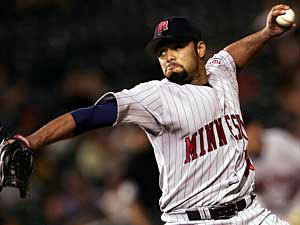 By resigning Mike Lowell and Curt Schilling the Red Sox drew a line in the sand. (I don't know, maybe winning the World Series had something to do with it as well.) They are the team to beat, not only in their own division, but in the whole American League. Every significant contributor from the 2007 Championship team has been signed for 2008, except Mike Timlin. Timlin is a valuable bullpen arm, even at age 42, but if the Red Sox decide to part ways with him permanently, it won't leave a gaping hole. Not in a bullpen that includes Jonathan Papelbon, Manny Delcarmon, Hideki Okajima, Javier Lopez, Brendon Donnelly, and Julian Tavarez. Timlin might even be seen as superfluous, with Craig Hansen, Kyle Snyder, and Devern Hansack also ready for the bigs.
As that list of relief arms suggests, not only has Boston filled the 2008 roster, they have an abundance in almost every area. Assuming Josh Beckett, Daisuke Matsuzake, and Curt Schilling are certain members of the rotation, that leaves two spots for the quartet of Clay Bucholz, Jon Lester, Tim Wakefield, and Kason Gabbard. Although they picked up his option, it isn't unlikely that 17-game-winner Wakefield may be headed back to the bullpen as a swingman and long reliever. Also, since Jacoby Ellsbury took over the starting job in centerfield during the playoffs, Coco Crisp is currently the most over-qualified fourth outfielder in baseball, joined by Brandon Moss, a young left-handed power hitter who fits the Boston mold and, at 24, after smacking 59 extra base hits in 500 AAA at-bats in 2007, appears ready for his shot in the show. The only real question mark for the Red Sox is whether they can depend on Julio Lugo as the shortstop after he abysmal showing, offensively and defensively, during the first year of his contract. Thankfully, if he starts '08 the way he started '07, they won't have to put up with it for long. Prospect Jed Lowrie was the Red Sox' Minor League Player of the Year in '07, posting an 896 OPS between AA and AAA, and sluggling above .500 at each level. Unless they deal him to Minnesota as part of a package for Johan Santana, I expect Lowrie to supplant Lugo (or, possibly, Pedroia, if he suffers a sophomore slump) sometime during the 2008 season.
While there is always a case to be made for adding a pitcher of Santana's ilk, by doing so the Red Sox would be significantly sacrificing their depth chart. Any deal would almost certainly include at least one of their young pitching studs, possibly more, and two players from the cheap, young quartet of Ellsbury, Lowrie, Pedroia, and Crisp. (ESPN is reporting the package as Lester, Crisp, and Lowrie.) A rotation featuring Santana, Beckett, Schilling, and Dice-K would be something to marvel at, but it would cost Boston the ability to compensate for injuries to position players. For a team that employs many mid-to-late-thirties veterans, selling off youth is a serious risk.
Ditto for the Yankees. According to the Times, they have officially made an offer to the Twins (an offer which does not include Joba Chamberlain). I would bet that it is comprised of some configuration of Robinson Cano, Melky Cabrera, Phil Hughes, Ian Kennedy, Shelley Duncan, Eric Duncan, and Wilson Betemit. Again, alongside Chamberlain and Chen-Ming Wang, Santana would headline a very imposing rotation. But, he would be among the first to attest that there is a sizable difference between having Melky Cabrera as your everyday centerfielder or Johnny Damon. The Yankees have finally stockpiled enough quality prospects to prevent them from having to overpay for half a dozen free agents every winter. It would be a mistake to mortgage that surplus for another veteran whose demands will likely exceed $150 Million. They were younger and more defensively sound in the Bronx during the second half of 2008. It seemed to work.
Which brings us, naturally, to the Minnesota Twins. As an organization they have been, throughout the reign of Terry Ryan, vigilant in retaining players which provide depth, especially for their pitching staff. I don't expect that to change drastically as Ryan makes way for protege, Bill Smith. The Twins seem ready for action this offseason, prepared to part ways with three high-profile players: Torii Hunter, Johan Santana, and Joe Nathan. It remains to be seen whether Santana and Nathan will get dealt. But, it appears to be a legitimate possibility, as the Yankees and Red Sox have already publicized offers. Whatever happens, don't mistake Minnesota's willingness to part with a few stars as the beginning of a long rebuilding process. Popular superstars, Justin Morneau and Joe Mauer, have two and three years left on their contracts, respectively, so the Twins will be looking to make a serious run at a championship sometime in the next two years. Such a run will mean supplanting Cleveland and Detroit atop the AL Central, neither of whom show signs of impending decline. As such, the Twins realize that they must be willing to sacrifice domination at a few positions for solidity throughout the roster.
Going into the offseason, Minnesota had glaring question marks at second base, third base, left field, center field, and designated hitter. With the two trades they've already made, acquiring Craig Monroe from the Cubs and trading Matt Garza and Jason Bartlett to the Devil Rays for Delmon Young and Brendan Harris, they addressed a couple of those positions. They could afford to trade Garza because they assume that Francisco Liriano will be recovered in time to replace him in the rotation on opening day. If the season were to start tomorrow, it seems likely that Monroe would be the everyday leftfielder and Young would play center, while Harris would replace Bartlett at short. Offensively, I expect that Young will be the equal of Torii Hunter as soon as 2009. However, while he has great speed and a strong arm, he is much better suited to right than center, which is convenient since Micheal Cuddyer, the Twins' reigning rightfielder, is much better suited to left or DH. Similarly, while Brendan Harris is at least as good with the bat as Jason Bartlett, he is defensively better suited for second or third, rather than shortstop. Craig Monroe is a career .304 hitter at the Metrodome, and has an 814 career OPS against lefthanders. He is a very decent defensive leftfielder. I imagine the Twins see him as the righthanded side of a platoon with Jason Kubel, with the ability to spell their other outfielders and hit off the bench.
I would guess that the depth chart in Bill Smith's office looks something like this:
C - Mauer
1B - Morneau
2B - Harris
3B - ?
SS - ?
LF - Kubel/Monroe
CF - ?
RF - Young
DH - Cuddyer
SP - Santana (?), Liriano, Bonser, Baker, Slowey, Perkins (?)
RP - Nathan (?), Neshek, Rincon, Guerrier, Crain, Reyes
IF - Casilla, Punto, Redmond
OF - Tyner
The Twins have some flexibility in the infield. Harris showed considerable offensive promise as a rookie in '07, hitting .286 with a 777 OPS and 12 HR and 59 RBI in 137 games with Tampa Bay, while playing respectable defense at second and thrid. Alexi Casilla struggled at the plate and in the field after replacing Luis Castillo at the end of 2007. But, he did steal eleven bases in twelve attempts, and his minor league numbers suggest he could develop into a solid lead-off hitter who plays mediocre defense at second or short. Punto provides outstanding defense at all three infield positions, but had the worst OPS of any major-leaguer in 2007, by a long shot (Punto: 562, Kendall (2nd Worst): 610). The Twins would definitely benefit most from adding a shortstop, but if none were available (for the right price), they could settle for solid offensive contributor who plays second or third.
Any package for Santana needs to include, at the minimum, a young, but major-league ready starting pitcher, a strong defensive centerfielder, and a promising infielder. Both Boston and New York have the first two pieces: Lester and Crisp from the Red Sox, Hughes and Cabrera from the Yankees. Hughes and Lester are essentially a draw in terms of quality. And, while Cabrera is probably the superior value compared to Crisp, Lowrie is likely to be the difference. He would be a Rookie of the Year candidate playing a critical position. The best the Yankees can offer is Wilson Betemit, who hasn't shown the ability to play short in the big leagues and has been an inconsistent hitter with stints in Atlanta, Los Angeles, and New York, all by the age of 25. Betemit could still turn into the superstar he was once predicted to be, but New York's best chance of beating out Boston in the Santana sweepstakes is to sweeten the offer with one of the Duncans, who could fit into the Twins' LF/DH mix. But, as I suggested earlier, a 4-for-1 swap does serious damage to a Yankees' depth.
Perhaps other teams will join the fray as the winter meetings get underway. Only a few can cobble together the pieces that would be required (including the $150 Million to sign Santana long term). The Mets are certainly interested, but by dealing Lastings Milledge to Washington, the let go of one of their best bargaining chips. They still have a couple of solid outfield prospects in Ben Johnson and Carlos Gomez. They've got major-league ready starters in Philip Humber and Mike Pelfrey (though neither is the equal of Hughes and Lester). And they have a young switch-hitting middle infielder named Anderson Hernandez. But, while the pieces are there, they would have to improve upon them in some way to beat out the Red Sox and Yankees. Would they be willing to part with John Maine?
The Dodgers, who have not been mentioned in Santana discussions, may be the darkhorse candidate. They have an abundance of young big-leaguers. Matt Kemp and Delwyn Young (Delmon's brother) can both play center field. Andy LaRoche, Tony Abreu, and Chin-Lung Hu are promising infielders (Hu is a shortstop). And, Clayton Kershaw, Chad Billingsley, and Hong-Chih Kuo are major-league ready starters. Los Angeles appears ready to deal some of their youth because they are log-jammed at several positions, but their most desperate need is a power bat. But if they fail to reel in Miguel Cabrera, they may turn their attentions elsewhere.
If Bill Smith does deal Santana, it is likely that Joe Nathan will follow, with Pat Neshek or Juan Rincon taking over closing duties in Minnesota. With Nathan as the centerpiece, Smith could craft a package to pursue a veteran like Scott Rolen (a third part would be necessary) or Miguel Tejada. Or, he could fleece a team desperate for a closer (Mikwaukee? Texas?) for several prospects and important role players.
By Opening Day 2008, I expect the Minnesota Twins will be completely redesigned. They have relied on pitching and defense in recent years. By no means do I expect them to forget the importance of either, but they will be supporting their young, promising rotation with a deep, potent lineup. Even now, the core of Mauer, Cuddyer, Morneau, and Young is nothing to scoff at. In 2009 it may be considered as good or better than the impressive quartets in Cleveland and Detroit.
Which brings us, naturally, to the Minnesota Twins. As an organization they have been, throughout the reign of Terry Ryan, vigilant in retaining players which provide depth, especially for their pitching staff. I don't expect that to change drastically as Ryan makes way for protege, Bill Smith. The Twins seem ready for action this offseason, prepared to part ways with three high-profile players: Torii Hunter, Johan Santana, and Joe Nathan. It remains to be seen whether Santana and Nathan will get dealt. But, it appears to be a legitimate possibility, as the Yankees and Red Sox have already publicized offers. Whatever happens, don't mistake Minnesota's willingness to part with a few stars as the beginning of a long rebuilding process. Popular superstars, Justin Morneau and Joe Mauer, have two and three years left on their contracts, respectively, so the Twins will be looking to make a serious run at a championship sometime in the next two years. Such a run will mean supplanting Cleveland and Detroit atop the AL Central, neither of whom show signs of impending decline. As such, the Twins realize that they must be willing to sacrifice domination at a few positions for solidity throughout the roster.
Going into the offseason, Minnesota had glaring question marks at second base, third base, left field, center field, and designated hitter. With the two trades they've already made, acquiring Craig Monroe from the Cubs and trading Matt Garza and Jason Bartlett to the Devil Rays for Delmon Young and Brendan Harris, they addressed a couple of those positions. They could afford to trade Garza because they assume that Francisco Liriano will be recovered in time to replace him in the rotation on opening day. If the season were to start tomorrow, it seems likely that Monroe would be the everyday leftfielder and Young would play center, while Harris would replace Bartlett at short. Offensively, I expect that Young will be the equal of Torii Hunter as soon as 2009. However, while he has great speed and a strong arm, he is much better suited to right than center, which is convenient since Micheal Cuddyer, the Twins' reigning rightfielder, is much better suited to left or DH. Similarly, while Brendan Harris is at least as good with the bat as Jason Bartlett, he is defensively better suited for second or third, rather than shortstop. Craig Monroe is a career .304 hitter at the Metrodome, and has an 814 career OPS against lefthanders. He is a very decent defensive leftfielder. I imagine the Twins see him as the righthanded side of a platoon with Jason Kubel, with the ability to spell their other outfielders and hit off the bench.
I would guess that the depth chart in Bill Smith's office looks something like this:
C - Mauer
1B - Morneau
2B - Harris
3B - ?
SS - ?
LF - Kubel/Monroe
CF - ?
RF - Young
DH - Cuddyer
SP - Santana (?), Liriano, Bonser, Baker, Slowey, Perkins (?)
RP - Nathan (?), Neshek, Rincon, Guerrier, Crain, Reyes
IF - Casilla, Punto, Redmond
OF - Tyner
The Twins have some flexibility in the infield. Harris showed considerable offensive promise as a rookie in '07, hitting .286 with a 777 OPS and 12 HR and 59 RBI in 137 games with Tampa Bay, while playing respectable defense at second and thrid. Alexi Casilla struggled at the plate and in the field after replacing Luis Castillo at the end of 2007. But, he did steal eleven bases in twelve attempts, and his minor league numbers suggest he could develop into a solid lead-off hitter who plays mediocre defense at second or short. Punto provides outstanding defense at all three infield positions, but had the worst OPS of any major-leaguer in 2007, by a long shot (Punto: 562, Kendall (2nd Worst): 610). The Twins would definitely benefit most from adding a shortstop, but if none were available (for the right price), they could settle for solid offensive contributor who plays second or third.
Any package for Santana needs to include, at the minimum, a young, but major-league ready starting pitcher, a strong defensive centerfielder, and a promising infielder. Both Boston and New York have the first two pieces: Lester and Crisp from the Red Sox, Hughes and Cabrera from the Yankees. Hughes and Lester are essentially a draw in terms of quality. And, while Cabrera is probably the superior value compared to Crisp, Lowrie is likely to be the difference. He would be a Rookie of the Year candidate playing a critical position. The best the Yankees can offer is Wilson Betemit, who hasn't shown the ability to play short in the big leagues and has been an inconsistent hitter with stints in Atlanta, Los Angeles, and New York, all by the age of 25. Betemit could still turn into the superstar he was once predicted to be, but New York's best chance of beating out Boston in the Santana sweepstakes is to sweeten the offer with one of the Duncans, who could fit into the Twins' LF/DH mix. But, as I suggested earlier, a 4-for-1 swap does serious damage to a Yankees' depth.
Perhaps other teams will join the fray as the winter meetings get underway. Only a few can cobble together the pieces that would be required (including the $150 Million to sign Santana long term). The Mets are certainly interested, but by dealing Lastings Milledge to Washington, the let go of one of their best bargaining chips. They still have a couple of solid outfield prospects in Ben Johnson and Carlos Gomez. They've got major-league ready starters in Philip Humber and Mike Pelfrey (though neither is the equal of Hughes and Lester). And they have a young switch-hitting middle infielder named Anderson Hernandez. But, while the pieces are there, they would have to improve upon them in some way to beat out the Red Sox and Yankees. Would they be willing to part with John Maine?
The Dodgers, who have not been mentioned in Santana discussions, may be the darkhorse candidate. They have an abundance of young big-leaguers. Matt Kemp and Delwyn Young (Delmon's brother) can both play center field. Andy LaRoche, Tony Abreu, and Chin-Lung Hu are promising infielders (Hu is a shortstop). And, Clayton Kershaw, Chad Billingsley, and Hong-Chih Kuo are major-league ready starters. Los Angeles appears ready to deal some of their youth because they are log-jammed at several positions, but their most desperate need is a power bat. But if they fail to reel in Miguel Cabrera, they may turn their attentions elsewhere.
If Bill Smith does deal Santana, it is likely that Joe Nathan will follow, with Pat Neshek or Juan Rincon taking over closing duties in Minnesota. With Nathan as the centerpiece, Smith could craft a package to pursue a veteran like Scott Rolen (a third part would be necessary) or Miguel Tejada. Or, he could fleece a team desperate for a closer (Mikwaukee? Texas?) for several prospects and important role players.
By Opening Day 2008, I expect the Minnesota Twins will be completely redesigned. They have relied on pitching and defense in recent years. By no means do I expect them to forget the importance of either, but they will be supporting their young, promising rotation with a deep, potent lineup. Even now, the core of Mauer, Cuddyer, Morneau, and Young is nothing to scoff at. In 2009 it may be considered as good or better than the impressive quartets in Cleveland and Detroit.
Subscribe to:
Posts (Atom)